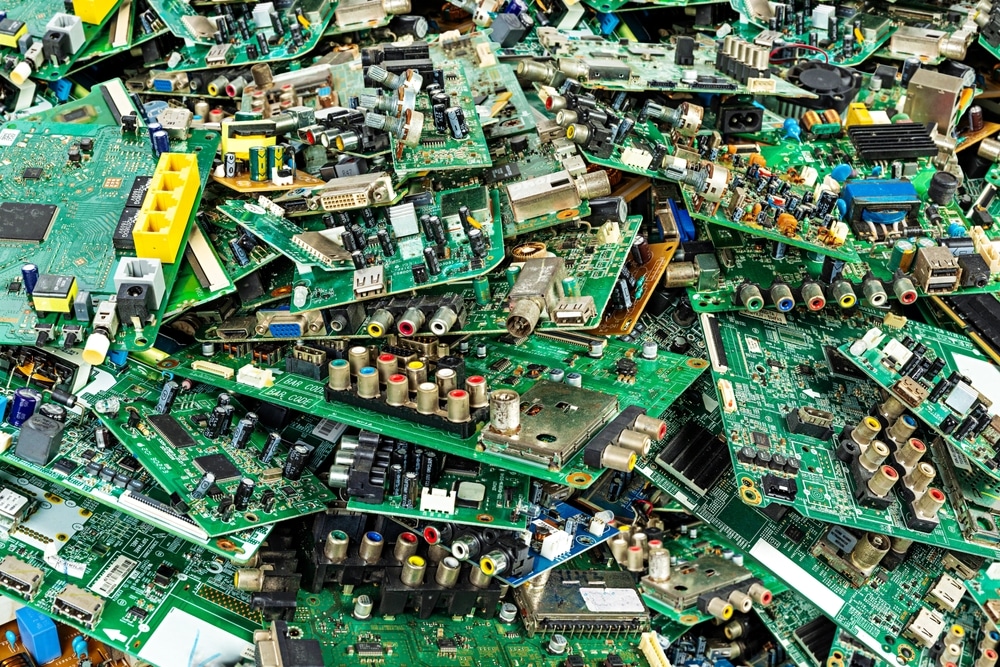

A surge of interest in electronic waste recycling has been sparked by a breakthrough from researchers at ETH Zurich, who demonstrated that discarded computer motherboards — often thrown away without a second thought — contain recoverable gold that can now be extracted using an unlikely ingredient: whey, a byproduct of cheese production. The study, published in 2024, is gaining traction in 2026 as industries search for cleaner, cheaper ways to reclaim valuable metals from mounting global e-waste.
The team processed 20 obsolete computer motherboards sourced from local waste streams and successfully recovered a 450-milligram nugget of gold, measured at around 22-carat purity (approximately 91% gold, with the remainder largely copper). While the quantity may appear small, the result highlights the cumulative value embedded in everyday electronics that frequently end up in landfills or incinerators.
Gold is widely used in circuit boards due to its resistance to corrosion and superior conductivity. These gold layers are extremely thin — often measured in microns — making them difficult and costly to extract using traditional industrial methods, which typically involve high-temperature furnaces and toxic chemical solvents.
A low-cost, cleaner alternative to traditional extraction
The ETH Zurich researchers, led by Professor Raffaele Mezzenga and scientist Mohammad Peydayesh, developed a process that replaces energy-intensive and hazardous techniques with a biologically derived material. Their approach uses whey proteins, a low-value byproduct of the dairy industry, which are transformed under acidic and heat-controlled conditions into amyloid fibrils — microscopic fibers that form a sponge-like structure.
This porous sponge has a large internal surface area, allowing it to selectively bind gold ions from a liquid mixture containing dissolved metals such as copper, iron and aluminum. The process begins by dissolving shredded motherboard components in an acid solution, creating a metal-rich liquid. When the protein sponge is introduced, it captures gold ions far more efficiently than other metals.
Once saturated, the sponge is heated, triggering a chemical reduction that converts the gold ions into solid metallic particles. These particles accumulate on the sponge and can then be melted into a nugget. Although the heating step destroys the sponge, the overall process remains economically viable because whey is inexpensive — estimated to cost roughly 50 times less than the value of the recovered gold.
The researchers emphasized that the method requires no toxic solvents and avoids the extreme temperatures associated with conventional smelting, making it significantly more environmentally sustainable.
Two waste streams, one valuable output
The innovation lies not only in recovering gold, but in linking two unrelated waste streams — dairy byproducts and electronic scrap — into a single circular system. Whey, often discarded or used as low-grade animal feed, is repurposed into a high-functioning material capable of extracting precious metals.
This intersection of industries could reshape how recyclers approach electronic waste, especially as global e-waste volumes continue to rise sharply. According to the Global E-waste Monitor, millions of tonnes of electronic waste are generated annually, with only a fraction properly recycled.
Despite the promise, the findings do not suggest that individuals can easily extract gold from household electronics. The gold present in devices like computers and smartphones is microscopic and embedded within complex materials, requiring controlled chemical processes and specialized facilities to recover safely and efficiently.
However, at scale, the implications are significant. Across large volumes of discarded electronics, these tiny traces accumulate into meaningful quantities. The ETH Zurich team noted that the recovered gold required no additional refining before potential industrial use, further improving its economic attractiveness.
Looking ahead, researchers are exploring whether the same protein-based sponge can be adapted to recover other valuable metals such as palladium and platinum, which are also commonly used in electronics and automotive components. They are also working to improve the process by enabling reuse of the acid solution, potentially closing the loop and eliminating remaining chemical waste.
The development reflects a broader shift toward sustainable resource recovery, where waste is increasingly seen not as a liability, but as a reservoir of untapped materials. As industries grapple with supply constraints and environmental pressures, innovations like this may play a critical role in redefining how value is extracted from what society leaves behind.
You may also like: Rocket Lab Stock: Hold or Sell After the $3.3 Billion Wealth Surge?
Make Swikblog your go-to source on Google for reliable updates, smart insights, and daily trends.