
Updated: July 6, 2026
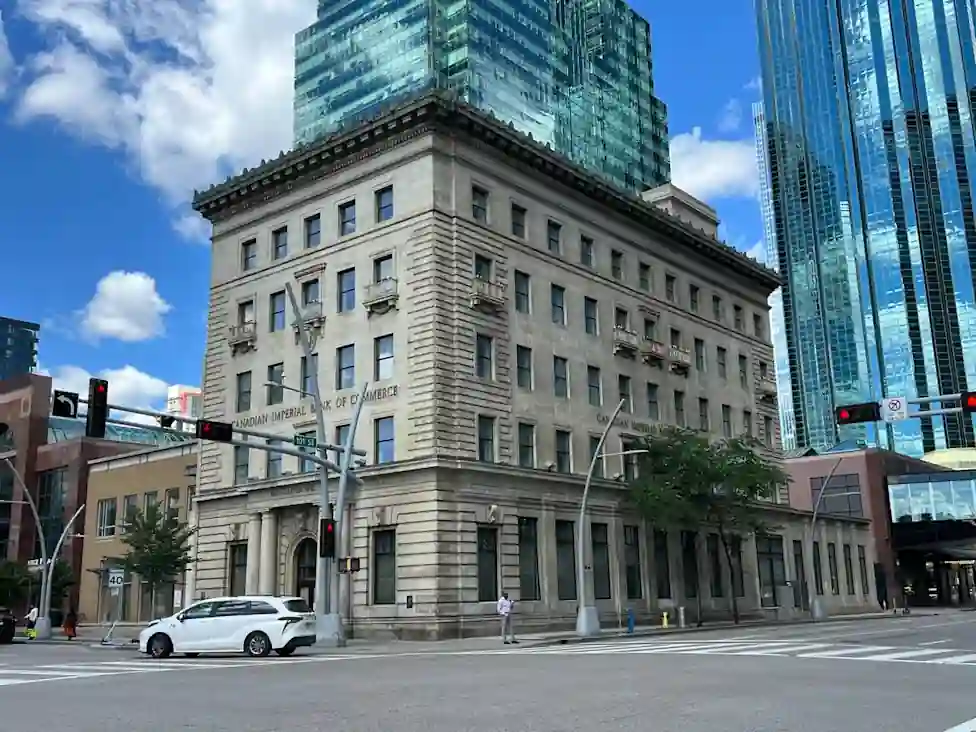
One of downtown Edmonton’s longest-standing commercial landmarks is looking for a new owner. The former Canadian Imperial Bank of Commerce (CIBC) building at the corner of Jasper Avenue and 101 Street has officially been listed for sale after the bank completed its move to offices in the Ice District, leaving the nearly century-old property vacant.
The sale is drawing attention because the property is more than an empty office building. Completed in 1929, the five-storey heritage structure occupies one of the busiest intersections along Jasper Avenue and has been a familiar part of Edmonton’s downtown landscape for generations.
With city leaders continuing efforts to revive the downtown core, the future of the building could become an important example of how historic properties are adapted for modern business and community use.
A Nearly 100-Year-Old Landmark Enters the Market
The property, spanning close to 60,000 square feet, is being marketed by commercial real estate firm Colliers. After serving as a CIBC branch and office for decades, the building became vacant when the bank consolidated operations at its newer location in Edmonton’s Ice District.
Unlike many downtown office listings, this sale involves a recognized heritage building that occupies a highly visible corner along Jasper Avenue. Its historic architecture and central location give it value beyond traditional office space, making it attractive to investors looking at long-term redevelopment opportunities.
Commercial real estate experts often describe assets of this type as rare because they seldom become available after remaining under institutional ownership for decades.
Why The Sale Matters For Downtown Edmonton
The listing comes as Edmonton continues investing in its downtown through public improvements, business development initiatives and efforts to increase activity along Jasper Avenue.
Like many Canadian cities, Edmonton is adapting to lasting changes in office demand following the rise of hybrid and remote work. Older commercial buildings are increasingly being evaluated for new uses rather than simply replacing office tenants.
James L. Robinson, executive director of the Edmonton Downtown Business Association, has said the property presents an opportunity to attract fresh investment while preserving an important piece of the city’s history. A successful redevelopment could help generate additional foot traffic and strengthen surrounding businesses.
The building is also located near several organizations supporting Edmonton’s innovation economy, including the Alberta Machine Intelligence Institute (Amii), Edmonton Unlimited and Applied Pharmaceutical Innovation. That proximity could appeal to technology firms, research organizations and professional services looking for a central location.
Vacancy Brings Both Opportunity And Challenges
Not everyone views the vacancy as positive. Cheryll Watson, chair of the Downtown Revitalization Coalition, has noted that another empty landmark on Jasper Avenue highlights the ongoing challenge of maintaining an active and vibrant downtown.
Large vacant buildings can affect surrounding businesses by reducing pedestrian activity and changing public perception of commercial districts. While CIBC remains committed to downtown through its Ice District offices, its departure from this historic location leaves a noticeable gap along one of Edmonton’s best-known streets.
The eventual redevelopment timeline will likely depend on market conditions, renovation costs and the vision of a future owner.
Adaptive Reuse Could Shape The Building’s Future
Across Canada, many heritage buildings have found new life through adaptive reuse. Former banks and office buildings have been transformed into boutique hotels, mixed-use developments, restaurants, creative office space and residential projects while preserving their historic character.
Edmonton has already seen successful examples of this approach. Watson has pointed to the restored Canada Permanent Building, which now houses businesses including Bar Trove and Kyle & Co. Design Studio, demonstrating that preservation and commercial investment can work together.
Redeveloping heritage properties, however, typically requires significant investment. Buyers must account for restoration work, updated building systems, accessibility requirements and modern energy standards while respecting heritage features.
Those considerations are becoming increasingly important as investors place greater emphasis on redevelopment potential and long-term property value. Similar trends are reflected in expectations for the Canada housing market in 2026, where location and future redevelopment opportunities continue to influence investment decisions.
Read More
What Buyers Will Be Watching
The next owner will inherit a building with both commercial potential and historical significance. Possible future uses include modern office space, retail, hospitality, mixed-use redevelopment or flexible work environments, depending on market demand and planning approvals.
How quickly the property is redeveloped will be closely watched by investors, business groups and city officials as Edmonton continues working to strengthen its downtown economy. The sale represents an opportunity to preserve an important landmark while introducing new activity to one of the city’s most recognizable commercial corridors.
Information about heritage conservation and adaptive reuse practices is available through the U.S. National Park Service Historic Preservation Program.

Make Swikblog your go-to source on Google for reliable updates, smart insights, and daily trends.