
For nearly a century, bourbon has flowed steadily from the same Kentucky location that helped define Jim Beam as a global whiskey powerhouse. That continuity is now briefly interrupted. The 230-year-old bourbon brand has confirmed it will pause new distillation at its flagship Clermont facility for the whole of 2026 — a move that has raised questions far beyond Kentucky.
The decision is not a closure, nor a retreat from bourbon altogether. Instead, it reflects mounting pressure on American spirits producers as global demand cools, export markets contract, and trade policies reshape where — and how — U.S. whiskey is consumed.
A distillery with nearly 100 years of history
Bourbon has been distilled at Jim Beam’s Clermont site on Happy Hollow Road for almost 100 years. Rebuilt in 1935 after Prohibition by James Beauregard “Jim” Beam, the distillery became the beating heart of the brand’s modern identity and a major stop on the Kentucky Bourbon Trail.
Over the decades, the site evolved into a flagship campus, welcoming visitors from around the world while producing some of the most recognisable bourbons on the market. Pausing production at such a location is rare — and symbolic.
What exactly is being paused — and what isn’t
Starting January 1, 2026, Jim Beam will pause new distillation at its main James B. Beam distillery in Clermont for one year. Other facilities will continue operating, including the Freddie Booker Noe craft distillery in Clermont and the larger Booker Noe distillery in Boston, Kentucky.
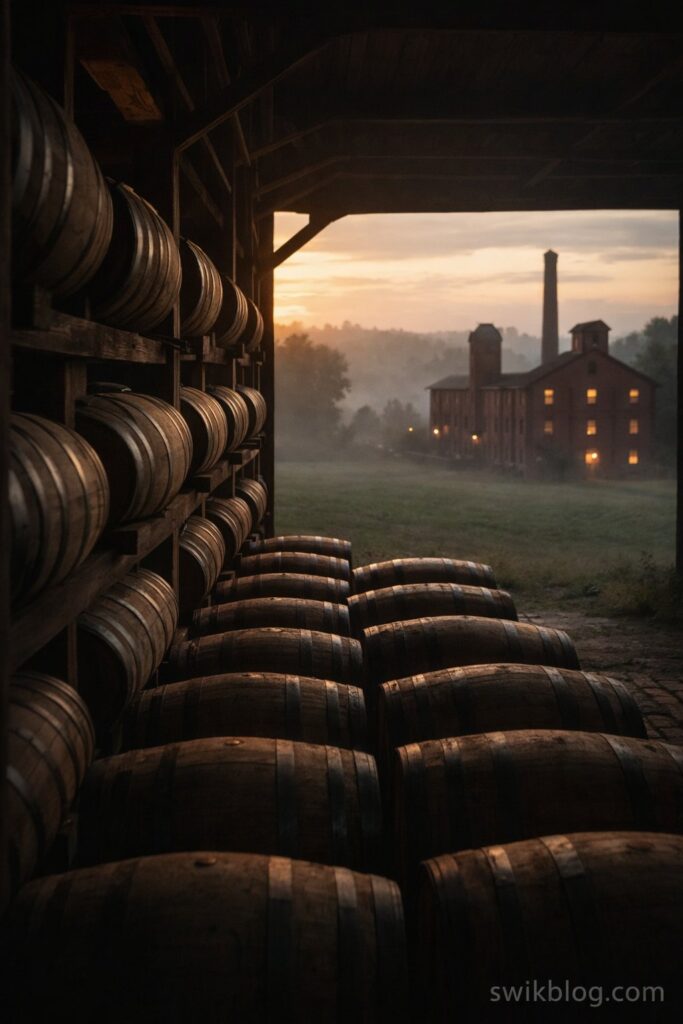
Bottling, barrel aging, warehousing, and distribution will continue uninterrupted. The visitor centre at the James B. Beam campus will remain open, allowing guests to tour the grounds and experience the brand’s history while the site undergoes enhancements.
Why rising costs are changing consumer behaviour
When production costs rise, consumers tend to migrate toward cheaper alternatives — and that shift is now playing out across the global liquor market. Tariffs and retaliatory trade actions have made American spirits more expensive abroad, pushing international buyers toward locally produced or non-U.S. brands.
Exports of U.S.-made liquor fell sharply in the second quarter of 2025, with particularly steep declines in key markets such as the European Union, the United Kingdom, Canada, and Japan. Together, those regions account for the majority of American spirits exports by value.
Nowhere has the impact been more pronounced than in Canada. U.S. spirits exports there collapsed by more than 80%, falling below $10 million in the second quarter, as provincial bans and consumer boycotts sharply reduced shelf space for American brands.
A troubling signal for U.S. distillers
After a record export year in 2024, the sudden downturn has alarmed producers. Trade tensions have not only reduced volumes but also altered long-term consumer habits. International drinkers are increasingly opting for domestically produced spirits or imports from countries unaffected by U.S. trade disputes.
For Jim Beam, declining overseas demand combined with a well-stocked inventory made slowing production a calculated — if sobering — decision.
What makes bourbon different — and why production can’t be rushed
Bourbon is not just another whiskey. To legally carry the name, it must follow strict U.S. standards. It has to be made in the United States, use a mash bill of at least 51% corn, be distilled to no more than 160 proof, aged in new charred oak barrels, and bottled at a minimum of 80 proof.
Unlike many spirits, bourbon cannot include flavourings, colouring, or additives. What ends up in the bottle is shaped by grain, wood, time, and nothing else. Because most Jim Beam products are aged for several years, production decisions made today won’t fully show up on shelves until much later.
Why this pause matters beyond Jim Beam
A production pause at one of America’s most iconic bourbon distilleries signals broader stress across the spirits industry. When a brand with more than two centuries of history slows down, it underscores how deeply global trade policy can affect even the most established manufacturers.
The ripple effects extend beyond whiskey. Reduced distillation impacts agricultural suppliers, tourism, local employment, and regional economies that rely on bourbon as both a product and a cultural export.
What happens next
For consumers, little is expected to change in the near term. Jim Beam’s warehouses are filled with aging bourbon laid down years ago, ensuring steady supply. For the industry, however, the pause serves as a warning — and a recalibration.
Rather than signaling decline, Jim Beam’s decision reflects a brand confident enough in its heritage and inventory to slow down when the market demands it. Whether global demand rebounds — or continues to shift away from American spirits — will determine how long this pause echoes across Kentucky and beyond.
You may also like:
The Christmas Songs Americans Love — and Hate — the Most in 2025

Make Swikblog your go-to source on Google for reliable updates, smart insights, and daily trends.