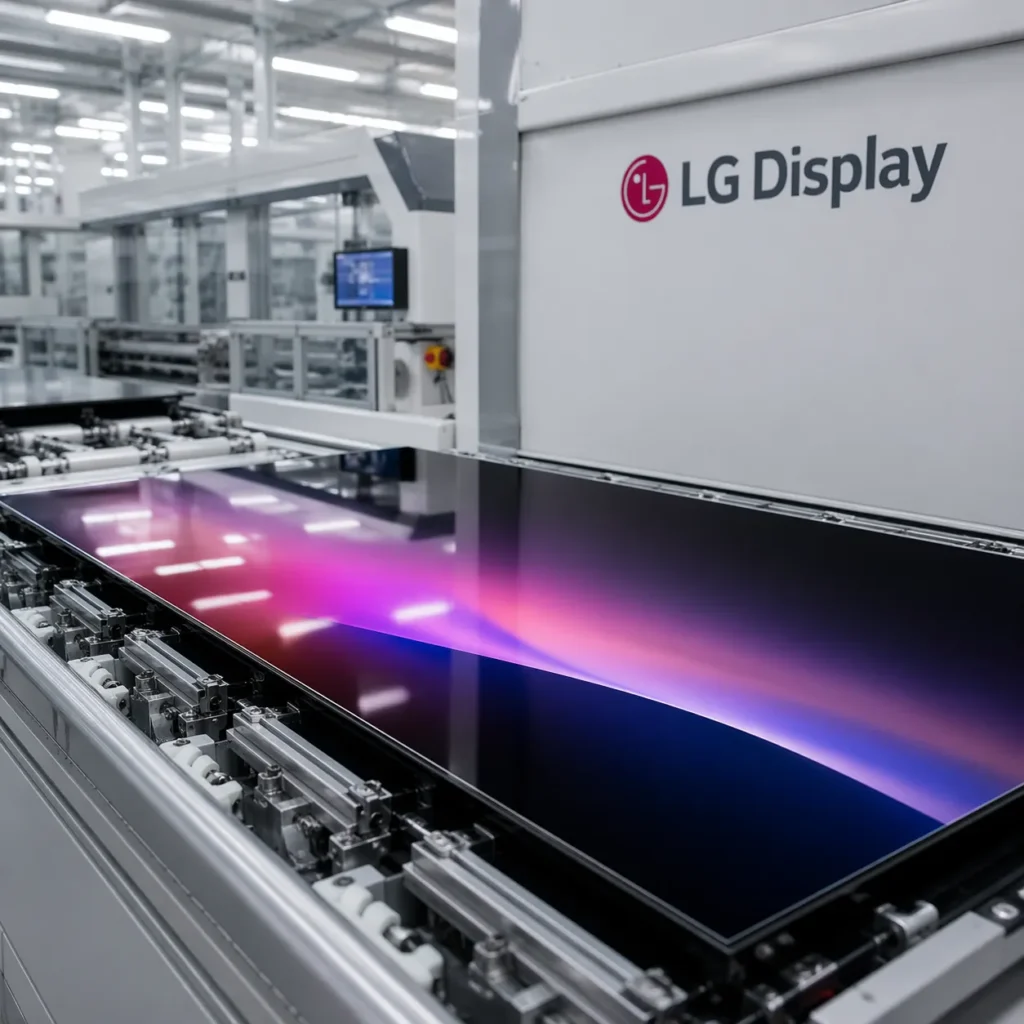

LG Display is back in focus after the company laid out a sizable new OLED investment plan, but the market’s first reaction was restrained rather than enthusiastic. The stock fell to $5.05 on Wednesday even as the South Korean display maker announced it would invest 1.1 trillion won, or about $744.94 million, into OLED-related infrastructure. That is the kind of number that usually grabs attention, yet investors appear to be asking a more practical question: will this spending meaningfully improve earnings power, or does it simply add another layer of pressure to a business that still needs to prove the strength of its recovery?
The investment is set to run from April 2026 to June 2028, which makes it clear this is not a short, reactive move. LG Display is committing to a multi-year buildout aimed at reinforcing its technological edge in OLED, the part of the display market where it has the best chance to stand out. In simple terms, the company is choosing to spend heavily where margins, customer stickiness, and long-term relevance should be better than in more commoditized LCD segments.
That strategic direction matters. In displays, scale alone is no longer enough. Pricing pressure remains intense, especially in lower-end categories, and manufacturers that cannot differentiate on technology often find themselves squeezed on margins. OLED gives LG Display a more defensible lane. It is already a core part of the company’s identity, and this latest commitment shows management is not treating it as an optional growth engine. It is treating OLED as the center of the business model going forward.
Why investors are watching this so closely
The market reaction tells an important story. When a company announces nearly $745 million in new infrastructure spending and the stock still drifts lower, it usually means investors are looking past the headline and focusing on execution. Capital expenditure is only attractive when shareholders believe it will translate into stronger returns, better margins, and more resilient cash generation. If those pieces remain uncertain, even a strategically sound announcement can fail to lift the stock in the short term.
LG Display’s latest reported annual numbers help explain why the market is cautious. The company reported 2025 revenue of KRW 25.81 trillion, operating income of KRW 517 billion, and net income of KRW 304 billion. Those figures show real improvement compared with the weaker stretches the company has gone through in recent years, but they do not suggest unlimited financial flexibility. A business in recovery has less room for expensive missteps, which is why investors will want more detail on where this new OLED spending goes and how quickly it can produce measurable returns. The stock’s market capitalization of roughly $1.89 billion also makes the scale of the commitment hard to ignore. This is not routine maintenance spending. It is a major allocation decision.
There is also a timing element here. LG Display has a Q1 2026 earnings conference call scheduled for April 23, just one day after the announcement. That raises the odds that the investment plan was meant to frame the broader discussion management is about to have with the market. Investors will likely be listening for specifics: which OLED product lines will benefit most, whether the spending supports premium TV panels, IT displays, automotive applications, or mobile demand, and how management expects the project to shape profitability over the next several quarters.
The near-term pressure on the stock does not automatically mean the market dislikes the move. In many cases, the first response to large investment plans is simply caution. Traders focus on the immediate cash outflow, while longer-term investors look for evidence that the spending can improve mix, pricing power, and customer relationships. LG Display now needs to make the second part of that argument convincingly.
What this means for LG Display’s longer-term story
The more interesting angle here is not the one-day dip to $5.05. It is the signal LG Display is sending about where it sees future value. The company is not talking about broad expansion for the sake of size. It is investing in infrastructure tied to OLED competitiveness, which suggests management sees advanced display technology as the clearest route to sustainable profitability. That is an important distinction. Growth for its own sake rarely gets rewarded in hardware manufacturing. Growth tied to technology leadership can.
OLED remains one of the few areas in the display market where product quality, efficiency, panel performance, and manufacturing know-how can still support stronger economics. Premium customers care about contrast, form factor, brightness, power efficiency, and next-generation design possibilities. Those are exactly the areas where OLED matters. If LG Display can use this spending cycle to strengthen its manufacturing base and defend higher-value business, the current stock reaction may end up looking overly cautious in hindsight.
For now, though, the market wants proof. A large investment headline is not enough on its own. Investors want to know how much of the spending is growth-oriented versus efficiency-driven, how it will affect depreciation and capital intensity, and when the payoff should begin to show up in revenue mix or operating profit. Until management fills in those gaps, the stock may continue to trade more on skepticism than optimism.
Readers looking for the official financial backdrop can review LG Display’s 2025 earnings results. For more market-moving corporate stories, you can also browse our latest stock market news coverage.
The bottom line for investors is straightforward even if the market reaction is not. LG Display fell to $5.05 after announcing a $744.94 million OLED infrastructure plan because the market is still weighing long-term opportunity against short-term execution risk. If management proves that this investment can strengthen margins, improve product mix, and support more durable earnings, the story could change quickly. Until then, the stock is likely to remain a debate between believers in the OLED strategy and skeptics who want harder evidence.

Make Swikblog your go-to source on Google for reliable updates, smart insights, and daily trends.