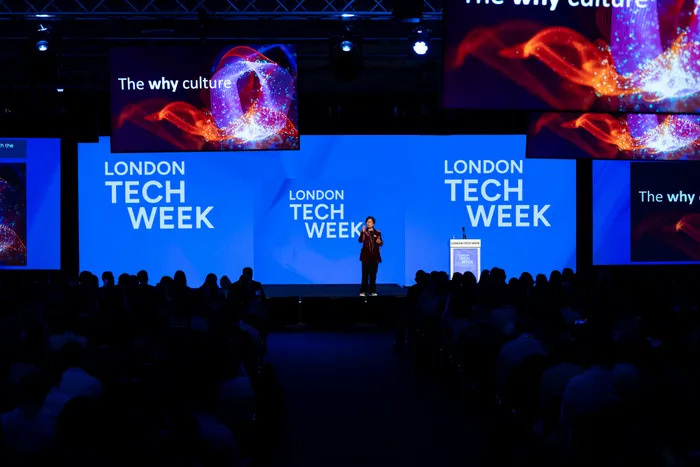

London Tech Week 2026 opens today, June 8, with the date, venue, speakers and AI agenda now in focus as global technology leaders gather in London. The event runs from June 8 to June 12, with the main expo and content stages taking place at Olympia London from June 8 to June 10, before a wider fringe programme continues across the capital.
The event begins today at Olympia London, with artificial intelligence, enterprise technology, startup growth and deep tech sitting at the centre of the programme. But the larger story is not just another conference opening. It is the way London is trying to turn a week of panels, launches and networking into a wider argument about its place in the next phase of the global technology economy.
The official London Tech Week 2026 programme brings together founders, enterprise executives, investors and policymakers at a time when AI is moving from experiment to infrastructure. The speaker list includes high-profile names from major technology companies, cloud platforms, AI firms and startups, including AMD, Perplexity, Microsoft UK and Ireland, AWS UK and Ireland, OpenAI, Notion and Wayve.
The event’s scale also matters. London Tech Week is expected to bring together more than 30,000 attendees, including enterprise leaders, startups and investors. That mix gives the event a different weight from a standard industry gathering. It is not just a place for product demos. It is a marketplace for capital, hiring, policy influence and business adoption.
AI moves from headline theme to business test
AI is the obvious draw, but the more important question in 2026 is whether companies can turn AI excitement into measurable business value. That is the unique context around this year’s event. The market has moved past the first wave of hype. Investors, executives and customers now want to see productivity gains, lower operating costs, stronger automation and clearer returns on expensive AI infrastructure.
That shift makes London Tech Week more than a showcase for new tools. It is a test of which companies can explain how AI will actually change work, finance, healthcare, transport, retail and public services. The agenda’s focus on applied AI, data excellence, enterprise reinvention, quantum, robotics and capital growth reflects the wider pressure on the industry: bold claims now need practical proof.
For London, this is an important moment. The city has long had advantages in finance, regulation, universities, media, healthcare and international talent. Those strengths make it attractive for companies trying to sell AI into complex real-world industries rather than only into software teams. London’s challenge is turning that ecosystem into durable global leadership while competing with the United States, continental Europe, the Gulf and Asia for investment.
That competition is especially visible in AI infrastructure. The race for chips, cloud capacity, model training, enterprise adoption and regulation is becoming one of the defining economic stories of the decade. Recent investor attention around the AI chip rally and Nvidia, AMD and Micron shows how closely markets are tracking the hardware layer behind the AI boom.
Startups and investors face a more selective market
The major focus of the London Tech Week 2026 are Startups, but the funding mood is more selective than it was during the easiest years of cheap capital. Founders still have a strong opportunity to meet investors and enterprise buyers, but the questions are sharper. Revenue quality, customer retention, defensible technology and real adoption now matter more than pitch-deck momentum.
That makes the event useful for both sides of the market. Investors can compare companies across AI, fintech, deep tech, robotics, health technology and enterprise software in one place. Founders can test whether their products solve urgent problems for large customers. Enterprise leaders can look beyond headline AI tools and ask which startups can improve efficiency, security, customer service or decision-making inside established businesses.
London also has a visible role in applied AI and autonomy. Companies such as Wayve have helped put UK-based AI mobility on the global map, and wider interest in Wayve’s robotaxi and autonomous driving plans shows how British startups are trying to compete in areas that require both frontier research and commercial execution.
The wider agenda also gives policymakers a platform. AI regulation, online safety, digital sovereignty, skills and productivity are no longer abstract technology debates. They affect jobs, public services, national competitiveness and investor confidence. London Tech Week gives ministers, founders and global executives a shared stage at a time when the rules around AI are still being written.
Those who are following the event from outside the venue, the main takeaway is that London Tech Week 2026 is not only about who is speaking on stage. It is about where the technology economy is heading next. AI remains the magnet, but the deeper story is whether startups, investors and global technology firms can turn rapid innovation into practical growth, trusted products and long-term economic value.
As the event opens on June 8, London has a chance to present itself as a serious centre for AI adoption, startup growth and enterprise technology. The attention will be on Olympia London this week, but the real measure of success will be whether the conversations there translate into investment, partnerships and technology that lasts beyond the conference cycle.

Make Swikblog your go-to source on Google for reliable updates, smart insights, and daily trends.