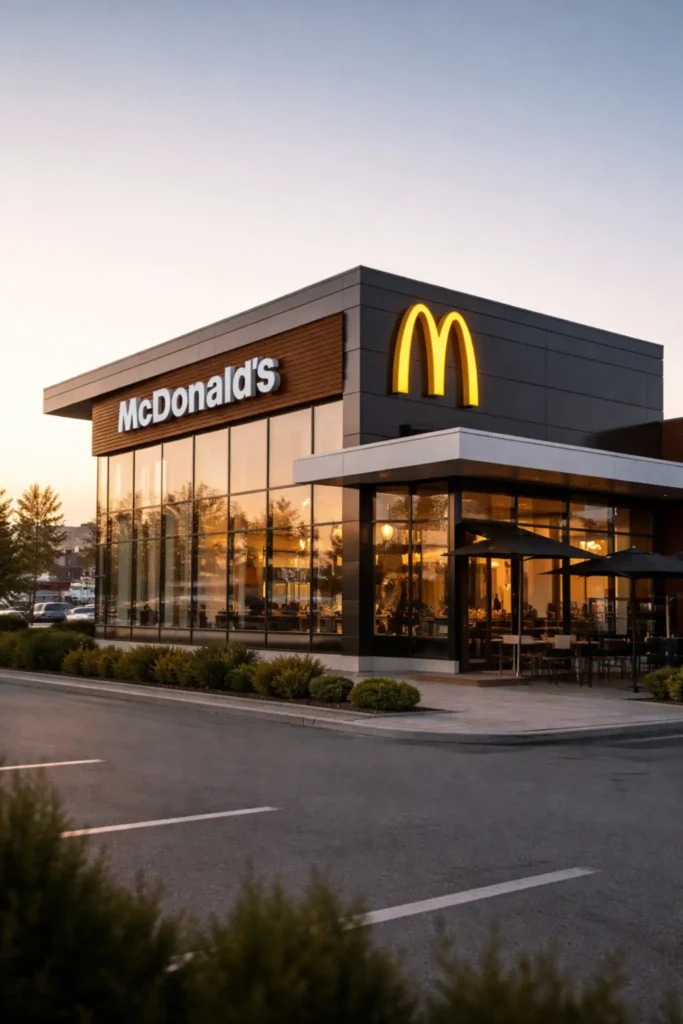

McDonald’s (MCD) is leaning into what it does best when the macro gets noisy: spend into growth, widen its footprint, and let scale do the rest. With the stock trading near its recent highs, management’s decision to lift 2026 capital spending to as much as $3.9 billion is becoming a central debate for investors — not because the brand needs reinvention, but because the company is pushing the expansion accelerator while the market is paying a premium for consistency.
For readers tracking defensive winners, McDonald’s has quietly separated itself from much of the restaurant pack over the last year. While several consumer-facing names have struggled through uneven traffic patterns and value-sensitive spending, McDonald’s has kept investors focused on a simple equation: more restaurants, stronger systemwide sales, and a long runway in underbuilt trade areas. If the plan holds, the 2026 CapEx step-up is less “spending surge” and more a deliberate reinvestment cycle designed to compound returns.
CapEx moves higher, and the strategy is clear
Management guided to $3.7–$3.9 billion of capital expenditures in 2026, up from roughly $3.4 billion in 2025. The headline driver is unit growth — the company opened about 2,275 restaurants globally in 2025 and is aiming for roughly 2,600 gross openings in 2026, keeping McDonald’s on track to reach 50,000 restaurants worldwide by the end of 2027.
That expansion pace matters because McDonald’s growth model is built to translate new units into systemwide sales and cash flow without needing dramatic operational changes. In mature markets like the United States, the company has flagged opportunities tied to population migration, suburban buildouts, and underpenetrated trade areas — a reminder that even in “fully developed” markets, location strategy can still deliver incremental growth if unit economics stay disciplined.
The ROI case is tied to unit economics and systemwide sales
McDonald’s isn’t pitching CapEx as optional. It’s framing it as core infrastructure for the next phase of compounding — and it’s giving investors a clean way to track it. Management expects net restaurant unit expansion to contribute about 2.5% to 2026 systemwide sales growth (in constant currencies), a signal that the development pipeline is expected to show up directly in top-line momentum.
What makes this bet more investable than many growth plans is the company’s operating model. McDonald’s systemwide performance is driven by a combination of comparable sales and net new units, and the franchise-heavy structure means a meaningful portion of restaurant-level investment and day-to-day execution sits with operators, while the brand captures economics through rent, royalties, and fees. It’s not “risk-free,” but it’s historically been one of the reasons MCD can expand while still maintaining a defensive reputation.
McDonald’s also pointed to timing and pipeline dynamics. Some 2025 spending landed modestly above initial expectations due to foreign exchange impacts and work completed ahead of openings scheduled for 2026 and 2027 — essentially pulling forward certain development-related costs. For investors, this helps explain why CapEx can look lumpy year to year even when the long-term framework is steady.
Valuation is rich, but the market is paying for reliability
With the stock near highs, the question isn’t whether McDonald’s is growing — it’s whether the market is already pricing in most of that growth. On a forward basis, MCD is trading at roughly 8.1x price-to-sales, well above the restaurant industry average of about 3.7x. Peer comparisons underline the premium: Starbucks sits around 2.8x, Sweetgreen near 0.9x, and Chipotle around 3.8x.
That gap is not simply “overvaluation.” It’s the market assigning a higher multiple to durability — steady global demand, a massive unit base, scale advantages, and a long track record of turning expansion into systemwide sales growth. The trade-off is that premium names can’t afford many execution surprises. When investors pay up, they want predictable openings, consistent traffic, and clean franchise economics.
What to watch next as the growth push ramps
If you’re covering MCD as a “core holding” type of stock, 2026 will likely come down to a handful of metrics that matter more than headlines. First, watch whether the company keeps new restaurant performance “in line with expectations,” especially in mature markets where trade-area selection and convenience can make or break returns. Second, watch the pace of openings — the plan is ambitious, and higher CapEx naturally raises execution requirements. Third, keep an eye on FX and build costs, which can distort reported spending even if underlying demand stays healthy.
In practical terms, the bull case is straightforward: if McDonald’s delivers the targeted opening cadence and unit expansion contributes roughly 2.5% to systemwide sales growth as outlined, the CapEx increase becomes a visible driver of growth rather than a margin worry. The bear case is equally simple: if openings slow, costs rise, or new unit economics soften, the valuation premium can compress quickly.
For now, McDonald’s is positioning its higher CapEx as a continuation of its established framework — build more, modernize where needed, and let systemwide scale translate into sales growth. Investors don’t have to guess what success looks like. The company has put the targets on the table.
Read more company guidance details in McDonald’s latest filing here.
You may also like: Swikblog Markets Hub | TD Stock on TSX: Dividend, Risk, and Canada Housing Focus

Make Swikblog your go-to source on Google for reliable updates, smart insights, and daily trends.