
NYT Connections for June 29, 2026, puzzle #1114, was tricky because it mixed plain vocabulary with disguised wordplay. The yellow and green groups were reachable once the tone clicked, but the blue and purple sets could easily pull solvers into the wrong meanings.
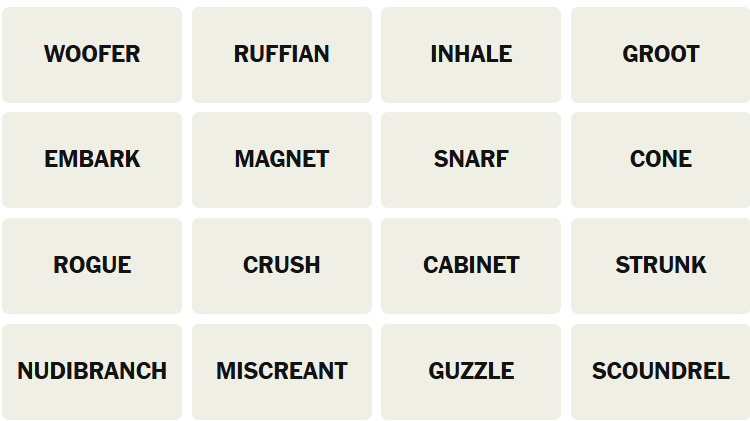
The main trap was reading the words too literally. Woofer looked animal-related, Cabinet looked like furniture, Crush looked like breaking something, and the purple answers only made sense after spotting tree parts hidden at the ends of longer words.
NYT Connections June 29 Hints
Yellow hint: These words describe someone who behaves badly.
Sharper clue: Think old-fashioned labels for a rogue, villain or shady character.
Trap to avoid: Do not look for different types of criminals. The link is broader: a troublesome or dishonest person.
Green hint: These words describe eating or drinking with speed and enthusiasm.
Sharper clue: Imagine someone finishing food so fast that the action sounds exaggerated.
Trap to avoid: Do not lock Crush into the meaning of smashing. In slang, you can also crush a meal or drink.
Blue hint: These words belong to audio equipment.
Sharper clue: Think of parts that help a speaker produce, shape or contain sound.
Trap to avoid: Woofer is not about a dog here, and Cabinet is not just household furniture.
Purple hint: Look at the endings of the words, not their meanings.
Sharper clue: Each answer ends with a part of a tree.
Trap to avoid: The words do not all describe forests, plants or nature. The pattern is hidden in spelling.
Common wrong paths: Today’s board invited several false starts. Groot could make solvers think of characters or pop culture, while Strunk may look like a proper name instead of a wordplay entry. Nudibranch is a long biological word, so it can feel impossible to place until the ending is noticed.
In the blue group, Cabinet and Woofer were also easy to misread unless the board was approached through speaker parts rather than everyday meanings.
Why Today’s NYT Connections Puzzle Was Tricky
Connections puzzle #1114 was not difficult because every category was obscure. It was difficult because several words had stronger surface meanings than category meanings. That is where NYT Connections often becomes dangerous: the first definition you see is not always the one the puzzle wants.
The yellow group used older troublemaker vocabulary, the green group relied on casual food slang, the blue group required a shift into audio hardware, and the purple group was a spelling pattern disguised as random-looking words.
Today’s NYT Connections Answers
Yellow Group
Tap to reveal Yellow answers
Category: Old-timey troublemakers
Answers: Miscreant, Rogue, Ruffian, Scoundrel
Explanation: These four words all describe someone dishonest, unruly or morally questionable. They have a slightly old-fashioned feel, which is why the category works as “old-timey troublemakers” rather than simply “bad people.”
Main trap: Rogue can sometimes sound charming or independent, while Miscreant sounds harsher. The shared troublemaker tone is the real link.
Green Group
Tap to reveal Green answers
Category: Consume with gusto
Answers: Crush, Guzzle, Inhale, Snarf
Explanation: All four can describe consuming food or drink quickly and eagerly. Guzzle points most clearly toward drinking, while Inhale and Snarf suggest eating fast. Crush fits through casual slang.
Main trap: Crush is the key misdirection because its most obvious meaning is to break or squeeze something.
Blue Group
Tap to reveal Blue answers
Category: Parts of a speaker
Answers: Cabinet, Cone, Magnet, Woofer
Explanation: These words all connect to speaker construction or sound output. The cabinet houses the components, the cone moves air to create sound, the magnet is part of the driver system, and the woofer handles lower-frequency sound.
Main trap: This group was easy to miss because the words are common outside audio. Cabinet can mean furniture, Cone can point to shape or ice cream, and Woofer can sound like a dog clue.
Purple Group
Tap to reveal Purple answers
Category: Ending in parts of a tree
Answers: Embark, Groot, Nudibranch, Strunk
Explanation: Each word ends with a tree-related part: Embark, Groot, Nudibranch and Strunk.
Main trap: Purple was the most deceptive group because the answers do not connect by normal meaning. Groot suggests a character, Nudibranch suggests marine life, and Strunk may look like a name. The solving anchor was spelling, not definition.
Likely false groupings today: Some solvers may have tried to connect Groot directly with trees, but the category was not simply “tree-related words.” Others may have tried to group Cabinet, Cone and Trunk as physical objects, but Trunk was hidden inside Strunk for purple.
Today’s solving lesson: When a Connections board includes a few words that feel unusually random, check for hidden endings, prefixes or embedded words. Puzzle #1114 looked meaning-based at first, but the final group depended on seeing word parts inside the answers.
For official gameplay, players can visit the New York Times Connections page.

Make Swikblog your go-to source on Google for reliable updates, smart insights, and daily trends.