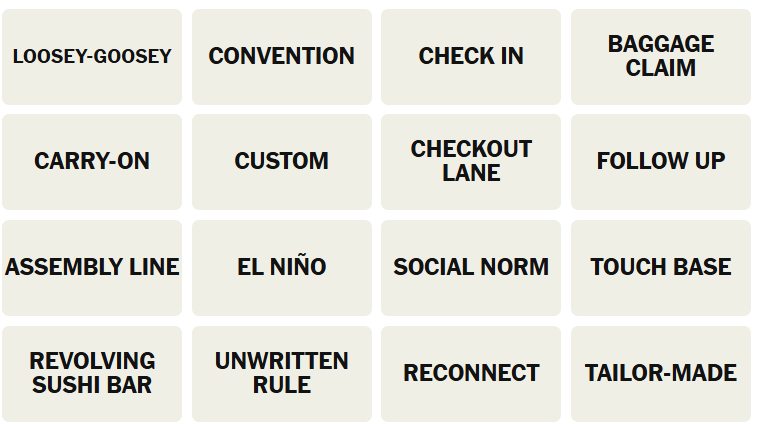
NYT Connections puzzle #1076 for May 22, 2026, looked manageable at first because several words naturally paired together, but the board became difficult once the obvious associations started overlapping. The yellow and green groups both contained language people hear regularly in work and social settings, which created multiple believable combinations that did not fully solve.
The biggest challenge came from the purple category. Several players likely tried building travel-related or casual-phrase groups before realizing the connection depended entirely on name homophones hidden inside the opening sounds of each phrase. The blue group also caused confusion because the conveyor-belt theme was spread across manufacturing, airports, retail, and restaurants instead of one obvious setting.
NYT Connections May 22 Hints
Yellow hint: Phrases used when reconnecting with someone.
Sharper clue: Think about communication after some time has passed.
Trap to avoid: A few of these sound like project-management or office workflow language, but the connection is personal contact.
Green hint: Accepted behavior inside a group or society.
Sharper clue: These describe informal expectations rather than official laws.
Trap to avoid: Don’t separate “unwritten rule” from the others just because it is longer.
Blue hint: Places where things move continuously in front of people.
Sharper clue: A moving belt or rotating system connects all four.
Trap to avoid: Airport and shopping words may tempt you into separate themes.
Purple hint: The beginning of each phrase sounds like a first name.
Sharper clue: Read the first word or sound aloud slowly.
Trap to avoid: The meanings of the phrases themselves are mostly irrelevant.
Main misleading paths: “Carry-on” and “baggage claim” strongly suggest a travel category, while “checkout lane” feels like it belongs with everyday errands or shopping-related phrases. “Touch base” and “follow up” also look like they belong with workplace terminology instead of reconnecting communication phrases. The puzzle intentionally mixed ordinary conversational language with more abstract wordplay to delay the purple reveal.
Today’s NYT Connections Answers
Yellow Group
Category: Reach back out
Answers: Check in, Follow up, Reconnect, Touch base
Explanation: All four phrases involve contacting someone again after a pause, delay, or previous interaction. They are commonly used in personal conversations, work emails, and professional follow-ups.
Why players missed it: “Touch base” and “follow up” can easily feel like office-process terminology instead of communication actions. The puzzle leaned heavily into that ambiguity.
Best solving anchor: “Reconnect” clearly points toward renewed communication, making it the strongest entry point into the set.
Green Group
Category: The way things are done
Answers: Convention, Custom, Social norm, Unwritten rule
Explanation: Each term refers to accepted behavior patterns, traditions, or expectations followed within a society, culture, or group.
Why players missed it: “Convention” can refer to an event, and “custom” can relate to personalized products or border control terminology, which creates extra distraction.
Best solving anchor: “Social norm” and “unwritten rule” clearly establish the category once paired together.
Blue Group
Category: Places with conveyor belts
Answers: Assembly line, Baggage claim, Checkout lane, Revolving sushi bar
Explanation: All four places involve items moving along a conveyor or rotating system. The puzzle cleverly spread the locations across completely different industries and experiences.
Why players missed it: “Baggage claim” pushed many solvers toward travel themes, while “checkout lane” looked like a retail-only clue. The category only becomes clear after focusing on the belt mechanism itself.
Best solving anchor: “Revolving sushi bar” is unusual enough to point directly toward movement and rotating delivery systems.
Purple Group
Category: Starting with name homophones
Answers: Carry-on (Carrie), El Niño (Elle), Loosey-goosey (Lucy), Tailor-made (Taylor)
Explanation: The opening sounds of each phrase resemble common first names. This category depended entirely on pronunciation rather than meaning.
Why players missed it: The full phrases themselves have almost nothing in common semantically, which made normal grouping logic fail. Players had to switch from meaning-based solving to sound-based pattern recognition.
Best solving anchor: “Tailor-made” sounding like “Taylor” is usually the moment the category becomes visible.
Today’s board rewarded players who stopped chasing obvious semantic links and started testing sound patterns instead. Several believable mini-groups existed, but only the homophone logic unlocked the final category cleanly.
Swikblog News Desk delivers timely, fact-driven coverage across global markets, business, technology, and trending stories. Focused on clarity and accuracy, the team provides concise updates that keep readers informed on the stories shaping the world.
We use cookies on our website to give you the most relevant experience by remembering your preferences and repeat visits. By clicking “Accept All”, you consent to the use of ALL the cookies. However, you may visit "Cookie Settings" to provide a controlled consent.
This website uses cookies to improve your experience while you navigate through the website. Out of these, the cookies that are categorized as necessary are stored on your browser as they are essential for the working of basic functionalities of the website. We also use third-party cookies that help us analyze and understand how you use this website. These cookies will be stored in your browser only with your consent. You also have the option to opt-out of these cookies. But opting out of some of these cookies may affect your browsing experience.
Necessary cookies are absolutely essential for the website to function properly. These cookies ensure basic functionalities and security features of the website, anonymously.
Cookie
Duration
Description
cookielawinfo-checkbox-analytics
11 months
This cookie is set by GDPR Cookie Consent plugin. The cookie is used to store the user consent for the cookies in the category "Analytics".
cookielawinfo-checkbox-functional
11 months
The cookie is set by GDPR cookie consent to record the user consent for the cookies in the category "Functional".
cookielawinfo-checkbox-necessary
11 months
This cookie is set by GDPR Cookie Consent plugin. The cookies is used to store the user consent for the cookies in the category "Necessary".
cookielawinfo-checkbox-others
11 months
This cookie is set by GDPR Cookie Consent plugin. The cookie is used to store the user consent for the cookies in the category "Other.
cookielawinfo-checkbox-performance
11 months
This cookie is set by GDPR Cookie Consent plugin. The cookie is used to store the user consent for the cookies in the category "Performance".
viewed_cookie_policy
11 months
The cookie is set by the GDPR Cookie Consent plugin and is used to store whether or not user has consented to the use of cookies. It does not store any personal data.
Functional cookies help to perform certain functionalities like sharing the content of the website on social media platforms, collect feedbacks, and other third-party features.
Performance cookies are used to understand and analyze the key performance indexes of the website which helps in delivering a better user experience for the visitors.
Analytical cookies are used to understand how visitors interact with the website. These cookies help provide information on metrics the number of visitors, bounce rate, traffic source, etc.
Advertisement cookies are used to provide visitors with relevant ads and marketing campaigns. These cookies track visitors across websites and collect information to provide customized ads.