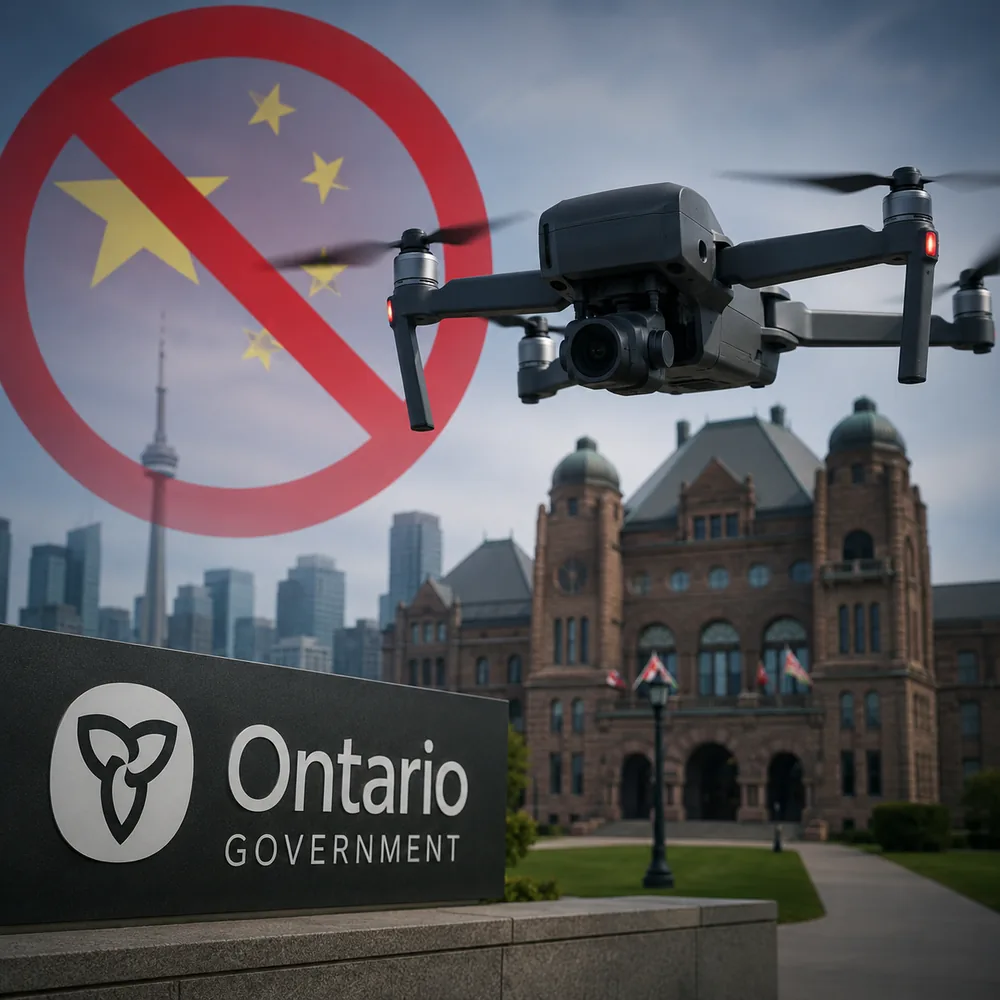

Ontario’s move to ban Chinese-made drones from government and provincial police use is more than a security warning. It is a test of how fast Canada can replace foreign-made surveillance technology without weakening front-line policing, emergency response or public-sector operations.
The province says it will immediately block Chinese-made drones from highly sensitive Ontario Provincial Police operations, stop future government purchases, and gradually replace existing units with drones made in Canada or in approved jurisdictions. The policy is being framed around privacy and data protection, but its impact could quickly spread into procurement budgets, police operations and Canada’s domestic drone industry.
Ontario’s concern is that drones used by police and government agencies can collect sensitive information, including images, locations, flight records and operational details. In public safety settings, that data may reveal more than one mission. It can expose patterns around police deployments, critical infrastructure, public events, emergency scenes and government facilities.
Ontario’s ban turns drone security into a purchasing test
The sharper issue is not only that Ontario is restricting Chinese-made drones. It is that the province is moving a security concern directly into the public purchasing system.
Drones are now routine tools for police services and government agencies. They are used in search and rescue, collision reconstruction, tactical awareness, major crime scenes, inspections, mapping and emergency response. Replacing them requires more than buying new aircraft. Agencies may need new software, training, maintenance contracts, cybersecurity checks and rules on which equipment can be used for sensitive missions.
The RCMP’s own figures show how widely Chinese-made drones have been used in Canadian policing. In a response filed with the Senate Standing Committee on National Security, Defence and Veterans Affairs, the RCMP said it operated 1,228 remotely piloted aircraft systems as of October 2025, with 973 from China, or about 79% of the fleet. The estimated replacement cost for those Chinese-made drones was $30.2 million to $34.1 million.
That federal example gives Ontario’s decision a wider meaning. If public agencies have built drone programs around cheaper foreign-made equipment, the next stage will involve difficult choices over cost, capability and security.
The challenge is protecting data without losing capability
Ontario appears to be starting with the highest-risk uses first. That matters because drones are valuable precisely because they are fast, flexible and relatively affordable. They can help officers search large areas, inspect dangerous sites and document scenes without putting more people at risk.
A rushed transition could create gaps for smaller services that rely on familiar equipment. A gradual replacement plan gives the province more room to identify approved suppliers and avoid disrupting emergency work.
The policy also reflects a broader shift in how governments view drones. They are no longer treated as simple flying cameras. They are data systems, connected to apps, firmware, cloud tools, sensors and supply chains. Security concerns can sit inside any part of that system, not just the drone itself, a concern also reflected in the RCMP’s parliamentary response on drone security.
That shift may create a real opening for Canadian and Ontario drone manufacturers. The province says it will consult industry stakeholders on replacement options, including domestic suppliers. If public procurement begins favouring trusted supply chains, the ban could become an industrial opportunity as well as a security measure.
But the opportunity comes with a commercial test. Canadian suppliers must offer drones that are secure, reliable, available and affordable enough for front-line use. Police and government buyers will need equipment that performs in difficult conditions, protects evidence-grade data and fits existing workflows.
The core issue is no longer just whether a drone can fly well. Ontario is asking whether the full technology stack can be trusted with public-sector data.
The cost question will remain difficult. The RCMP estimated replacement models could cost $31,000 to $35,000 per drone, more than twice the price of the Chinese-made units being assessed. That helps explain why such drones became common in the first place: they were capable, available and cheaper.
Ontario’s decision now puts pressure on governments to define what “secure procurement” really means. The province can ban future purchases and phase out existing drones, but the policy will be judged by whether approved replacements can protect sensitive data while keeping police and public agencies equipped for the work they already do every day.

Make Swikblog your go-to source on Google for reliable updates, smart insights, and daily trends.