
At least 30 workers are feared trapped after a nine-storey building under construction collapsed in Angeles City, Philippines, with 22 workers reported to have escaped and more than 100 police and emergency personnel searching the concrete rubble for survivors.
The collapse happened early Sunday in Angeles City, north of Manila, with emergency teams searching through a dense pile of concrete, twisted metal and construction material. Officials said several workers escaped or were rescued, while others remained missing as crews tried to reach possible survivors inside the wreckage.
Early accounts from local officials said eight people nearby were rescued and 11 others, including the site foreman, managed to escape. Police and emergency updates later indicated that 22 workers had got out, some with injuries, while at least 30 people may still be trapped based on information from the construction foreman.
Two people believed to be trapped were reported to be alive and in contact with rescuers, adding urgency to an operation where every movement of debris carries risk. More than 100 police and emergency personnel were involved in the rescue response, according to the Associated Press.
Rescue crews confront a concrete-collapse problem
The most urgent challenge is not only finding those trapped, but reaching them without triggering further collapse. Concrete structures can create heavy voids, unstable slabs and compressed spaces where survivors may still be alive but difficult to access safely.
That makes this more complex than clearing ordinary debris. Rescuers often have to listen for signs of life, secure loose sections, cut through metal and remove material in stages. Moving too quickly can endanger trapped workers and emergency crews; moving too slowly can reduce the chances of survival.
Officials said power lines were hit and were being secured, adding another layer of danger around the site. Residents nearby were urged to cooperate with authorities so rescue vehicles, engineers and emergency workers could operate without delays.
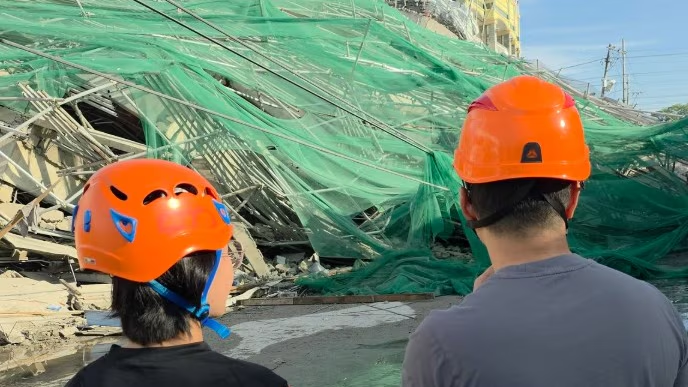
Photos shared by local authorities showed the building reduced to a mound of concrete and bent steel, with green construction netting still visible around parts of the collapsed site. The image underlined a key issue in under-construction disasters: the structure was not yet a finished building, but it was already occupied by workers exposed to the risks of height, weight and incomplete support systems.
The disaster also fits into a wider pattern of emergency incidents where public safety questions emerge only after the immediate response begins. Swikblog has covered similar urban safety concerns, including the London tower crane collapse that forced 100 workers to evacuate, where the first priority was securing the site before investigators could assess what failed.
Construction safety questions sit behind the emergency response
The cause of the collapse has not been confirmed. Officials said the assessment was still underway and that it was too early to say whether the failure was linked to design, materials, weather, construction sequencing, site supervision or another factor.
That caution matters. In major construction collapses, the first public question is often simple — why did it fall? The real answer usually depends on a longer technical review involving permits, structural plans, inspection records, concrete strength, temporary supports and the work being carried out at the time of failure.
The building reportedly collapsed before dawn during a thunderstorm, but authorities have not said that weather caused the disaster. A storm can complicate work conditions and rescue access, yet investigators still need to examine whether the structure had weaknesses before the collapse happened.
Angeles City sits in Pampanga province, about 80 kilometres north of Metro Manila, in a busy urban corridor linked to commerce, transport and development around the Clark area. A collapse of this scale is likely to draw attention not only because of the number of people feared trapped, but because it happened at an active construction site where workers were still building the structure.
Large emergency scenes can also affect surrounding residents, transport routes and utility crews long after the first collapse. In another recent incident, Swikblog reported on a Bangkok bus crash near an airport rail station that showed how rescue operations, fire response and safety investigations can overlap in crowded urban areas.
For families waiting near the rescue zone, the investigation can wait. The immediate priority remains the search for survivors, especially after reports that trapped people were still communicating with rescuers. For the city, the larger question will come after the rubble is cleared: whether this was a sudden accident, a preventable construction failure, or a warning sign about oversight at fast-moving building sites.

Make Swikblog your go-to source on Google for reliable updates, smart insights, and daily trends.