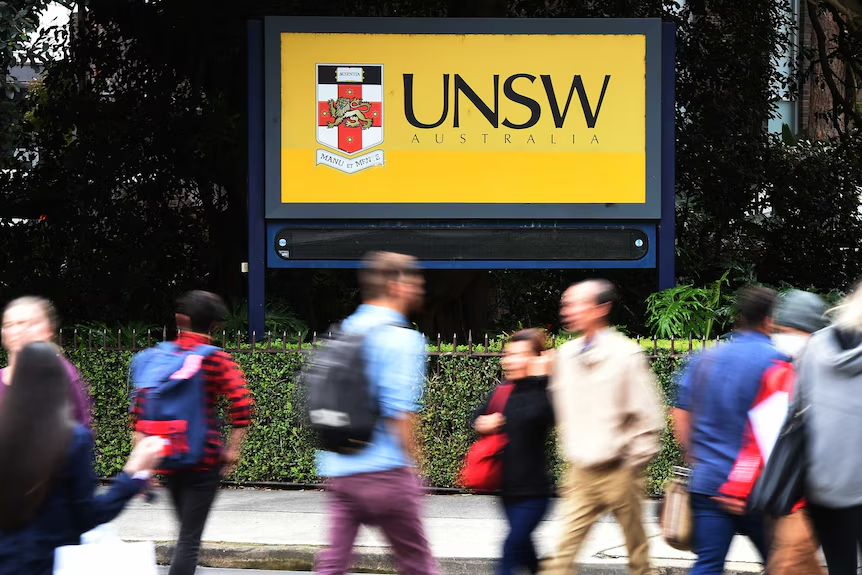

The University of New South Wales has moved to the top of Australia’s higher education table in the QS World University Rankings 2027, ranking 19th globally and pushing ahead of the University of Melbourne for the first time in the QS list.
For UNSW, the result is more than a headline number. It gives the Sydney university a valuable global signal at a time when students, employers and governments are looking harder at the real return from higher education. For Australia, it confirms that its universities remain highly visible internationally, even as the sector faces pressure over funding, workloads and student experience.
The latest QS ranking places UNSW at 19th in the world, followed by the University of Melbourne at 22nd, the University of Sydney at 28th, Australian National University at 29th and Monash University at 31st. The official QS World University Rankings compare more than 1,500 universities worldwide across reputation, research, employability, international engagement, learning experience and sustainability.
Why UNSW’s No.1 Australia Ranking Matters
UNSW’s rise is important because global university rankings are not just used by students. They influence international recruitment, research partnerships, employer perception and how universities position themselves in competitive overseas markets.
The university has climbed 30 places since 2017, showing a long-term improvement rather than a sudden one-year jump. Its strongest areas include employment outcomes, sustainability, employer reputation and international research partnerships.
UNSW ranked first among Australian universities for graduate outcomes and sustainability, two categories that increasingly influence student decision-making. The university was also among the national leaders for employer reputation and international research collaboration, highlighting its growing global footprint.
That combination helps explain why UNSW has gained ground. A university that performs well on both research visibility and graduate employability can appeal to two different audiences at the same time: researchers looking for global collaboration and students looking for career value.
Australia’s Universities Are Climbing the Global Ladder
Australia’s performance was broader than UNSW’s result. QS reported that 21 Australian universities improved their positions this year, while nine achieved their highest ranking ever.
The Australian universities ranked inside the global top 100 are:
- University of New South Wales — 19th globally
- University of Melbourne — 22nd
- University of Sydney — 28th
- Australian National University — 29th
- Monash University — 31st
- University of Queensland — 40th
- University of Western Australia — 77th
- Adelaide University — 79th
- University of Technology Sydney — 87th
This gives Australia one of the strongest national showings among major study destinations. Compared with many universities in the United States and United Kingdom, Australian institutions recorded a higher proportion of ranking improvements this year.
The performance also reinforces Australia’s reputation as a preferred destination for international education, a sector worth billions of dollars annually to the national economy.
What Students Should Understand Before Using Rankings
A high QS ranking can be useful, but it should not be treated as the only measure of university quality. The ranking captures global reputation, research strength, employer views, graduate outcomes, international networks and sustainability.
Those factors are important, especially for students comparing universities across different countries. However, they do not always reflect the quality of classroom teaching, student support services, internship opportunities or satisfaction levels within a specific degree program.
For domestic students, factors such as course quality, learning environment, graduate employment prospects and overall value for money may be equally important when selecting a university.
Questions about teaching quality and student outcomes have become increasingly important as universities face pressure to justify rising education costs. Concerns over the value students receive from expensive degrees have also gained attention, particularly amid debates around whether expensive Australian degrees are delivering enough value.
QS Identifies Areas Where Australia Still Lags
Despite the strong overall performance, QS highlighted several areas where Australian universities continue to trail leading international competitors.
While Australia performs strongly in academic reputation, citations and international engagement, the country scores less favourably on teaching capacity and graduate outcomes compared with some of the world’s highest-performing higher education systems.
QS Chief Executive Jessica Turner said maintaining momentum would require ongoing investment in employability, student experience and workforce skills, particularly as artificial intelligence reshapes labour markets around the world.
The organisation also pointed to the importance of ensuring Australia remains an attractive destination for international students and researchers at a time when global competition for talent is intensifying.
International Student Revenue Remains Central to the Model
The rankings also highlight the financial reality behind Australia’s higher education system. Universities rely heavily on international student fees, which help support research activity, staffing and infrastructure.
A recent New South Wales Auditor-General report found universities received less funding than it cost them to educate domestic students, increasing reliance on international student revenue to cover operating shortfalls.
That creates a powerful cycle. Strong rankings help attract overseas students. International student fees support research output. Higher research output can then help future rankings.
The model has helped Australian universities compete globally, but it also leaves institutions exposed if overseas demand weakens, visa settings tighten or students become more price-sensitive.
Staff Workload Concerns Add Pressure Behind the Success
The rankings celebration comes alongside evidence of rising discontent inside the sector. A survey of 537 academic and professional staff from 31 of Australia’s 39 public universities found only 42.1% planned to stay in academia until retirement.
The same research found 18.5% planned to leave, while 48.5% said they were dissatisfied or very dissatisfied with their workload.
The findings suggest many staff remain motivated by teaching and research but are increasingly frustrated by heavy workloads, job insecurity, cost-cutting and performance pressure.
Some academics have raised concerns about long working hours, reduced support and the growing use of corporate-style metrics. Those issues matter because staff wellbeing can directly affect teaching quality, research output and the student experience over time.
What This Means for Students and Universities
UNSW’s rise to 19th globally gives it a powerful advantage in branding, international recruitment and research partnerships. It also strengthens Sydney’s position as a major education hub competing with Melbourne, London, Singapore, Toronto and other global student cities.
For students, the ranking is a useful signal of reputation, employability and research strength. But it should be weighed alongside course-level data, teaching quality, graduate outcomes and personal career goals.
Read More
For Australian universities, the message is more complex. The sector has shown it can compete with the world’s best, but sustaining that position will require more than strong league-table results.
The next challenge is turning global recognition into stronger teaching, better student outcomes and a more sustainable environment for the academic staff whose work makes those rankings possible.

Make Swikblog your go-to source on Google for reliable updates, smart insights, and daily trends.