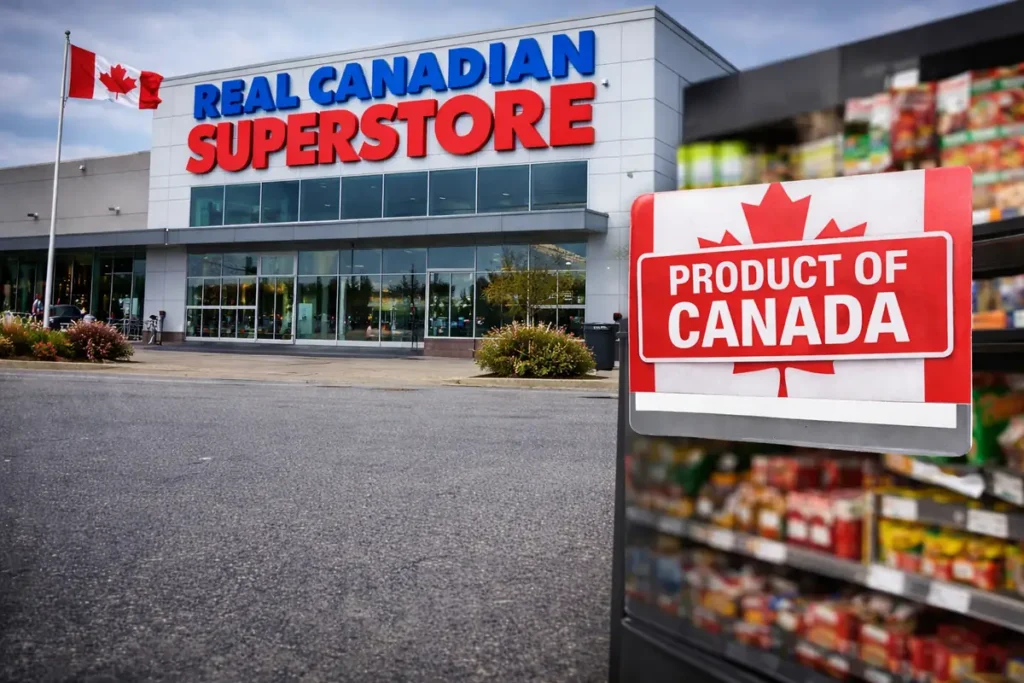

Real Canadian Superstore has been fined $10,000 after the Canadian Food Inspection Agency said in-store displays at a Toronto location used misleading “Product of Canada” claims. The penalty applies to store 1033 in Toronto and puts fresh attention on how grocery retailers present Canadian-origin food labels to shoppers.
CFIA penalty tied to Toronto store displays
The CFIA said the issue involved how the phrase “Product of Canada” appeared on store displays. The agency has not publicly named the specific products involved or released images of the signage, but it described the displays as misleading under Canada’s food labelling and advertising rules.
The fine was issued as an administrative monetary penalty. For grocery chains, the case shows that origin claims on shelf signs, promotional displays and packaging must remain accurate when product sourcing changes.
Loblaw says signage processes are being strengthened
Real Canadian Superstore is part of Loblaw Companies Limited. The company said it takes labelling and signage obligations seriously and acknowledged that large grocery stores handle thousands of products whose sourcing can shift throughout the year.
Loblaw said store signage can sometimes lag behind inventory changes and that human error may occur in busy retail settings. The company apologized for any confusion and said it is reviewing processes so incorrect signs can be identified and corrected more quickly.
What “Product of Canada” means
“Product of Canada” is one of the strictest Canadian-origin claims used on food. Under CFIA guidance, the claim generally means that virtually all major ingredients, processing and labour are Canadian.
The CFIA allows up to 2% of a food product to come from outside Canada in limited cases. These minor exceptions may include ingredients such as spices, food additives, vitamins, minerals or flavouring preparations that are not always available from Canadian sources.
Imported packaging does not automatically prevent a food from qualifying. A product may also qualify if it is grown in Canada using imported agricultural inputs such as seed, fertilizer, animal feed or veterinary medicines, provided the finished food meets the overall Canadian-origin standard.
The official rules for claims such as “Product of Canada” and “Made in Canada” are explained in the CFIA’s guidance on food origin claims.
How “Made in Canada” is different
“Made in Canada” follows a different standard. A food may use that claim when its last substantial transformation happens in Canada, even if some ingredients were imported.
When imported ingredients are used, the claim must include a qualifying statement. That wording should clarify whether the product is made from imported ingredients or from a mix of imported and domestic ingredients.
The difference matters because “Product of Canada” signals a higher level of Canadian content, while “Made in Canada” can still apply to foods that include imported inputs.
Why accurate origin claims matter
Country-of-origin labels can strongly influence grocery decisions, especially when Canadians are trying to support domestic farmers, processors and food manufacturers. A shelf sign that incorrectly suggests a product is Canadian may affect what shoppers choose before they read the package label.
That is why the CFIA expects retailers to keep shelf tags, promotional signs and product information aligned with the items being sold. If inventory changes but signage is not updated, customers may receive inaccurate information about where a product comes from.
For broader coverage of Canadian consumer issues, business updates and public policy developments, visit the latest Canada news and consumer updates.
What the fine signals for grocery retailers
The $10,000 penalty shows that regulators expect retailers to manage origin claims carefully, even when mistakes are linked to fast-moving inventory changes rather than intentional misrepresentation.
For large grocery chains, the bigger risk is not only the financial penalty. Misleading origin claims can weaken consumer trust at a time when food sourcing, domestic supply chains and Canadian-made labels are receiving more public attention.
What shoppers should check
Consumers who want Canadian food should check the actual package label, not only the shelf display. A “Product of Canada” claim usually indicates that virtually all significant ingredients, processing and labour are Canadian.
A “Made in Canada” claim follows a different rule and may include imported ingredients when the correct qualifying statement is provided. If a label or display appears inconsistent, shoppers can raise the issue with store staff or report the concern to the CFIA.
The Real Canadian Superstore penalty is a reminder that food origin claims are not just marketing language. They are regulated statements that must be clear, accurate and consistent from the package to the store display.
Read more: CRA Tax Season 2026 Begins with 1,500 New Agents and 90% Online Accuracy

Make Swikblog your go-to source on Google for reliable updates, smart insights, and daily trends.