
Team Canada will skate into its biggest test of the Milano Cortina 2026 men’s hockey tournament without its captain. Sidney Crosby has been ruled out of Friday’s Olympic semifinal against Finland at Santagiulia Arena, forcing Canada to reshuffle leadership, special teams, and late-game matchups with a gold-medal berth on the line.
If you’re looking for the full game-time details and matchup rundown, here’s our complete guide: Canada vs Finland semifinal kickoff time and prediction for Winter Olympics 2026.
The injury that changed Canada’s semifinal plan
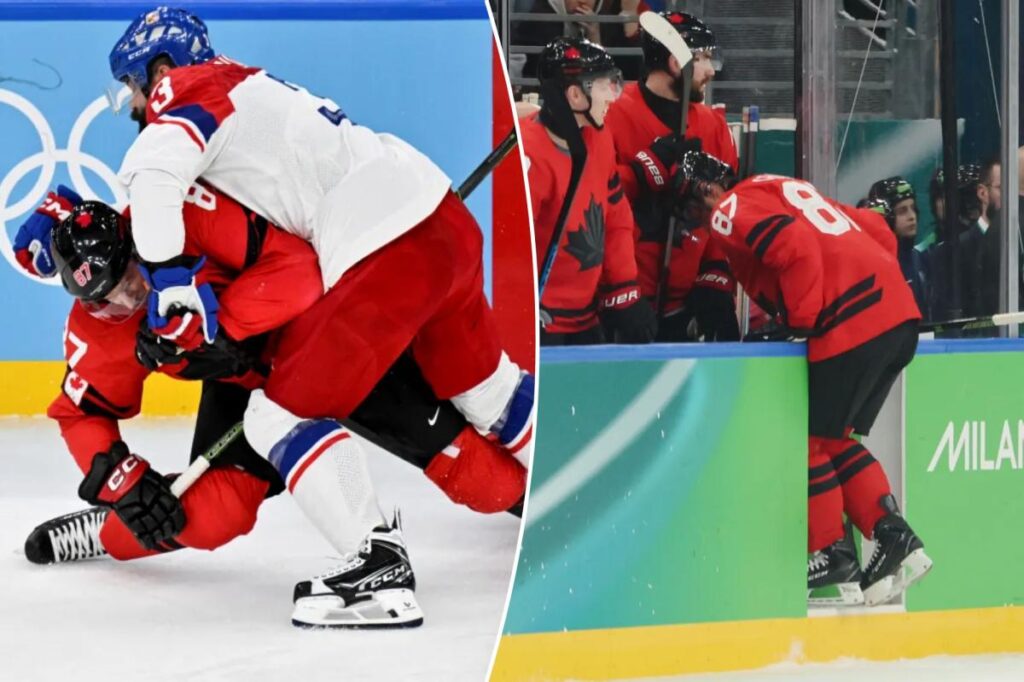
Crosby sustained a lower-body injury in the second period of Canada’s 4-3 overtime quarterfinal win over Czechia on Wednesday. The sequence unfolded quickly: a collision at center ice left Crosby favoring his right leg, and a second heavy contact along the boards near Canada’s bench prompted a short medical assessment before he headed to the dressing room with 13:55 remaining in the period. He did not return, and Canada had to finish a tense elimination game without the player who typically steadies every important shift.
Even with the disruption, Canada found a way through. The response under pressure offered a preview of what the semifinal could demand: deeper minutes for secondary lines, sharper special teams execution, and a collective commitment to structure when the game tightens.
McDavid wears the ‘C’ as the room recalibrates
International rules require a designated captain for each game, and Connor McDavid will wear the ‘C’ against Finland. Canada’s room is packed with NHL captains and alternate captains, but Crosby’s influence is uniquely stabilizing — not just for scoring, but for tempo control, defensive reads, and those small moments that keep momentum from swinging the wrong way.
Goaltender Jordan Binnington framed it simply: Crosby is a presence you want in any room, and the message now is to compete hard and leave everything on the ice. That mentality matters more than ever in a one-game path to the gold medal final.
Lineup changes: Suzuki steps into a bigger two-way role
Nick Suzuki will replace Crosby at center on Canada’s third line, skating with Mitch Marner on the left side and Mark Stone on the right. That trio has been trusted in difficult minutes because it can defend without giving away pace, then flip the ice in one clean transition. For Suzuki, the ask is clear: absorb the late-game responsibility Crosby typically carries, manage matchups, and keep the line’s identity intact rather than trying to replicate Crosby shift-for-shift.
The challenge is less about highlight plays and more about consistent decisions — winning a neutral-zone battle, making the safe exit, and forcing Finland to skate the full length when possession turns over.
Power-play adjustment: Celebrini gets a starring assignment
Canada is also expected to keep Macklin Celebrini on the first power-play unit, alongside McDavid, Nathan MacKinnon, Sam Reinhart, and Cale Makar. Celebrini already delivered a meaningful impact in the quarterfinal, setting up MacKinnon on a power-play goal that helped Canada stay within reach during a turbulent stretch of the game.
In a semifinal that could be decided by one special-teams moment, the top unit’s timing and shot selection become even more important. Without Crosby’s patient puck control and net-front deception, Canada may lean more on pace, quick-touch movement, and Makar’s ability to change angles at the blue line.
What Canada loses without Crosby — and what it must replace
Crosby entered the semifinal stage with six points in four games — two goals and four assists — but the bigger loss is his control of the game’s emotional temperature. Crosby is the player who can slow a frantic sequence into a composed cycle, then speed it up in one decisive cut to the middle. In Olympic elimination hockey, that ability can be the difference between surviving a push and surrendering one.
Canada’s answer will likely be distributed rather than concentrated. McDavid’s speed can blow open seams. MacKinnon can power through contact and create chaos off the rush. Marner and Stone can tilt puck possession in tight areas. And Makar can dictate the shape of shifts from the back end.
Why Finland is a difficult opponent for a reshuffled Canada
Finland’s identity is built on disciplined structure and the patience to let opponents make the first mistake. That makes Friday’s matchup especially unforgiving for a Canadian lineup adjusting on the fly. Without Crosby’s elite defensive reads down low and his knack for winning small moments along the wall, Canada’s details must be sharper: clean breakouts, controlled entries, and fewer risky passes through the middle.
If the game tightens late, faceoffs, line changes, and special teams may decide it. Canada’s depth is still imposing, but the margin for error shrinks when your most reliable stabilizer is watching from the press box.
A tournament storyline with history attached
Crosby is chasing a third Olympic gold medal, adding to titles from Vancouver 2010 and Sochi 2014. This tournament was already framed as one more defining chapter for a player whose international résumé is as decorated as any of his era. Now, the storyline shifts: can Canada prove it can chase gold even when its captain can’t take a shift?
For full Olympic coverage and game-day context beyond the semifinal, follow the tournament hub at NHL.com/Olympics.
Friday’s semifinal isn’t just a matchup — it’s a pressure test of Canada’s depth, composure, and adaptability. Canada still has the star power to reach Sunday’s gold medal game, but it must do it the hard way: by replacing Crosby’s influence with collective execution, one disciplined shift at a time.

Make Swikblog your go-to source on Google for reliable updates, smart insights, and daily trends.