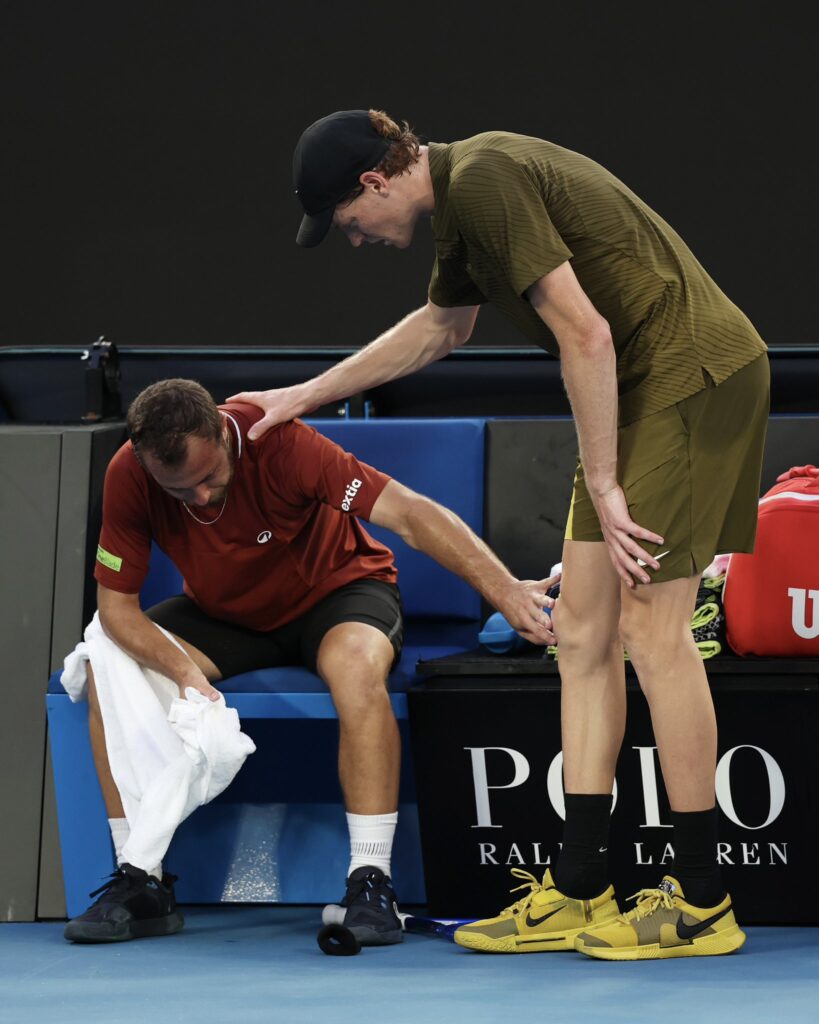
Match update — Rod Laver Arena (Completed): Jannik Sinner has closed it out in four sets, defeating Eliot Spizzirri 4–6, 6–3, 6–4, 6–4 to move safely through a physically demanding third-round encounter.
It wasn’t vintage Sinner, but it was controlled when it mattered. After battling cramp and surviving a momentum swing during the extreme-heat stoppage, the defending champion steadied himself under the closed roof and found the key break late in the fourth set.
- Aces: Spizzirri 6, Sinner 17 — free points played a crucial role as rallies became harder to sustain.
- Break points: Spizzirri 6/16, Sinner 8/11 — the clearest statistical difference on the day.
- Total points won: Sinner edges it 121–119, underlining how tight the match remained throughout.
- Games won: Sinner 22, Spizzirri 17.
4-6 6-3 6-4 6-4 – Jannik Sinner moves into the second week of #AO26 🙌@wwos • @espn • @tntsports • @wowowtennis pic.twitter.com/E8DFXFUMHv
— #AusOpen (@AustralianOpen) January 24, 2026
Big picture: Spizzirri pushed the two-time champion harder than the scoreline suggests, but Sinner’s ability to capitalise on key chances — even while physically compromised — proved decisive in Melbourne.
Jannik Sinner looked, for long stretches, like a champion being slowly unstitched by the weather. Legs heavy, movement dulled, his serve reduced to a careful nudge rather than a weapon, the two-time defending Australian Open winner staggered through a third-round afternoon that refused to behave like a routine day at the office. And yet, when the match threatened to tip into a full-blown upset, Sinner did what the best players do when they cannot play their best: he found a smaller version of his game and made it count.
With Melbourne’s heat tightening its grip on the tournament, and the stadium protocols beginning to shape the day as much as the tennis, Sinner clawed his way to a 4-6, 6-3, 6-4 lead over American underdog Eliot Spizzirri after three sets. The scoreline was neat. The reality was not. Sinner’s body was clearly in a fight of its own, cramp taking bites out of his footwork, his posture and even his ability to push off on serve. Spizzirri, playing just his first Australian Open main-draw match and his first encounter with a top-10 opponent, sensed the opening and played like a man determined to make the moment last.
The scare had arrived early. Spizzirri took the first set 6-4 and carried that belief into the third, where he broke to move 3-1 ahead and briefly had Rod Laver Arena murmuring. Sinner, usually so crisp in his patterns, was coughing up errors and finishing points with the guarded instincts of someone trying to shorten rallies without having the legs to do it safely. He did not look good. He did not look comfortable. He simply kept looking for the next game.
Then the day intervened. The Australian Open’s heat protocol, triggered when conditions spike into the highest zone on its heat stress scale, brought play into a short suspension to allow the retractable roof to be closed. Outside courts were halted and, inside the arena, the match paused at a moment that felt almost cinematic: the champion visibly spent, the outsider holding a lead, the sun dictating terms. For Sinner, the timing mattered. A brief break to towel down, reset the breathing and calm the legs was not a luxury; it was oxygen.
When play resumed under indoor conditions, the match shifted. Sinner began going after returns earlier, taking bigger cuts to end points quickly and refusing to let Spizzirri settle into extended patterns. He broke back immediately, then held through pressure to level at 3-3, saving break points in a game that looked, for a few minutes, like it might decide the entire afternoon. The rallies did not suddenly sparkle. But the champion’s choices sharpened. He was no longer trying to win every point beautifully. He was trying to win them efficiently.
Spizzirri still had his chances, and that, perhaps, will be the part of the match that stays with him longest. He created openings and repeatedly dragged the contest into the kind of stressful territory where a favourite begins to feel the weight of expectation. But break points are a cruel currency at this level. Across the first three sets, Spizzirri generated far more chances than the scoreboard suggested, only to convert five of 14. Sinner, by contrast, was ruthless on the few looks he received, converting six of nine. In a match where one player looked physically compromised, that difference in clarity under pressure was decisive.
The third set’s turning point arrived in a marathon game that ran close to 10 minutes, the kind of game that exposes the smallest cracks in nerve and execution. Spizzirri, under the strain of protecting his lead and facing down a champion who would not go away, blinked at the wrong time. A double fault handed Sinner the break he needed, and suddenly the Italian was serving for the set at 5-4. He held to love, not so much as a flourish but as a statement: however unsteady the body looked, the mind was still intact.
As the set ended, the tournament’s heat rule granted players a 10-minute break between sets, another pause that felt tailor-made for a player battling cramps. Sinner took it, and so did the match. The heat had threatened to turn his defence into a slow, painful unraveling; instead it became part of the story of survival. Somewhere between the stoppage, the roof closing and the scramble for momentum, the champion had managed to patch himself together.
JANNIK SINNER.
— The Tennis Letter (@TheTennisLetter) January 24, 2026
What a tennis player.
🤯🤯🤯🤯🤯
pic.twitter.com/qbRL3Rsdfi
The wider day across Melbourne Park carried the same theme: heat as the invisible opponent. With outside-court play suspended for long periods and only a handful of matches able to continue, the tournament schedule bent around safety protocols and shifting forecasts. In that stop-start atmosphere, No 5 seed Lorenzo Musetti reached the last 16 at the Australian Open for the first time, navigating a five-set battle of his own. The draw kept moving, but the conditions made every match feel slightly unstable, as if the weather could redraw the script at any moment.
For Sinner, the headline remains simple: he is still alive in Melbourne, even after an afternoon that asked uncomfortable questions about his physical reserves. For Spizzirri, there is no shame in pushing a two-time champion into a grind and leaving with the sense that the door was briefly open. The difference is that champions do not need the door open for long. They just need a crack.
Read more on the extreme heat disruption at Melbourne Park in this report from The Guardian.
For more tennis and Australian Open updates, visit Swikblog.

Make Swikblog your go-to source on Google for reliable updates, smart insights, and daily trends.