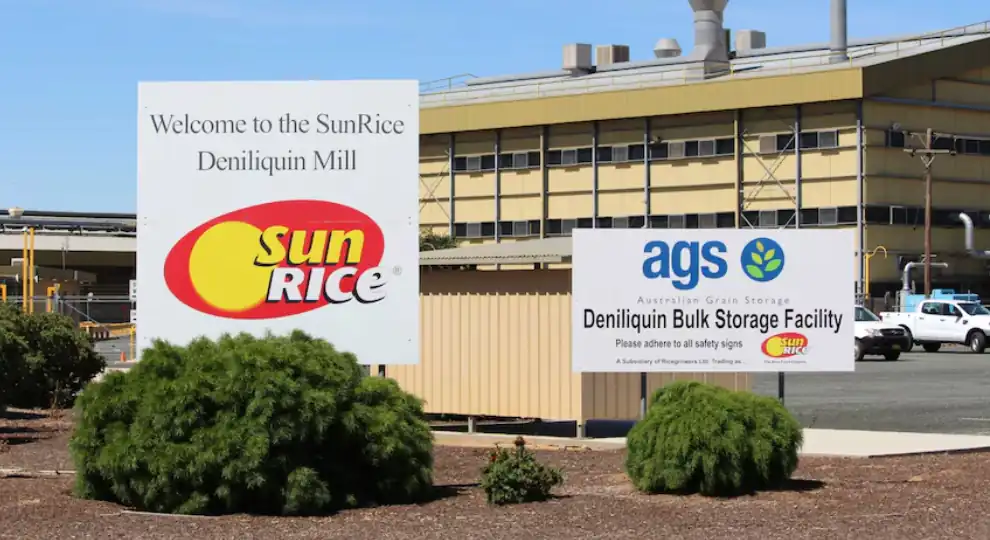

SunRice has confirmed 78 job losses across the NSW Riverina after a sharply smaller rice crop forced reduced production at its Leeton and Deniliquin mills, bringing drought, irrigation costs and federal water policy back into focus for regional communities.
The decision follows about a month of consultation with employees and unions. Another 92 positions will change across the Leeton and Deniliquin mills and Australian Grain Storage, while the company says it has considered redeployment opportunities where feasible.
SunRice employs about 650 people across the region and had warned in July that lower crop volumes would require a scale-back. Last summer’s rice production was about 180,000 tonnes, the smallest crop since the 2019-20 drought.
The pressure reflects the wider challenges facing Australian farmers dealing with water scarcity, climate extremes and rising production risks, especially for annual crops that depend heavily on irrigation availability and price.
SunRice reduces mill hours in Leeton and Deniliquin
The lower harvest is now translating directly into fewer operating hours at two major Riverina processing sites. Leeton will move from continuous 24-hour production to 16-hour shifts, five days a week. Deniliquin will continue processing five days a week, but daily operations will fall from 24 hours to eight.
SunRice Group chief executive Paul Serra said the company had focused on retaining as many employees as possible, including through redeployment. The business has also said it will continue supporting workers whose roles are affected.
Leeton Shire Council general manager Jackie Kruger said 68 families in Deniliquin and 10 in Leeton would be affected by the redundancies. The council plans to work with SunRice and other local employers to explore opportunities for displaced workers.
Ricegrowers’ Association of Australia president Peter Herrmann described the announcement as a difficult period for the industry and the communities tied to it.
The impact can spread beyond direct mill employment. Rice production supports transport operators, storage facilities, contractors, machinery services and other local businesses, so fewer processing hours can reduce activity across the wider regional supply chain.
Water buybacks sit at the centre of the policy dispute
SunRice has linked lower crop volumes to drought and what it describes as current water policy settings. Leeton Shire Council has taken a stronger position, arguing that Commonwealth water purchases under the Murray-Darling Basin Plan are adding pressure to the rice industry.
Kruger pointed to changes made in 2023 through the Restoring Our Rivers reforms, which allowed voluntary water entitlement purchases to play a larger role in recovering water for environmental targets.
The council argues that removing irrigation entitlements from agricultural production can reduce water availability and put upward pressure on costs for annual crops such as rice and cotton. The Riverina and Murray Joint Organisation has separately warned about the regional effects of water buybacks, including risks to processing, freight, farm services and jobs.
The policy argument remains contested. Water recovery is intended to improve environmental outcomes across the Murray-Darling Basin, while farming groups and regional councils argue that economic and employment impacts must also be weighed when recovery methods are chosen.
A 2024 ABARES assessment identified rice as the crop likely to face the largest proportional effect under scenarios involving further voluntary water purchases. The modelling does not prove that buybacks alone caused the SunRice redundancies, but it helps explain why rice production is particularly sensitive to changes in irrigation availability and price.
Rice is an annual crop, so growers can reduce planting relatively quickly when conditions are dry or water becomes expensive. A smaller planted area then means fewer tonnes reaching mills, leaving processing hours more exposed to seasonal changes.
That volatility is part of a broader Australian pattern. Recent heavy rain and flood warnings across Queensland and northern NSW showed how farming regions can move between water scarcity and damaging excess rainfall, complicating long-term production planning.
World Day to Combat Desertification and Drought 2026: Why Water and Land Resilience Matter
500 Turtles Found Alive After Outback Lake Nearly Dried Up in Australia
Riverina communities now face the immediate employment impact
The announcement turns a long-running water policy debate into a direct employment issue for Leeton and Deniliquin. Fewer mill shifts affect workers immediately, while businesses connected to agriculture and food processing may also feel the slowdown.
The issue has reached federal parliament. One Nation member for Farrer David Farley used his maiden speech this week to criticise the Murray-Darling Basin Plan and argue that environmental policy should be considered alongside food production, regional communities and national resilience. His comments represent one side of a broader political dispute over balancing environmental recovery with irrigated agriculture.
Federal Environment and Water Minister Murray Watt had been contacted for comment on the confirmed redundancies at the time of the latest report.
For SunRice, future production levels will depend on the size of coming Riverina crops. Rainfall, water allocations, irrigation prices and growers’ planting decisions will determine how much locally grown rice reaches the mills and how intensively those facilities operate.

Make Swikblog your go-to source on Google for reliable updates, smart insights, and daily trends.