
A Sydney-based international student has been charged over more than A$5 million in allegedly dishonest Tourist Refund Scheme claims involving luxury watches. The Australian Federal Police says the 28-year-old was remanded in custody and was scheduled to appear in Downing Centre Local Court on July 22, 2026. No later official court outcome had been published as of July 24.
The case centres on refund applications made through Sydney Airport, more than 20 short trips to China, altered bank documents and over A$1.1 million in alleged cash deposits. Every accusation remains unproven, and the student is presumed innocent unless convicted.
What is the student accused of doing?
Police allege the man repeatedly claimed Goods and Services Tax refunds for watches that were not eligible under Australia’s Tourist Refund Scheme, commonly known as the TRS.
The disputed claims exceeded A$5 million. Authorities have not revealed how much was approved or paid, meaning that figure represents the value of the alleged applications rather than a confirmed loss to taxpayers.
The AFP has not disclosed how many claims were submitted, whether any invoices were reused or which retailers supplied the documents. No retailer was accused of wrongdoing in the official announcement.
Why did the investigation begin?
Taskforce Avarus opened the investigation in February 2026 after the Australian Border Force identified suspected links between high-value refund claims, rapid international travel, structured cash deposits and the movement of expensive goods.
Investigators allege the student travelled to Chengdu Tianfu International Airport in China more than 20 times, sometimes remaining overseas for less than 24 hours. Brief or frequent journeys are legal, but police say this travel pattern became relevant when compared with the refund and financial records.
Australian border agencies use connected passenger and identity systems during these checks. The effect of relying on such systems became clear during the Australian passport processing outage, when some airport procedures temporarily returned to manual handling.
Cash and luxury watches seized in Sydney
Between February 2025 and May 2026, the student allegedly deposited more than A$1.1 million in cash into Australian bank accounts. Police say most deposits occurred through ATMs in Sydney’s central business district.
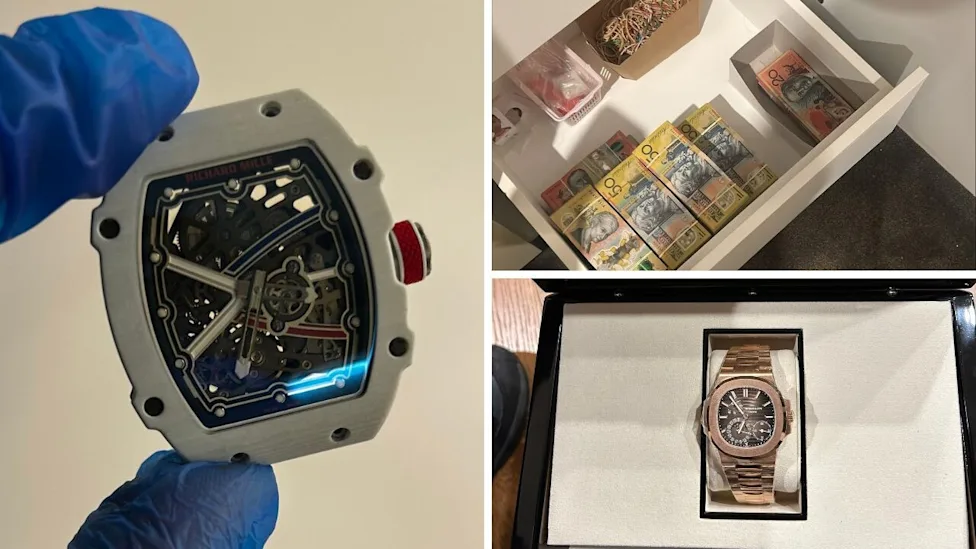
AFP and Border Force officers executed warrants in the CBD on May 20, seizing approximately A$270,000 in cash, electronic devices, a cash-counting machine, invoices and receipts.
They also seized a Richard Mille watch valued at about A$170,000, three Patek Philippe watches, one Van Cleef watch and two allegedly counterfeit luxury watches. Police have not alleged that the genuine timepieces were stolen. Seizure does not prove that an item represents criminal proceeds or mean it has been permanently forfeited.
How does Australia’s Tourist Refund Scheme work?
The TRS allows eligible Australian residents and international visitors to recover GST—and, in limited cases, Wine Equalisation Tax—on qualifying goods taken out of Australia.
Under the official Australian Border Force TRS rules, a traveller must generally spend at least A$300, including GST, with one supplier or businesses using the same Australian Business Number.
A valid tax invoice is required, and the goods must be carried or worn when departing. Officers may request an inspection before approving the refund. The GST component is normally one-eleventh of the purchase price, so an eligible A$1,100 item generally contains A$100 in GST.
Refunded goods can later return to Australia, but travellers must declare them. GST or duty may apply if their combined value exceeds the passenger concession—normally A$900 for adults and A$450 for travellers under 18. Separate travel-document requirements have also caused confusion following a passport rule change affecting Australian travellers.
What penalty could the student face?
The man was charged with one count of dishonestly intending to obtain a gain from a Commonwealth entity under section 135.1 of the Commonwealth Criminal Code. He was remanded in custody on May 21.
The charge carries a maximum penalty of 10 years in prison if proven. That maximum is not an automatic sentence and does not predict the eventual court outcome.
The AFP has not publicly identified the student’s name, nationality, university or course, and no visa cancellation has been announced. Further court findings will determine whether the allegations are established.

Make Swikblog your go-to source on Google for reliable updates, smart insights, and daily trends.