
The 2026 Tour de France has been forced into a historic route change after extreme temperatures prompted organisers to shorten Stage 9 between Malemort and Ussel. Around 30 kilometres have been removed from the original course after France’s Corrèze department was placed under the country’s highest heat warning.
The stage scheduled for July 12 was originally set to cover 185.5 kilometres. Race organiser Amaury Sport Organisation removed a hilly loop from the opening section, reducing the amount of time riders, officials, volunteers and spectators would be exposed to the most severe conditions.
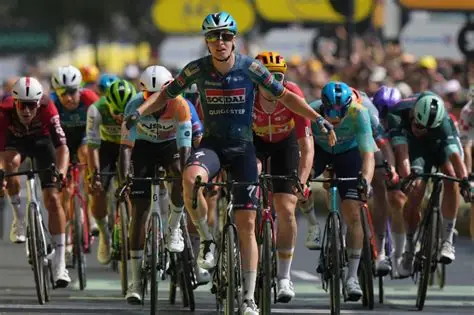
The announcement came shortly after Tim Merlier claimed his second victory of the race with a powerful sprint in Bergerac. Although the Belgian’s Stage 8 win carried major significance for the green jersey contest, the unprecedented heat-related intervention quickly became the Tour’s biggest story.
Red heatwave warning forces a major change
Météo-France issued a red heatwave alert for Corrèze after forecasting exceptionally intense conditions. Red is the highest warning level used by the French weather authority and indicates that the heat may threaten the wider population, including people who are not normally considered vulnerable.
The warning created concerns extending beyond the professional cyclists. Police officers, medical personnel, race officials and volunteers can spend hours working beside exposed roads before and after the peloton passes.
Tour director Christian Prudhomme said organisers had a responsibility to work with local authorities, whose resources were already being used to manage the wider effects of the heatwave.
The official Tour de France website provides the latest route information and race updates as organisers continue adapting the event to changing conditions.
Stage 9 remains a difficult racing test
Removing the opening loop reduces the total distance, but it does not transform Stage 9 into an easy day. The revised course still includes four categorised climbs and enough elevation to reward aggressive riders.
The longest climb measures 4.8 kilometres, while the steepest ascent carries an average gradient of 7.7%. Those figures mean riders will continue to face repeated efforts even though the overall duration of the stage has been reduced.
Prudhomme insisted that the sporting character of the route would remain intact. Breakaway specialists will still see an opportunity, while general-classification teams must protect their leaders on a day when heat and fatigue could affect performance.
A shorter stage may even produce more intense racing. Riders have fewer kilometres in which to conserve energy, while teams have less time to control attacks and organise a chase.
Why extreme heat changes race strategy
Professional cyclists regularly compete in warm summer conditions, but temperatures approaching 40°C create a far more demanding challenge. Riders must produce high power for several hours while wearing helmets and racing on roads exposed to direct sunlight.
Heavy sweating causes rapid fluid and electrolyte loss. Without sufficient water and salt replacement, a rider may experience reduced concentration, weaker muscle performance and slower recovery.
The effects can build across a three-week Grand Tour. Heat exposure on one stage may disrupt appetite, sleep and recovery, leaving riders at a disadvantage on the following day.
Teams rely on ice vests, cold towels, chilled bottles and ice placed inside jerseys. Prudhomme said approximately 450 kilograms of ice were being distributed to the teams every day to support those cooling measures.
Weather-related disruption is becoming a larger part of international sport, with recent sports news and safety updates showing how organisers increasingly have to adjust routes, schedules and crowd arrangements when conditions become dangerous.
Tim Merlier backs the shortened route
Merlier supported the decision after describing a difficult opening week in which temperatures had regularly exceeded 35°C.
The Soudal-QuickStep sprinter said accessing enough water, cold drinks and ice between team vehicles had become a constant challenge. In his view, reducing the distance was a practical response to the conditions facing the peloton.
Sprinters are especially vulnerable to accumulated fatigue because they must survive the full stage before battling for position at high speed in the final kilometres. Heat-related exhaustion can therefore affect endurance, decision-making and safety during crowded finishes.
Tadej Pogačar expects temperatures near 40°C
Race leader Tadej Pogačar said his UAE Team Emirates-XRG squad expected temperatures of approximately 35°C to 40°C during Stage 9.
The reigning champion explained that the team would continue approaching the race one day at a time, with hydration and cooling becoming central parts of its strategy.
Prudhomme said Pogačar thanked Tour route director Thierry Gouvenou after being informed that the stage would be shortened.
The revised course does not remove the tactical pressure on Pogačar or his leading rivals. Jonas Vingegaard, Remco Evenepoel, Juan Ayuso and other overall contenders must still remain alert across the four climbs.
Heat also increases the workload for support riders. Domestiques repeatedly drop back to team cars to collect bottles before moving through the peloton to supply their leaders.
Previous route changes involved different threats
The Tour de France has altered stages before when circumstances made the original route unsafe or impractical, but those interventions were caused by different hazards.
Earlier in 2026, the second stage in Spain was shortened by 13.5 kilometres after a swine flu outbreak was detected near part of the planned course.
Spectators were later advised to stay away from the finish area of another stage in the Pyrenees because of a wildfire burning around 70 kilometres away in southwestern France.
Stage 19 of the 2025 Tour was also reduced after lumpy skin disease was discovered among cattle near the Col des Saisies. Organisers removed the climb to keep the race convoy and large crowds away from the affected area.
The Corrèze decision creates a new precedent because the temperature itself was considered serious enough to justify shortening the race.
The change may influence how future editions prepare for severe weather, including planning around the Tour de France 2027 route through the UK, where public safety, crowd management and weather resilience will remain important operational issues.
Read More:
- Disney World opens registration for 2027 runDisney events
- Canada’s 2030 World Cup qualification outlook explained
- Visit the Swikblog homepage for more latest news
Merlier delivers another dominant sprint
The heatwave announcement followed one of the strongest sprint performances of the Tour so far. Merlier appeared to be poorly positioned during the final few hundred metres of the 180-kilometre Stage 8 route from Périgueux to Bergerac.
The 33-year-old then launched a long-range acceleration, moved past his rivals and reached the finish line ahead of Biniam Girmay. Dutch sprinter Olav Kooij finished third.
The result gave Merlier his second victory from three sprint opportunities in the 2026 race and the fifth Tour de France stage win of his career.
It also moved him to within 15 points of Mads Pedersen in the competition for the green jersey.
Belgian rider Liam Slock had attempted to prevent the expected bunch finish by attacking alone with around 40 kilometres remaining. He had earlier spent much of the stage in a breakaway with Czech rider Jakub Otruba and French cyclist Thibault Guernalec.
Slock continued alone after his companions were caught, but the peloton closed the gap just 1.3 kilometres from the finish. The sprint teams then took control and created the opportunity for Merlier’s late surge.
A test of competition and risk management
The altered Stage 9 remains important for the yellow jersey battle, but its significance now extends beyond the sporting result.
Organisers must balance the traditions of the Tour with their responsibility to protect everyone involved in an event that travels through public roads, towns and rural communities.
Removing around 30 kilometres cannot eliminate the danger posed by the heat, and riders will still need to manage hydration and body temperature throughout the day. However, the decision reduces the duration of exposure while preserving the stage’s four main climbs.
For the Tour de France, the change establishes an important precedent. When the highest heat warning is in place, maintaining every kilometre of the original route may be less important than ensuring the race can continue responsibly.

Make Swikblog your go-to source on Google for reliable updates, smart insights, and daily trends.