
Airport travel across the United States is becoming increasingly stressful, and the ongoing DHS shutdown is now at the center of the disruption. What was once a political standoff is quickly turning into a full-blown travel crisis, with airport wait times reportedly surging up to 300% at major hubs.
The Transportation Security Administration (TSA), one of the most visible agencies under the Department of Homeland Security, is facing mounting pressure as thousands of officers continue to work without pay. Despite the 9/11 security fee still being collected from airline passengers, the funding lapse has created serious operational strain — and travelers are now feeling the impact firsthand.
Why TSA Wait Times Are Surging Nationwide
The biggest driver behind the spike in airport wait times is staffing pressure. TSA officers are classified as essential workers, meaning they must continue working even during a shutdown — but without immediate pay. Over time, this creates fatigue, lower morale, and potential staffing shortages as workers struggle to keep up with increasing passenger volumes.
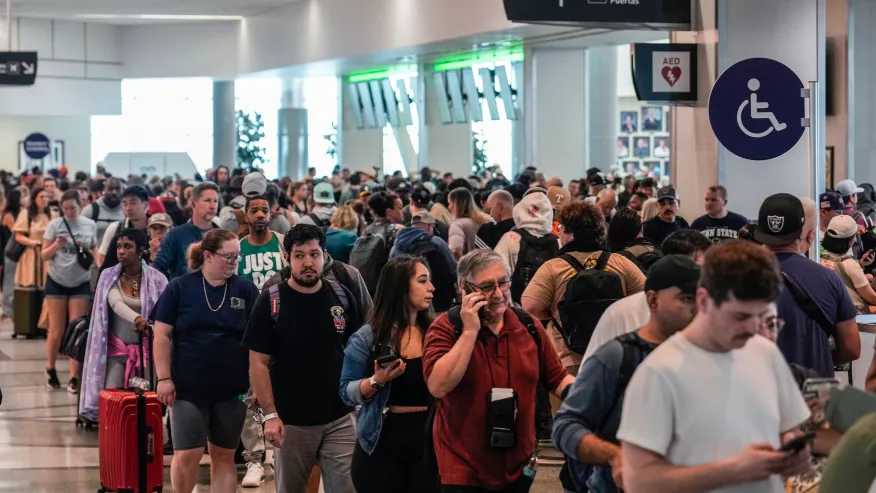
Recent reports show that long lines are now common at major airports like Atlanta, New York, Los Angeles, and Dallas. In some cases, security lines have stretched far beyond checkpoints into baggage claim areas and parking zones, signaling how severe the congestion has become.
The situation is further worsened by external factors. Severe storms have already caused hundreds of flight cancellations, especially impacting major airline hubs. When delayed passengers re-enter the system, it creates a domino effect — overcrowded terminals, rescheduled flights, and even longer TSA queues.
The Hidden Crisis: TSA Workers Unpaid but Still Working
One of the most concerning aspects of the DHS shutdown is that TSA officers have missed full paychecks while continuing to operate security checkpoints. This raises serious questions about sustainability. While workers are expected to receive back pay once funding resumes, the immediate financial strain cannot be ignored.
This situation is not just about fairness — it directly impacts efficiency. A workforce under financial and emotional stress is more likely to face burnout, which can slow down screening processes and increase wait times for passengers.
Airport Security vs Aviation Security: A Critical Difference
Many travelers assume airport security and aviation security are the same, but they are not. Airport security refers to the screening process at checkpoints, while aviation security includes a much broader system — intelligence gathering, risk assessment programs, air marshals, and passenger vetting systems.
The TSA plays a critical role in both. Programs like Secure Flight and TSA PreCheck are part of a larger risk-based security strategy designed to identify threats before they reach the checkpoint. This layered approach ensures that aviation security remains intact even when airport operations face challenges.
Can Privatizing Airport Security Solve the Crisis?
The ongoing shutdown has reignited debate around privatizing airport security screening. The TSA already offers a Screening Partnership Program (SPP), which allows airports to hire private contractors to manage security checkpoints while still following TSA standards.
Airports like San Francisco International and Kansas City International have already adopted this model. Interestingly, these airports have continued operating smoothly during the shutdown, largely unaffected by federal funding issues.
This has led some policymakers to question whether expanding privatization could reduce dependency on federal staffing and make airport operations more resilient during political disruptions.
Does Privatization Reduce Security?
One of the biggest concerns raised by critics — especially unions representing TSA workers — is whether private contractors can maintain the same level of security. However, there is currently no strong evidence to suggest that privatized screening is less effective.
The key reason is simple: TSA still sets all security protocols. Private contractors do not create their own rules; they strictly follow federal guidelines. The only difference is who performs the screening, not how it is done.
This means privatization could potentially improve operational stability without compromising safety, though debates around cost savings and workforce impact remain unresolved.
TSA PreCheck and Risk-Based Screening Still Play a Key Role
Amid the chaos, programs like TSA PreCheck continue to provide some relief for travelers. These programs are based on risk-based security principles, where passengers who voluntarily provide background information can move through expedited screening lanes.
PreCheck lanes are typically faster and more efficient, helping reduce congestion at standard checkpoints. However, even these lanes are starting to feel pressure as overall airport traffic increases and staffing challenges persist.
Real Impact on Travelers: Delays, Stress, and Uncertainty
For travelers, the consequences are immediate and frustrating. Many passengers are now arriving at airports hours earlier than usual, only to still face long lines. Missed flights, delayed connections, and overcrowded terminals are becoming more common.
The uncertainty is perhaps the biggest challenge. Without a clear timeline for when the DHS shutdown will end, travelers are left guessing how much extra time they need to budget for airport security.
Airlines and airports are also feeling the pressure, as operational delays ripple across the entire travel ecosystem.
What Happens Next?
The DHS shutdown will eventually end, and TSA workers are expected to receive back pay. However, the current situation has exposed a critical weakness in the system — heavy reliance on federal staffing without a strong backup during political disruptions.
As a result, the conversation around privatization, workforce stability, and airport efficiency is likely to intensify in the coming months.
For now, travelers should prepare for continued disruptions. Arriving early, staying updated on flight changes, and considering programs like TSA PreCheck may help reduce some of the stress.
But unless the funding deadlock is resolved soon, airport wait times could remain elevated — turning what used to be a routine travel step into one of the biggest headaches of 2026.

Make Swikblog your go-to source on Google for reliable updates, smart insights, and daily trends.