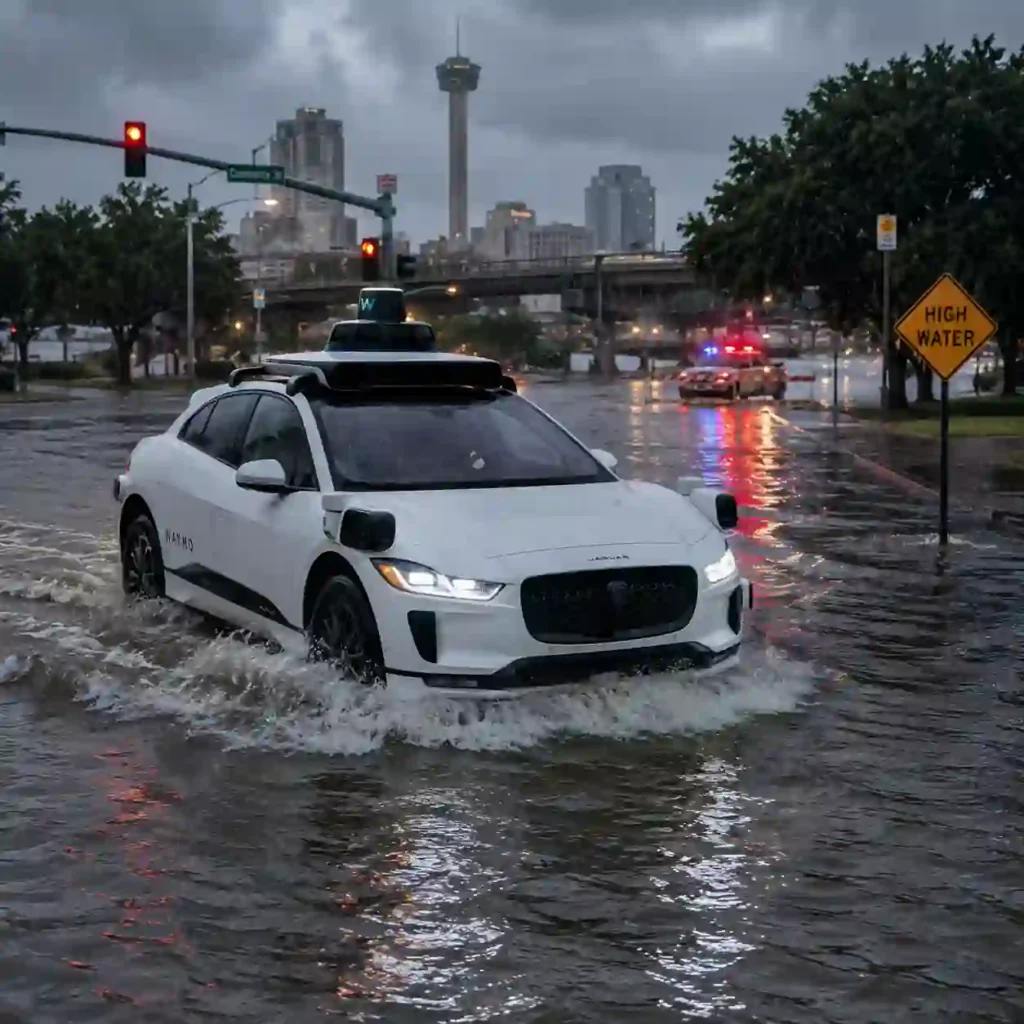

Waymo is recalling nearly 3,800 robotaxis across the United States after one of its autonomous vehicles drove into a flooded road during severe weather in Texas, adding fresh pressure on the self-driving car industry as regulators continue investigating multiple incidents involving autonomous vehicles.
The incident happened on April 20 in San Antonio, Texas, where torrential rain caused widespread flash flooding and submerged several roads across the city. According to reports, a Waymo robotaxi entered a flooded roadway despite dangerous conditions. No passengers were inside the vehicle at the time, and no injuries were reported, but the event prompted an internal review by the company and triggered a software-related recall.
Waymo said the issue was linked to how its autonomous driving software handled flooded roads and severe weather scenarios. The company acknowledged that additional safeguards were needed to prevent vehicles from entering areas affected by flash flooding.
“We are working to implement additional software safeguards and have put mitigations in place, including refining our extreme weather operations during periods of intense rain, limiting access to areas where flash flooding might occur,” Waymo said in a statement.
The recall affects vehicles using Waymo’s autonomous driving system in several U.S. cities where the company currently operates robotaxi services, including Phoenix, San Francisco, Los Angeles and Austin. The software update is expected to improve how Waymo vehicles recognize dangerous flood conditions and react during extreme weather events.
According to the National Highway Traffic Safety Administration, Waymo has already started implementing corrective measures. Those include increasing weather-related operating restrictions, updating maps to better identify flood-prone locations and refining how the vehicles respond during heavy rainfall.
Why the Texas incident raised concerns
Floodwater remains one of the biggest challenges for autonomous driving systems because road conditions can change rapidly and visual sensors may struggle to determine water depth accurately. Human drivers are often advised to avoid driving through standing water because even shallow flooding can disable a vehicle or hide road damage underneath.
For robotaxis, the challenge is even more complex. Autonomous systems rely on cameras, radar, lidar sensors and detailed mapping data to make driving decisions. But extreme weather can interfere with visibility, distort sensor readings and create situations that were not fully anticipated during testing.
The San Antonio incident showed that even advanced autonomous systems can still face limitations in unpredictable real-world conditions. While the Waymo vehicle reportedly slowed down before entering the flooded area, regulators and safety experts are likely to focus on why the system failed to avoid the road entirely.
The recall also highlights how autonomous vehicle companies are increasingly being judged not only on everyday driving performance but also on how safely they handle rare and dangerous edge-case scenarios.
Waymo has spent years positioning itself as one of the leaders in autonomous transportation. The company currently provides fully driverless ride-hailing services in multiple cities and continues expanding operations into more crowded urban environments and regions with more complicated traffic conditions.
As robotaxi competition intensifies, companies are under pressure to prove that self-driving technology can safely operate without human intervention in nearly all situations, including heavy rain, flooding and emergency traffic conditions.
Waymo already facing multiple investigations
The recall comes during a period of growing scrutiny for the autonomous vehicle industry. Waymo is already under investigation by federal regulators following other safety-related incidents involving its robotaxis.
Earlier this year, the National Highway Traffic Safety Administration opened an investigation after one of Waymo’s autonomous vehicles reportedly struck a child near a school in California. Authorities are reviewing how the system responded in a sensitive pedestrian-heavy environment.
Separately, the National Transportation Safety Board is investigating another incident that reportedly took place in Texas earlier this year. According to reports, Waymo vehicles allegedly passed a stopped school bus while its flashing stop lights were activated — a serious traffic violation that can endanger children crossing the road.
Those incidents, combined with the latest flood-related recall, are likely to intensify questions about whether autonomous driving systems are ready to operate at larger scale across American cities.
The broader self-driving industry has already faced setbacks in recent years as regulators increase oversight and cities demand stronger safety accountability from robotaxi operators. Companies developing autonomous vehicles argue that self-driving systems can eventually reduce accidents caused by human error, but critics say the technology still struggles with unpredictable real-world situations.
For readers following the rapidly changing autonomous vehicle market, Swikblog recently covered how transportation and mobility companies are increasing investments in driverless technology in this report on Uber’s growing robotaxi strategy.
Waymo’s latest recall may ultimately be resolved through software updates, but the incident is another reminder that autonomous driving technology is still evolving. As robotaxi services expand into new cities and more difficult weather environments, companies will face increasing pressure to prove their systems can respond safely when conditions suddenly become dangerous.
The Texas flood incident did not result in injuries, but it demonstrated how quickly confidence in autonomous technology can be tested when software decisions meet unpredictable real-world hazards. For Waymo and the wider self-driving industry, the focus now shifts to whether these systems can improve fast enough to earn long-term public trust.

Make Swikblog your go-to source on Google for reliable updates, smart insights, and daily trends.