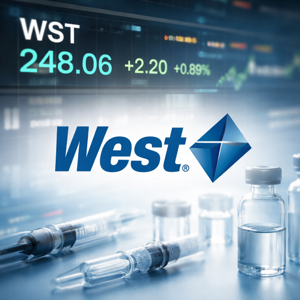

West Pharmaceutical (NYSE: WST) rallied to $248.06, up 0.89% intraday, after news broke that long‑time CEO Eric Green will retire in 2026 and the company initiates a succession process, sparking fresh investor interest and stock momentum.
Shares in West Pharmaceutical Services have demonstrated surprising resilience amid leadership transition speculation, climbing 2.20 points and drawing renewed focus on the pharmaceutical components maker’s future growth path. With markets digesting both the retirement announcement and West’s strategic positioning in high‑growth drug delivery markets, the stock’s performance suggests optimism rather than sell‑off.
Investors tracking West (WST) should balance near‑term sentiment with fundamental analysis, particularly given the company’s role supplying critical components for injectable therapies, including GLP‑1 and other biologic drugs. Below, we unpack the latest market drivers, leadership changes, valuation outlook, and what comes next for WST stock holders.
Leadership Transition and Market Reaction
On March 9, it was confirmed that West Pharmaceutical’s CEO Eric M. Green plans to retire once his successor is appointed, marking the end of an 11‑year tenure at the company’s helm. According to reporting by Reuters, Green’s retirement has been framed as a planned leadership evolution rather than a sudden exit, with an executive search firm engaged to identify the next CEO.
Investors reacted positively to the news, driving the stock to today’s levels. The narrative among traders is that a structured succession process minimizes disruption and allows West to pursue its strategic objectives with continuity.
Key Financial and Market Indicators
West Pharmaceutical’s recent stock performance reflects underlying demand for its core offerings: precision components for injectable drugs and advanced drug delivery systems. As markets increasingly prioritize healthcare innovation, companies like West sit at the intersection of strong fundamentals and secular growth trends.
- Current stock price: $248.06 (+0.89%)
- Market capitalization: $17.866 billion
- Forward dividend & yield: 0.88 (0.36%)
- PE ratio (TTM): 36.53
- EPS (TTM): 6.79
- 52‑week range: 187.43 – 322.34
These figures indicate robust earnings quality, albeit at a premium valuation compared with peers. West’s forward guidance reaffirmed earlier forecasts, signaling confidence in near‑term revenue growth even as GLP‑1 demand expansion moderates relative to 2025 peaks.
The GLP‑1 Market and West’s Strategic Position
One of the most significant drivers of West’s recent financial performance has been its exposure to GLP‑1 therapy markets. These therapies, used in obesity and diabetes treatment, have surged in adoption, fueling demand for drug delivery components where West holds a leadership position.
Despite a slowdown in the growth rate of GLP‑1 demand compared to the unprecedented figures seen in 2025, West has reiterated its confidence in sustained long‑term growth. Analysts see this segment as a key catalyst for revenue diversification—especially as new biologics enter the market and require specialized delivery technology.
Valuation Debate: Is WST Too Expensive?
Despite strong growth indicators, valuation metrics such as a mid‑30s PE ratio compared with industry peers have prompted debate among investors. Some argue that at today’s prices, WST reflects high expectations for future expansion, while others see the valuation justified by the company’s essential role in high‑growth therapy markets.
Long‑term holders may view the valuation as a reasonable price for exposure to healthcare innovation and defensive earnings streams. Short‑term traders, however, will likely focus on technical resistance levels and reaction to macroeconomic data influencing broader market sentiment.
Market Drivers Beyond Leadership Change
Beyond executive turnover, other catalysts are shaping West’s near‑term outlook:
- Healthcare demand stability. Aging populations and persistent chronic conditions continue to underpin demand for injectable therapies.
- Biologic pipeline expansion. A rising number of biologic drugs entering clinical and commercial phases points to increasing demand for West’s components.
- Resilience in defensive sectors. Healthcare stocks often show strength when broader markets are volatile, attracting capital from risk‑off investors.
These factors contribute to a narrative where West could outperform less resilient sectors even amidst macroeconomic uncertainty.
Technical Levels To Watch
From a technical standpoint, WST’s climb above $245.86 earlier in the session indicated strength. Support around $240 might serve as a key level if profit‑taking emerges. Resistance near the 52‑week highs could determine whether WST resumes a broader uptrend.
Traders are also watching volume patterns and relative strength indicators to gauge institutional interest. A breakout above recent highs with sustained volume could attract additional momentum buyers.
Investor Sentiment and Future Outlook
Investor sentiment is currently tilted toward cautious optimism. Leadership changes often introduce uncertainty, but West’s structured transition process and continued focus on core markets have helped maintain confidence. Future catalysts could include contract expansions, new product launches in delivery systems, and favorable updates in biologics adoption rates.
For those interested in a broader look at the healthcare sector’s resilience and factors influencing equities, check out our related piece on Healthcare Sector Trends for 2026.
You May Also Like:

Make Swikblog your go-to source on Google for reliable updates, smart insights, and daily trends.