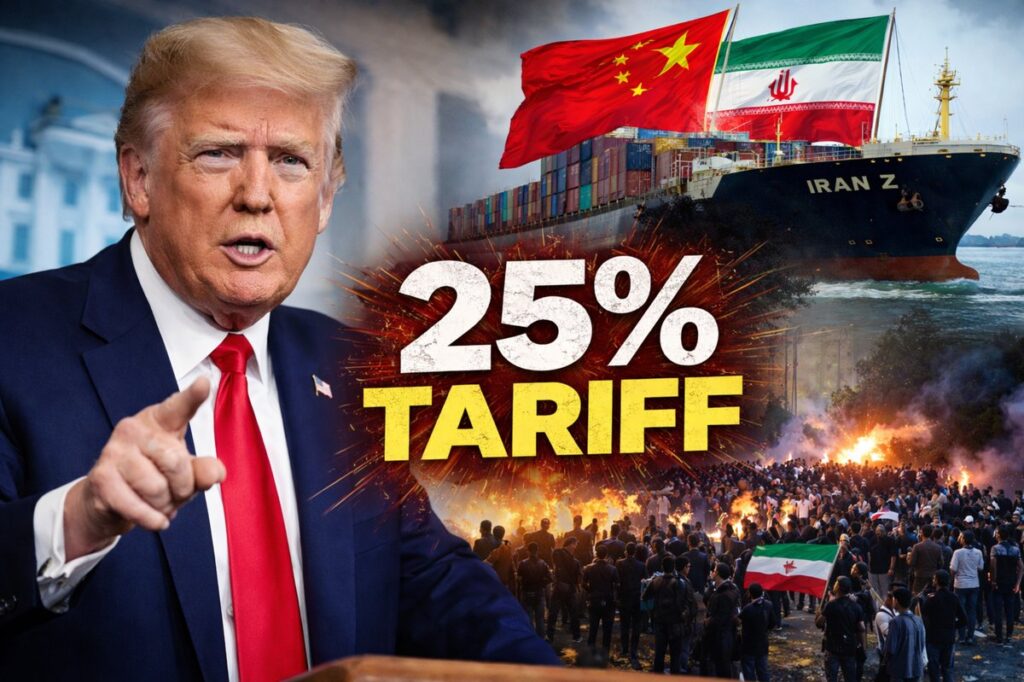

Washington — Former US president Donald Trump has announced a sweeping new trade threat, declaring that any country continuing to do business with Iran will face a 25% tariff on trade with the United States, following what he described as a deadly crackdown on anti-government protests inside the country.
The announcement marks a sharp escalation in Washington’s response to the unrest in Iran, where human rights groups say hundreds of protesters have been killed during nationwide demonstrations that erupted earlier this month.
Trump said the tariff would take effect “immediately,” warning that the United States would no longer tolerate economic engagement with Tehran while security forces “fire on their own people.”
A broad threat with major global implications
The tariff proposal targets not Iran directly, but its trading partners — a move that could reshape global trade flows if enforced. Countries maintaining commercial ties with Tehran would see their exports to the US subjected to the new 25% duty.
What remains unclear is how broadly the policy would be applied. Trump has not specified whether the tariff would affect all nations trading with Iran or focus on its largest partners, which include China, India and Turkey.
Economists warn that if the tariff is layered on top of existing US trade duties, American importers could face sharply higher costs, with knock-on effects for consumers and global supply chains.
China pushes back
China, Iran’s largest trading partner, reacted swiftly. Beijing said it would take “all necessary measures” to safeguard its interests, warning that trade wars and coercive tariffs ultimately harm all sides.
In a statement posted by the Chinese embassy in Washington, officials said China opposes the “indiscriminate imposition of tariffs” and called for political solutions rather than economic pressure.
The response raises the prospect of renewed trade tensions between Washington and Beijing at a time when global markets are already on edge.
Unrest inside Iran and rising death toll
The tariff announcement follows days of intense unrest across Iran, including major protests in cities such as Mashhad. Demonstrations were sparked by long-standing grievances over economic hardship, corruption and political repression.
Human rights organisations estimate that at least 648 protesters have been killed in clashes with security forces, though they warn the true number could be significantly higher.
A near-total internet blackout imposed by Iranian authorities has made independent verification difficult. International media, including the BBC, are unable to report freely from inside the country, relying instead on eyewitness accounts and limited video footage.
Military options discussed behind the scenes
According to US officials briefed on the matter, Trump has also received briefings on a range of military and covert options should the situation deteriorate further.
These reportedly include long-range missile strikes, cyber operations and psychological tools designed to pressure the Iranian leadership without a full-scale military intervention.
Trump has warned in recent days that the killing of protesters could trigger a stronger US response, and his national security team is expected to meet to assess next steps.
Legal questions at home
The legality of the proposed tariff is already being questioned by legal experts. Trump is expected to rely on emergency economic powers to justify the move — the same mechanism used for previous tariffs that are currently under legal challenge in US courts.
A ruling on those earlier tariffs could come within days, potentially setting a precedent that affects whether the Iran-related trade penalties can survive scrutiny.
Iran signals openness — and defiance
Iran’s foreign minister said Tehran remains open to talks with Washington but stressed that the country is also “prepared for war” if threatened.
Supreme Leader Ayatollah Ali Khamenei has vowed that the Islamic Republic will not back down, accusing foreign powers of exploiting unrest to weaken the state.
For now, Trump’s tariff threat stands as one of the most aggressive economic measures proposed against Iran in years — one that could strain alliances, disrupt trade and push an already volatile crisis into dangerous new territory.
Related: North London Derby trends and global reaction stories
Read more: BBC News coverage on Iran protests | CBS News reporting on US policy options

Make Swikblog your go-to source on Google for reliable updates, smart insights, and daily trends.