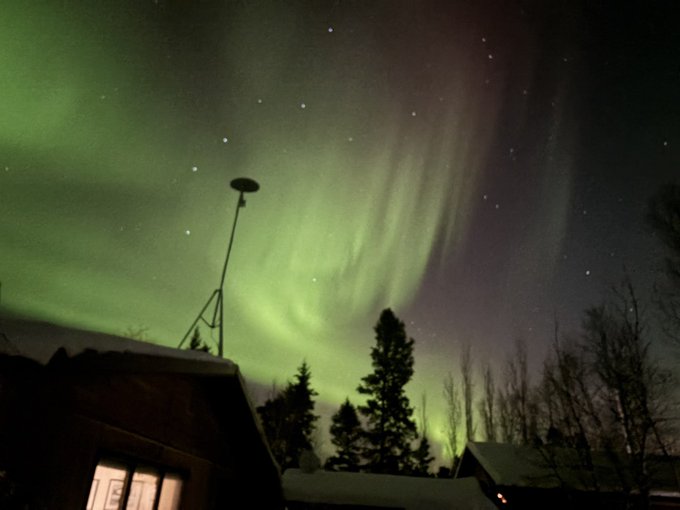
The #northernlights were spectacular tonight north of ThePasMb.
Residents across Metro Vancouver were treated to a rare and dazzling light show this week as the aurora borealis shimmered across the night sky, painting waves of green and violet above the region. For a city that rarely sits under strong geomagnetic activity, the sudden appearance of the northern lights sparked excitement among skywatchers and photographers alike.
The unexpected display followed heightened solar activity observed by National Oceanic and Atmospheric Administration’s Space Weather Prediction Center, which recorded a powerful R3 strong solar flare earlier in the week. That burst of solar energy triggered geomagnetic disturbances strong enough to push auroral visibility much farther south than usual — including into parts of southern British Columbia.
The #northernlights were spectacular tonight north of ThePasMb. @MurphTWN @KMacTWN #AuroraBorealis #ShareYourWeather pic.twitter.com/j5hP3E02FS
— Alan McLauchlan (@AlMclauchlan123) February 5, 2026
Clear skies amplified the spectacle. With cloud-free conditions across Metro Vancouver on the night of February 5, residents were able to spot faint but unmistakable ribbons of colour rippling above treetops and city skylines. Long-exposure photography revealed even richer tones, turning the aurora into a viral moment across social media.
Local aurora chasers described the display as unusually vivid for the region. Some reported emerald arcs stretching low across the horizon, while others caught fleeting flashes of purple — colours typically reserved for more intense geomagnetic storms farther north.
Why Vancouver saw the northern lights
According to forecasts from University of Alaska Fairbanks, highly active auroral displays were expected across northern Canada during this window, with the viewing zone dipping southward under favorable conditions. While cities like Yellowknife, Iqaluit, and Winnipeg sat directly under the strongest activity, observers in Vancouver benefited from a rare overlap of solar strength and clear weather.
The university’s online aurora monitoring map shows the likelihood of auroral visibility expanding into the Pacific Northwest during geomagnetic upticks. Even when the aurora appears faint to the naked eye, modern smartphone cameras and DSLRs often reveal striking detail.
Could the aurora return tonight?
Space weather forecasters say it’s possible. The Space Weather Prediction Center logged multiple minor geomagnetic storms overnight and indicated the potential for additional activity. Combined with another stretch of clear skies forecast for the region, Vancouverites may have another opportunity to spot the elusive glow — especially in darker areas away from city lights.
For the best chance, experts recommend watching between 10 p.m. and 2 a.m., looking north toward darker horizons. Elevated viewpoints, coastal areas, and parks can significantly improve visibility.
The northern lights could become visible across parts of 11 northern U.S. states from Thursday, February 5, into Friday, February 6, 2026, after federal space-weather forecasters issued a geomagnetic storm watch. The best chance of seeing the aurora will depend on the storm’s strength, local cloud cover and how far observers are located from city lights.
The alert was linked to increased solar activity capable of disturbing Earth’s magnetic field. When charged particles from the Sun interact with gases in the upper atmosphere, they can create glowing bands of green, red, pink or purple light known as the aurora borealis.
Northern Lights Alert: 11 States May See Aurora Thursday
— Forbes (@Forbes) February 5, 2026
The northern lights may be seen in U.S. states Thursday, Feb. 5, through Friday, Feb. 6, after the National Oceanic and Atmospheric Administration (NOAA) issued a geomagnetic storm watch. https://t.co/3tnliYdJVG
(Photo:… pic.twitter.com/SWNAmsnvRB
Read More
Which states may see the northern lights?
The strongest viewing potential is expected across the northernmost parts of the United States. Areas that may have a chance include Alaska, Washington, Idaho, Montana, North Dakota, Minnesota, Wisconsin, Michigan, New York, Vermont and Maine.
Visibility is not guaranteed throughout each state. The aurora is usually easier to spot in communities near the Canadian border, while locations farther south may only see a faint glow close to the northern horizon.
Forecast maps show the possible southern boundary of auroral activity rather than confirming that the lights will appear everywhere inside that area. Conditions can change quickly as incoming solar material reaches Earth.
Why a geomagnetic storm can produce auroras
A geomagnetic storm occurs when energy from the Sun disrupts Earth’s magnetosphere, the protective magnetic region surrounding the planet. These disturbances are commonly associated with fast solar wind or coronal mass ejections, which are large releases of plasma and magnetic material from the Sun.
During stronger periods of activity, the auroral oval surrounding the polar region can expand toward lower latitudes. This allows the northern lights to appear in places where they are normally uncommon.
The National Oceanic and Atmospheric Administration’s Space Weather Prediction Center monitors solar eruptions, geomagnetic conditions and possible effects on satellites, radio communications, navigation systems and electrical infrastructure.
A storm watch means forecasters believe the required conditions may develop. It does not mean a geomagnetic storm has already reached its predicted intensity. Officials continue to evaluate solar-wind speed, magnetic orientation and real-time satellite measurements as the event approaches.
Best time and conditions for viewing
Aurora viewing is generally best during the darkest overnight hours, often between approximately 10 p.m. and 2 a.m. local time. However, short periods of activity may occur earlier or later, and the brightest display can sometimes last only a few minutes.
Observers should find a safe location with a clear view toward the north. Rural areas, open fields, elevated ground and lakeshores usually offer better visibility than brightly illuminated neighbourhoods.
Moonlight, clouds, haze and artificial lighting can make a weak aurora difficult to see. Even under clear skies, the display may look like a pale grey or greenish haze to the naked eye rather than the vivid colours commonly captured in photographs.
Smartphone cameras may detect more colour because their sensors can gather light over a longer exposure. Using night mode, keeping the phone steady and avoiding direct streetlights can improve the result.
People following this event may find additional viewing guidance in this guide to northern lights forecasts and viewing conditions, which explains how geomagnetic strength, location and darkness affect the chances of seeing an aurora.
Forecasts can change at short notice
Aurora predictions remain less certain than ordinary weather forecasts because scientists cannot fully measure the speed and magnetic structure of incoming solar material until it moves closer to Earth. A small change in the direction of its magnetic field can significantly strengthen or weaken a geomagnetic storm.
People hoping to watch the display should check updated NOAA aurora maps and local weather conditions shortly before going outside. A clear northern sky and a darker location may be just as important as the storm forecast itself.
While auroras are never guaranteed this far south, this week’s surprise has reminded locals that sometimes the night sky still has a few tricks left — even over one of Canada’s brightest cities.
If the solar winds cooperate again, Vancouver’s skies could light up once more.

Make Swikblog your go-to source on Google for reliable updates, smart insights, and daily trends.