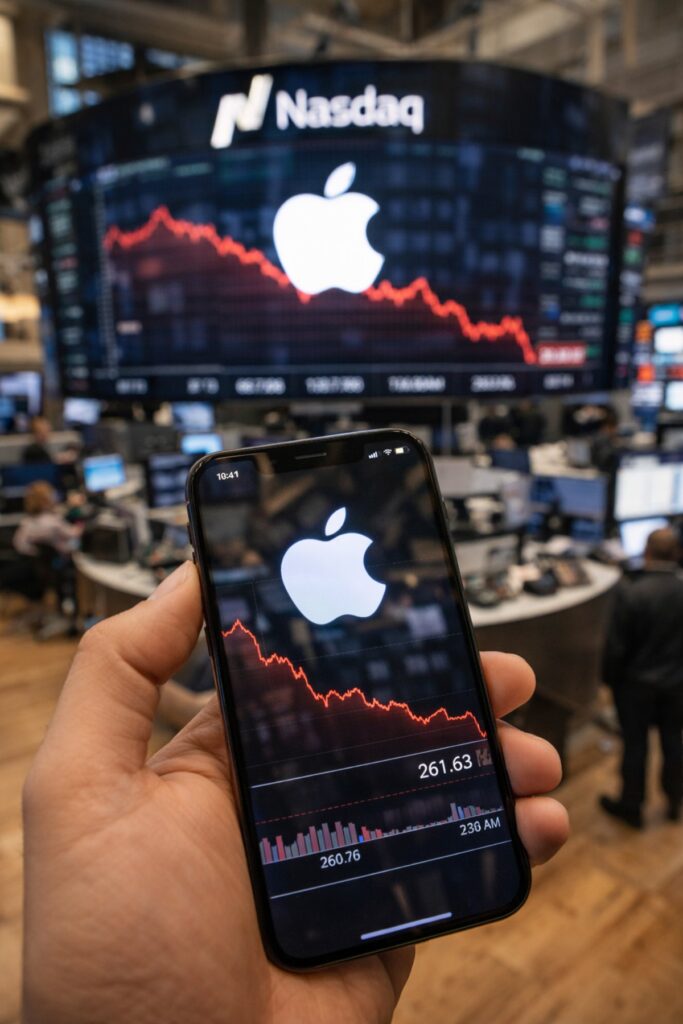

Apple shares slid sharply in Thursday trading, with Apple Inc. (NASDAQ: AAPL) last seen at $261.67, down 5.13% on the day. The move wiped out more than $14 per share from the previous close of $275.50 and left the stock hovering near the low end of its intraday band as selling pressure intensified across mega-cap technology.
The decline unfolded in a session defined by broad risk-off positioning, with investors rotating away from richly valued growth names and repricing near-term expectations around artificial intelligence. Apple, one of the market’s largest index weights, often acts like a “pressure valve” in these moments, amplifying the tone of the wider Nasdaq when flows turn defensive.
Market snapshot
Last price $261.67
Day change -$14.12 (-5.13%)
Previous close $275.50
Day range $260.18 – $275.72
52-week range $169.21 – $288.62
Intraday market cap $3.842T
Volume 48,361,105
Avg. volume 47,980,221
Beta (5Y monthly) 1.11
Intraday trend
This visual summarizes the session’s direction using today’s reported high, low, and last price levels.
What stood out in the tape was the speed of the downdraft after the open. Apple traded as high as $275.72 before sliding toward $260, a range that highlights how quickly momentum shifted. With 48.36 million shares traded versus average volume of 47.98 million, activity was elevated enough to suggest the move was driven by more than retail noise, with institutional flows likely playing a role.
The broader context is that large-cap tech has been carrying a substantial portion of index performance. When traders reduce exposure to the same crowded names at the same time, even a high-quality, cash-generating company like Apple can fall hard in a single session. Apple’s scale amplifies that effect: with an intraday market value around $3.842 trillion, small shifts in risk appetite translate into very large dollar swings.
Valuation and expectations also matter. Apple’s P/E ratio (TTM) of 33.04 and EPS (TTM) of 7.91 reflect a market that continues to price Apple as more than a hardware cycle story. Investors are increasingly attentive to the company’s AI roadmap and services trajectory, and the stock can react sharply when confidence in the timing of new features wobbles, even if the long-term business remains intact.
Income investors tend to view Apple differently than high-yield equities, and today’s numbers reinforce that positioning. Apple’s forward dividend is listed at $1.04 with a yield of 0.38%, which keeps the focus firmly on earnings power and growth expectations rather than income alone. The stock’s beta of 1.11 suggests it can move slightly more than the market over time, and sessions like this show how quickly that sensitivity can appear during tech-led selloffs.
Key calendar dates are now back in the spotlight. Apple’s next earnings date is listed as April 30, 2026, and the market will likely treat upcoming commentary on iPhone demand, services growth, and AI product cadence as a defining narrative for the next leg of trading. Meanwhile, the 1-year target estimate of $293.07 sits well above today’s price, underscoring the gap between near-term volatility and longer-term analyst expectations.
Apple stock stats at a glance
| Metric | Value | Why it matters |
|---|---|---|
| Day range | $260.18 – $275.72 | Shows the intensity of intraday volatility |
| 52-week range | $169.21 – $288.62 | Frames the pullback inside a larger trend |
| Volume vs average | 48.36M vs 47.98M | Confirms broad participation in the move |
| P/E (TTM) | 33.04 | Highlights how expectations can amplify price swings |
| EPS (TTM) | 7.91 | Core profitability baseline investors track |
| Forward dividend and yield | $1.04 (0.38%) | Reinforces growth-first positioning vs high-yield stocks |
The bigger market takeaway is that Apple’s decline is being treated as part of a wider tech de-risking rather than a single-company shock. When investors debate “risk-free” exposure inside the Nasdaq, Apple is one of the first names rebalanced because it is liquid, heavily owned, and large enough to shift index performance. That dynamic can create sharp moves even in the absence of a single headline that fully explains the day.
Apple’s long-running strengths remain the same: deep customer lock-in, premium hardware pricing power, and a services ecosystem that investors link to recurring revenue growth. The immediate focus, however, is on how the market values that story during a volatile tape where AI narratives, interest-rate sensitivity, and mega-cap positioning can dominate price action from one hour to the next.
For readers tracking official updates, Apple posts earnings materials and filings on its investor site at Apple Investor Relations. In sessions like this, that calendar-driven information often becomes the anchor investors return to once the intraday noise fades.

Make Swikblog your go-to source on Google for reliable updates, smart insights, and daily trends.