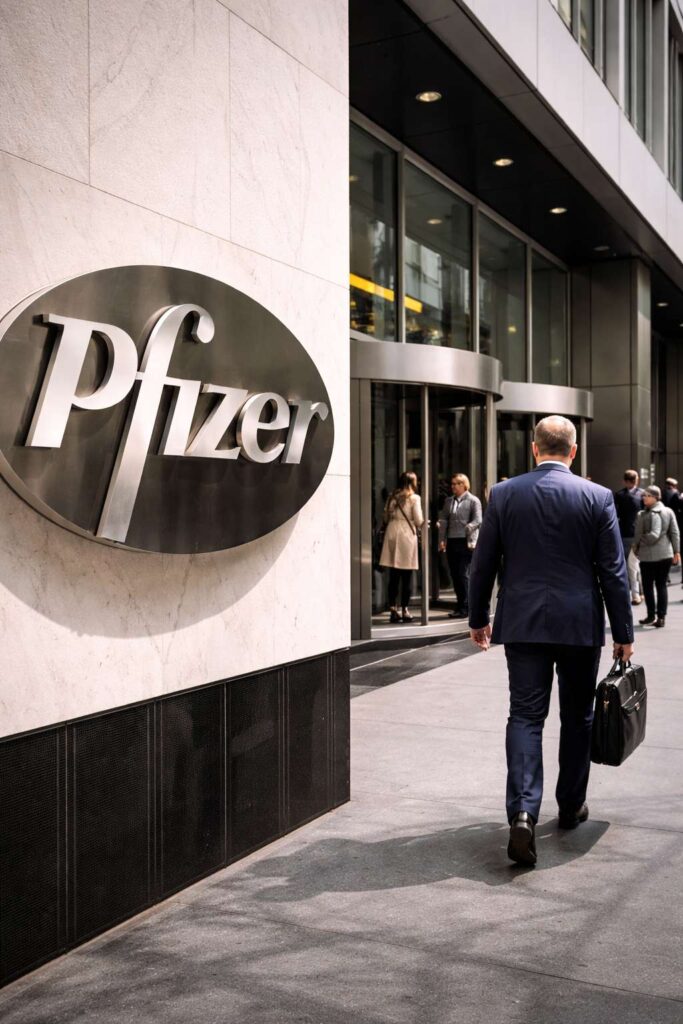

Pfizer (NYSE: PFE) slipped 1.20% to $26.97 on Thursday as investors weighed the drugmaker’s attractive 6.42% dividend yield against ongoing concerns around earnings pressure, patent expirations, and the company’s post-pandemic growth outlook. The stock’s decline came even as Pfizer remains one of the better-performing large pharmaceutical names in 2026, with shares still up about 9.64% year to date.
The move highlights the market’s mixed view on Pfizer right now. Income-focused investors continue to see value in the stock because of its high payout and relatively defensive healthcare profile. At the same time, growth-focused investors remain cautious as the company works to prove that its newer products and pipeline assets can offset fading COVID-related revenue and support a stronger long-term earnings trajectory.
Broader Market Weakness Added to the Pressure
Pfizer’s pullback did not happen in isolation. The healthcare sector declined 1.28% during the session, while the broader S&P 500 fell 1.13%, creating a weak backdrop for the stock. But Pfizer slightly underperformed even within that softer market environment, showing that company-specific concerns are still playing a major role in investor sentiment.
Those concerns are tied to Pfizer’s recent financial profile. Revenue growth has slipped by 1.65%, while earnings per share have declined by 3.55%. Even with those slower growth metrics, Pfizer’s valuation has climbed, with its price-to-earnings ratio rising to 17.92x in the fourth quarter of 2025. That combination has made some investors more cautious, especially as the company tries to transition into its next growth phase.
The 6.42% Dividend Yield Keeps Pfizer Relevant
The biggest reason Pfizer continues to attract attention is its dividend. A 6.42% yield stands out in a market where investors are still looking for dependable income, especially from blue-chip companies with global operations. That payout makes Pfizer appealing not only to traditional dividend investors but also to traders looking to build income strategies around stable, established names.
Still, a yield this high can cut both ways. Bulls see it as a strong source of shareholder return while the company’s pipeline matures. Bears see it as a sign that the market is demanding a higher yield because it is less certain about Pfizer’s growth outlook. That is why dividend sustainability remains a major talking point whenever the stock moves lower.
Pipeline Progress Is Giving Investors Something to Watch
While Pfizer is facing pressure on the financial side, it is still making progress in its pipeline. One of the most notable developments is tilrekimig, the company’s investigational trispecific antibody that has shown promising results in eczema, specifically in moderate-to-severe atopic dermatitis. That update matters because it supports Pfizer’s push into higher-value biologics and reinforces the view that the company is trying to build future growth around newer, innovative therapies.
Pfizer also secured approval in China for Xianweiying, its weight-management drug, giving the company a meaningful foothold in one of the fastest-growing treatment categories in global healthcare. The obesity and weight-management market has become a major battleground for pharmaceutical companies, and entry into China expands Pfizer’s reach in a market with enormous long-term demand potential.
These developments are important because they reflect Pfizer’s strategic shift away from the pandemic-driven revenue base that defined the last few years. Investors want proof that the company can generate its next wave of growth from immunology, obesity, oncology, and other durable treatment categories, and these pipeline wins help keep that thesis alive.
Analyst Sentiment Remains Mostly Neutral
Even with those positive updates, analysts remain cautious on Pfizer. Among 28 analysts covering the stock, 8 have assigned a Strong Buy rating, 1 has a Moderate Buy rating, 16 recommend Hold, and 3 maintain Strong Sell ratings. That breakdown reflects a market that sees both upside potential and meaningful risk.
Most price targets currently range between $24 and $28, which is close to the stock’s present level. That suggests Wall Street broadly expects Pfizer to remain range-bound unless a stronger growth catalyst emerges. In other words, the stock is not being written off, but it is also not being priced for a major breakout.
Covered Call Strategies Are Adding to Investor Interest
Pfizer’s high yield and relatively steady trading pattern have also made it a candidate for covered call strategies. Income investors often favor this setup because it allows them to collect dividend income while also generating additional premium from options.
One example involves buying 100 shares of Pfizer for about $2,723 and selling a May 15 $30 call option for around $0.24. That would generate $24 in premium income, or roughly 0.9% over 65 days, equal to around 10.9% on an annualized basis.
A longer-dated example involves selling a December 18 $30 call for about $1.35, producing income of roughly 5.2% over 282 days, or about 6.7% annualized. If the stock closes above $30 at expiration, the shares could be called away, lifting the total return to about 15.6%, or approximately 20.2% annualized. Those figures do not include any dividends collected along the way, which makes the strategy even more appealing for some investors.
Of course, the risk remains that Pfizer shares could fall enough to erase the option premium gains, so the strategy is not without downside.
Technical Indicators Still Lean Bullish
From a technical standpoint, Pfizer has continued to show some constructive signals. Barchart’s technical opinion currently rates the stock as a 100% Buy, with the strongest short-term outlook indicating the current trend could continue. Long-term indicators are also supportive, suggesting the recent move higher in 2026 has not completely broken down despite today’s weakness.
Implied volatility stands at 25.34%, compared with a 12-month low of 18.25% and a high of 52.17%. That puts Pfizer in a moderate volatility zone, which supports both its income appeal and its attractiveness for options-based strategies.
Insider Activity Also Drew Notice
Pfizer insiders recently reported 14 transactions, including 13 stock awards and one tax payment totaling $21,988.12. The largest award involved 708,666 shares granted to the chief executive officer, which stood out because it was significantly larger than the typical insider transaction. While these awards do not necessarily reflect open-market buying, they often attract attention because investors watch insider activity closely for clues about management sentiment.
Patent Risks and Business Transition Still Matter
Pfizer remains a global research-based biopharmaceutical company with six major business units: Oncology, Inflammation & Immunology, Rare Disease, Hospital, Vaccines, and Internal Medicine. It has also reshaped its business over time by spinning off Upjohn into Viatris and merging its consumer healthcare segment with Glaxo’s unit, moves that made Pfizer smaller but more focused on innovative medicines and vaccines.
That sharper focus is important, but so are the risks. Investors remain concerned about patent expirations, the strength of Pfizer’s post-pandemic product pipeline, and the company’s ability to adapt to regulatory challenges in clinical development. Those issues help explain why the stock can drift lower even when the news flow includes encouraging trial results and international approvals.
What Investors Are Watching Next
At $26.97, Pfizer sits in a position where the dividend is strong enough to keep investors interested, but the growth story still needs more proof. The stock has support from income seekers, pipeline updates, and new product approvals, but it also faces pressure from earnings declines, revenue softness, and concerns about how quickly newer medicines can drive meaningful financial improvement.
For now, Pfizer looks like a stock caught between being a defensive dividend play and a pipeline recovery story. That mix may keep PFE trading in a relatively narrow range until investors get clearer evidence that the company’s next chapter can deliver not just resilience, but growth.
External sources: Pfizer official website and Barchart stock analysis.

Make Swikblog your go-to source on Google for reliable updates, smart insights, and daily trends.