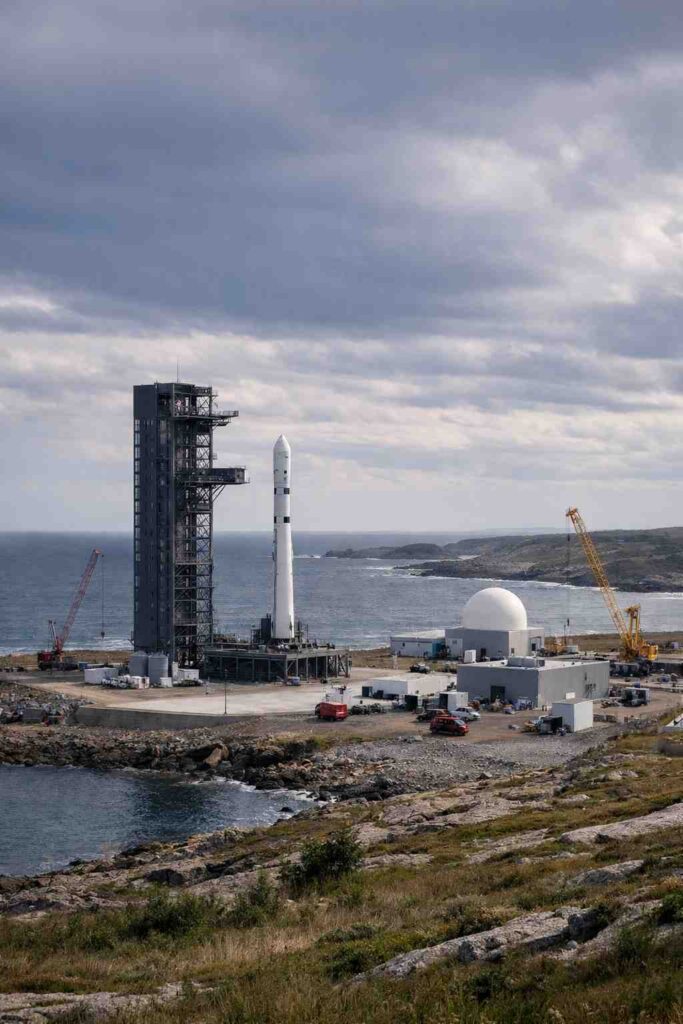

Canada is taking a major step toward building its own satellite launch capability. The federal government has announced a $200 million investment to secure access to a Canadian-owned launch pad near Canso, Nova Scotia — a move that could mark a turning point in the country’s long-standing reliance on foreign launch providers.
The funding will be used over the next decade to lease the launch facility, which will act as the foundation for a future Canadian spaceport. Defence Minister David McGuinty revealed the initiative during a news conference held at a Canadian Space Agency laboratory in Ottawa, describing it as part of a broader strategy to strengthen Canada’s domestic defence and space industries.
Canada moves to reduce reliance on U.S. satellite launches
Despite having one of the world’s most advanced satellite research programs and a long history of space innovation, Canada currently does not have the capability to launch satellites into orbit from its own territory. For decades, Canadian missions have relied heavily on launch services provided by the United States and other international partners.
That dependence has increasingly been viewed as a strategic vulnerability as space becomes more central to defence, communications, climate monitoring and national security operations.
The new federal funding aims to address that gap by supporting a domestic launch infrastructure that could eventually allow Canadian satellites to reach orbit from Canadian soil. The launch pad near Canso — a small coastal community on the northeastern tip of mainland Nova Scotia — has long been discussed as a potential location for a commercial spaceport because of its geographic advantages and open Atlantic launch trajectory.
The investment signals Ottawa’s intention to develop what officials call a “sovereign launch capability,” meaning Canada would have the ability to launch its own missions without depending on foreign launch providers.
$200 million lease agreement to support future spaceport
Rather than directly building a government-owned facility, Ottawa plans to use the $200 million investment to lease a Canadian-owned launch pad located near Canso over the next 10 years. The arrangement allows the federal government to secure launch access while supporting the development of a privately operated spaceport infrastructure.
The site is expected to serve as the cornerstone of a future Canadian spaceport capable of supporting orbital launches for satellites and potentially other missions. Officials say the approach could help accelerate development while allowing the private sector to play a major role in building and operating the launch infrastructure.
The region surrounding Canso has already drawn attention from aerospace companies and space industry planners because of its coastal position, which provides safer downrange flight paths over the Atlantic Ocean during launches.
These geographic advantages make the area particularly attractive for small satellite launches, which are expected to become one of the fastest-growing segments of the global space economy.
Part of broader defence and space strategy
The project is closely tied to the federal government’s wider effort to strengthen Canada’s domestic defence industry and reduce reliance on foreign suppliers in critical technologies.
Defence Minister David McGuinty emphasized that space is increasingly considered a key component of national security. Satellites now support a wide range of essential services including navigation, secure communications, environmental monitoring, disaster response and military coordination.
Without its own launch infrastructure, Canada must depend on other countries to deploy and maintain those systems in orbit.
Developing a domestic launch capability could give the government greater control over mission schedules, national security payloads and emergency satellite deployments.
The investment also reflects a growing recognition among Western governments that access to space is becoming a strategic asset as geopolitical competition expands into orbit.
2025 federal budget already set aside launch funding
The launch pad investment builds on funding announced in the federal government’s 2025 budget, which allocated $183 million over three years to support the development of sovereign space launch capabilities.
Together, the two funding streams represent one of the most significant federal commitments to Canada’s launch infrastructure in decades.
Officials say the funding will help establish the technical and operational foundations required to support Canadian launches, including infrastructure development, regulatory frameworks and industry partnerships.
The initiative also aligns with broader global trends as countries around the world invest heavily in domestic launch capabilities to support growing satellite networks and commercial space activity.
According to the Canadian Space Agency, Canada already plays a major role in satellite development, robotics and Earth observation technologies. However, launch services have historically been sourced internationally.
Potential economic impact for Atlantic Canada
The launch pad project could also have major economic implications for Nova Scotia and the broader Atlantic region.
If the Canso site evolves into a full-scale operational spaceport, it could attract aerospace investment, high-tech jobs and supply chain development tied to rocket launches, satellite integration and ground support infrastructure.
Industry observers say the development of a Canadian launch site could stimulate local engineering services, manufacturing operations and research partnerships with universities.
In addition to direct employment opportunities, spaceport infrastructure typically generates demand for construction, logistics, data processing and tracking systems.
Some industry planners believe that Canada could eventually position itself as a launch provider for small satellite operators seeking flexible alternatives to larger launch providers.
Companies involved in Nova Scotia’s launch ambitions have suggested that the region could serve both domestic missions and international customers in the future.
More details about the private-sector spaceport project near Canso can be found through Maritime Launch Services, which has been working to develop launch infrastructure in the region.
A long road toward Canadian launch independence
While the $200 million commitment marks a major milestone, Canada’s path toward full launch independence will still take time.
Developing a reliable orbital launch capability requires more than infrastructure. Rockets, safety certification, launch licensing, payload integration systems and mission control infrastructure must all be developed or coordinated.
Nevertheless, securing a launch site represents a critical first step.
For decades Canada has been a respected participant in global space exploration but without its own gateway to orbit. The new Nova Scotia launch pad investment signals that Ottawa is beginning to close that gap.
If the project progresses as planned, the quiet coastal community of Canso could eventually become the launch point for Canada’s next generation of satellites — and a new chapter in the country’s space ambitions.

Make Swikblog your go-to source on Google for reliable updates, smart insights, and daily trends.