Tropical Cyclone Narelle has re-formed off Western Australia and is quickly becoming one of the most closely watched weather systems in the country. After an extraordinary journey across northern Australia, the storm has regained cyclone strength near the WA coast and is now forecast to intensify again, with the risk of reaching Category 3 strength as it tracks south. That shift matters far beyond the Pilbara. It puts a growing spotlight on Perth and large parts of southern WA, where heavy rain, rough conditions and a rare late-week cyclone-driven weather pattern are beginning to dominate the forecast.
The immediate concern is not just the cyclone’s strength, but its path. Narelle is moving roughly parallel to the Pilbara coast, a region that carries huge economic significance because of its ports, mining operations and export infrastructure. A system lingering offshore can still create serious disruption through coastal wind, heavy rain bands and dangerous seas, but this one is drawing even more attention because forecasters expect it to bend south later in the week. That kind of movement is unusual enough to make this a major statewide weather story rather than a routine northern cyclone update.
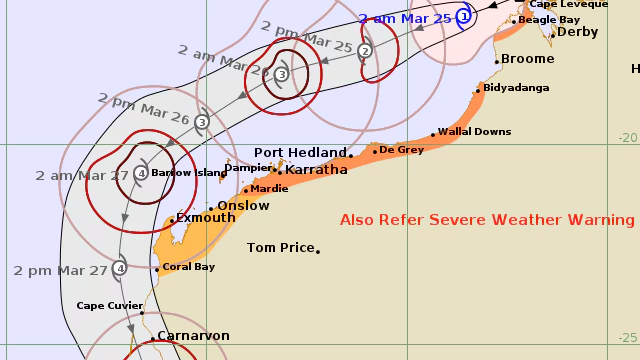
Latest guidance from the Bureau of Meteorology points to strengthening conditions offshore before the system begins turning down the west coast. That forecast has sharpened interest in Perth because southern Western Australia does not often find itself discussed in the same breath as tropical cyclone impacts. The city may not face the core of a severe cyclone in the way northern communities sometimes do, but the broader weather footprint of a system like Narelle can still be significant, especially when deep tropical moisture begins feeding into populated southern areas.
A rare track is lifting concern across WA
Narelle’s cross-country journey has already made it unusual. It formed off Queensland, crossed parts of the north, weakened over land and then re-formed as it moved back over warm water near Western Australia. That alone has made it a standout event, but what is now driving intense public attention is the possibility that its influence will be felt far down the coast. For many readers in Perth, the key point is simple: this is not the sort of cyclone pattern that typically stays confined to the far north.
That does not mean Perth is bracing for a textbook tropical cyclone landfall. It means the city is now within the conversation around widespread rain, strong winds and a volatile weekend forecast tied to a tropical system that still has room to evolve. Forecast confidence tends to fall as a storm curves south, especially when intensity changes are involved, but the signal for disruptive weather is already strong enough to put households, businesses and local authorities on alert.
Perth rain threat is becoming the headline risk
For the capital, rainfall is emerging as the most immediate and most likely impact. Current projections suggest Perth could receive 20 to 50 millimetres of rain on Saturday, with more to follow into Sunday. That would be a substantial weekend soaking for the metro area, and it is the sort of forecast that can quickly reshape local conditions, from traffic and drainage problems to beach hazards and outdoor event disruption. If rain bands become more persistent or the track shifts slightly, totals could change again.
Elsewhere, the numbers look more striking. Parts of the Wheatbelt and Great Southern are in line for 60 to 80 millimetres, with isolated pockets potentially seeing higher falls. Those are the kinds of totals that can trigger local flooding concerns, affect road travel and create difficult conditions for regional communities already sensitive to rapid weather swings. Even where the strongest cyclone winds stay offshore, the rain shield alone has the potential to become the dominant story by the weekend.
The timing is also important. Weather systems moving into populated southern regions late in the week tend to draw more public attention because of the way they intersect with weekend travel, sport, family plans and freight movement. In that sense, Narelle is not just a meteorological event. It is becoming a practical disruption risk for a wide slice of Western Australia.
Why this storm stands out from the usual pattern
Cyclones depend on warm water, and that is one reason southern WA is not usually a primary target zone for tropical systems. As they move south, they often weaken or transition into lower-pressure systems. But even when a cyclone no longer looks like a classic tropical threat, its remnants can still carry enormous amounts of moisture and enough wind energy to create damaging weather over a wide area. That is why Narelle is commanding so much attention. It may not need to remain at peak intensity to produce serious impacts.
The broader history of WA weather adds another layer of caution. Southern parts of the state have seen damaging cyclone-related events before, and people still remember how unusual systems can leave a deep mark long after the headlines move on. That memory tends to sharpen public response whenever a storm starts behaving outside the familiar script. Narelle is doing exactly that.
Preparation now matters more than waiting for certainty
The challenge with a system like this is that people naturally want a precise answer early: exactly where will it go, exactly how strong will it be, exactly which suburbs or towns will take the heaviest rain. Cyclones rarely reward that kind of certainty several days out. What residents can act on now is the growing likelihood of rough weather over a broad area of WA, including the south. Clearing gutters, securing loose outdoor items and paying close attention to forecast updates are sensible steps not because panic is justified, but because changing conditions can quickly turn an unusual weather system into a disruptive one.
That is what makes Tropical Cyclone Narelle such a compelling story for WA right now. It is not only the power of the storm that is drawing attention. It is the reach of the threat, the rarity of the track and the fact that Perth is now part of the weather conversation in a way that feels both uncommon and serious. As the system intensifies offshore and begins its turn south, the state is watching a storm that no longer feels distant.
Investors tracking sharp moves in small-cap and healthcare names may also like EnVue Medical Feed Stock Jumps 35% After Hospital Deal, another stock story that highlights how corporate updates can quickly reshape market sentiment.

Make Swikblog your go-to source on Google for reliable updates, smart insights, and daily trends.