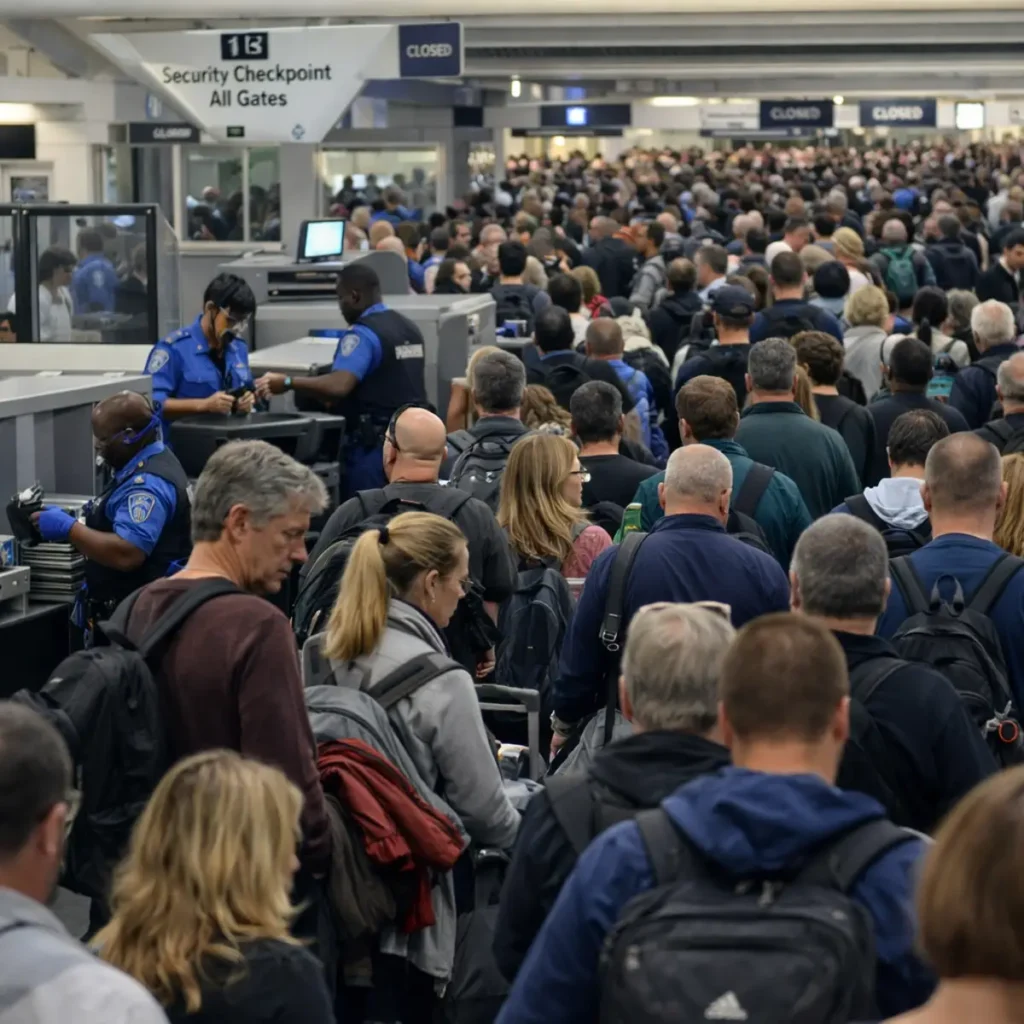

The U.S. travel system is facing a growing crisis, and it is hitting passengers at the worst possible time. More than 480 TSA officers have quit since mid-February, triggering massive disruptions at airports across the country as security wait times surge by as much as 300%.
What was once a routine airport process is now turning into a multi-hour ordeal. From Houston to New York, travelers are reporting wait times exceeding four hours, missed flights, and chaotic terminals — all driven by a deepening staffing crisis inside the Transportation Security Administration (TSA).
This situation is directly tied to the ongoing government shutdown, which has forced around 50,000 TSA officers to work without pay. The result is a dangerous mix of resignations, absenteeism, and operational breakdowns that are pushing the U.S. airport system to its limits. Travelers can check official updates via the TSA travel advisory page or use the MyTSA app for real-time wait times.
Why the TSA crisis is spiraling out of control
The core issue is simple but severe: TSA officers are working without pay, and many can no longer afford to continue. Officials revealed that more than 480 officers have already quit, and the number is rising daily as financial pressure builds.
In some of the most shocking accounts, TSA workers are reportedly sleeping in their cars, selling plasma, or taking second and third jobs just to survive. Despite this, they are still expected to perform high-level security duties under stressful conditions.
This financial strain is directly translating into staffing shortages. National absenteeism has surged past 10%, while some major airports — including New York, Houston, Atlanta, and New Orleans — have reported more than 30% of TSA staff not showing up for work.
4-hour security lines and missed flights becoming normal
The impact on passengers has been immediate and severe. Airports are struggling to keep enough screening lanes open, causing lines to stretch for hours. In several cases, passengers have waited over four hours just to clear security checkpoints.
Houston’s George Bush Intercontinental Airport has become a symbol of the crisis. Travelers there have faced some of the longest wait times in the country, with packed lines stretching through terminals and even underground transit areas. Many passengers have missed flights entirely and had to rebook for the next day.
Airport officials have warned that conditions could worsen, especially during peak travel days. With spring break travel already pushing passenger volumes about 5% higher than last year, the system is under intense pressure.
Why the problem is bigger than just staffing
This is not just about fewer workers — it is about how airport systems function. Security checkpoints depend on synchronized operations across multiple lanes. When staffing drops, fewer lanes open, and passenger flow slows dramatically.
At some airports, less than 50% of screening lanes are operational while handling full passenger loads. That imbalance creates exponential delays, not just linear ones. A small staffing drop can turn into hours of waiting time.
Adding to the challenge, TSA cannot quickly replace workers. New hires require months of training and clearance before they can operate at checkpoints, meaning the system cannot recover quickly even if hiring ramps up.
Government shutdown and political deadlock at the center
The root of the crisis lies in Washington. The Department of Homeland Security (DHS), which oversees TSA, remains caught in a political standoff between Republicans and Democrats over funding and immigration policies.
As negotiations stall, TSA funding remains uncertain. Meanwhile, other agencies like Immigration and Customs Enforcement (ICE) continue to operate with pay, highlighting the uneven impact of the shutdown.
To manage the growing chaos, hundreds of immigration and law enforcement officers have been deployed to assist at 14 major airports. However, experts say these measures are only temporary fixes and cannot fully replace trained TSA personnel.
National Guard deployment and emergency measures
In a sign of how serious the situation has become, former President Donald Trump has suggested deploying National Guard troops to airports to support security operations. While no large-scale deployment has been confirmed, the proposal reflects growing concern at the highest levels of government.
Officials have also warned that if staffing shortages continue to worsen, TSA may be forced to close smaller airports entirely to prioritize major hubs.
World Cup 2026 adds a major risk factor
One of the biggest concerns is timing. The U.S. is set to host millions of international visitors for the 2026 FIFA World Cup, and current staffing levels may not be enough to handle the surge.
TSA leadership has described the situation as a “perfect storm,” warning that new hires will not be ready in time because training takes four to six months. If the current crisis continues, airports could face unprecedented pressure during one of the largest global events.
What travelers should expect now
For passengers, the takeaway is clear: expect delays and plan accordingly. Travelers are being advised to arrive at airports at least three to five hours before departure, especially at major hubs.
The unpredictability is the biggest challenge. Wait times can change rapidly depending on staffing levels, flight schedules, and daily passenger volume. Even traditionally efficient airports may experience sudden disruptions.
Missing a flight is no longer a rare event — it is becoming a real risk in the current environment.
Outlook: A crisis that could get worse
The TSA crisis is not a short-term issue. With more than 480 officers already quitting, rising absenteeism, and ongoing political uncertainty, the situation could deteriorate further.
If the shutdown continues and staffing levels decline further, the U.S. could face the worst airport delays in its history. What started as a funding dispute has now evolved into a nationwide travel disruption affecting millions of passengers.
Until a resolution is reached, one thing is certain: U.S. airport travel will remain unpredictable, stressful, and increasingly time-consuming.

Make Swikblog your go-to source on Google for reliable updates, smart insights, and daily trends.