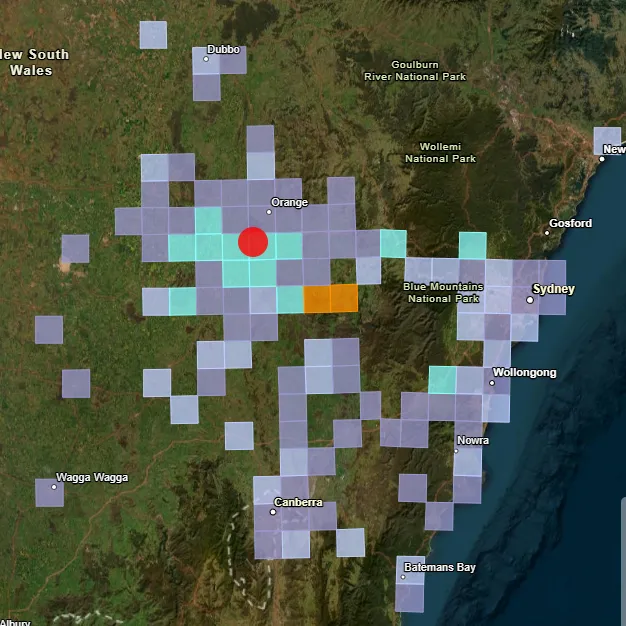

A magnitude 4.5 earthquake south of Orange has shaken homes across New South Wales, with tremors felt over an estimated 400 kilometres and more than 2,000 reports lodged within hours, turning a regional seismic event into the largest recorded in the area and one of the most widely felt in recent years.
The quake struck at about 8:19pm AEST on Tuesday, with its epicentre located east of the Cadia gold mine in the state’s Central West. The event has been described as the largest earthquake on record in the immediate area, overtaking the 4.3 magnitude tremor recorded in 2017 that forced a precautionary evacuation at Cadia and disrupted operations for months.
Residents in Orange, about 35 kilometres north of the epicentre, said homes shook for around 30 seconds as the tremor passed through the region. The shaking was also strongly recorded at Black Springs, west of Oberon, while hundreds of people in Canberra and Sydney reported feeling the quake. Reports also came from Batemans Bay, illustrating how unusually far the seismic movement travelled.
Record tremor felt across a wide stretch of NSW
The scale of the quake is what has pushed it into wider public attention. Seismologists said the shaking ranged from weak to light across a broad corridor stretching from Orange to the New South Wales south coast, with the geographic spread making it an unusually widely felt event for inland NSW.
More than 2,000 people submitted “felt” reports in the hours after the earthquake, giving authorities a rapid picture of its reach. While the tremor was not considered catastrophic, experts said a quake of this size could still cause light damage, including cracked walls, items falling from shelves and minor household disruption, especially in properties closer to the epicentre.
Local reaction reflected that intensity. Blayney Shire Mayor Bruce Reynolds, who lives roughly 12 kilometres from the epicentre, described it as the strongest earthquake he had experienced in the area. He said the house shook violently and the rumble felt as though a truck had struck the building, prompting his family to rush outside.
That response captures why the event has resonated so strongly across the state. Earthquakes do occur in Australia, but in this part of New South Wales they are usually smaller, with around 22 earthquakes recorded within 10 kilometres of this site since the 1960s, mostly in the magnitude two to three range. Tuesday night’s tremor was a clear break from that pattern.
Cadia mine back in focus as aftershocks remain possible
The proximity of the epicentre to Newmont’s Cadia gold mine has also revived questions that surfaced after the 2017 quake. Cadia is one of the largest gold mining operations in the world, and any notable seismic activity in the district quickly draws attention because of the mine’s economic importance and underground workforce.
In a statement, the company said its sensors detected seismic activity at about 8:20pm and that safety procedures worked as intended to protect workers. That reassurance is likely to matter locally, given concerns about what miners underground may have experienced at the time the earthquake struck.
Experts remain cautious about linking the event directly to mining activity. Seismologists say mining can trigger earthquakes in some cases, but establishing a direct connection is difficult and requires more than proximity alone. Geological stress, natural fault movement and human activity can all intersect in ways that are not immediately clear after a single event.
Attention is now turning to aftershocks, which experts say may follow in the coming days. These are expected to decrease in magnitude and frequency over time, though some may still be felt by residents already unsettled by the main shock. That lingering uncertainty, combined with the quake’s record local magnitude and broad impact zone, has made it one of the most significant earthquake events to hit the Orange region in decades. Readers looking for official earthquake monitoring updates can follow developments through Geoscience Australia.

Make Swikblog your go-to source on Google for reliable updates, smart insights, and daily trends.