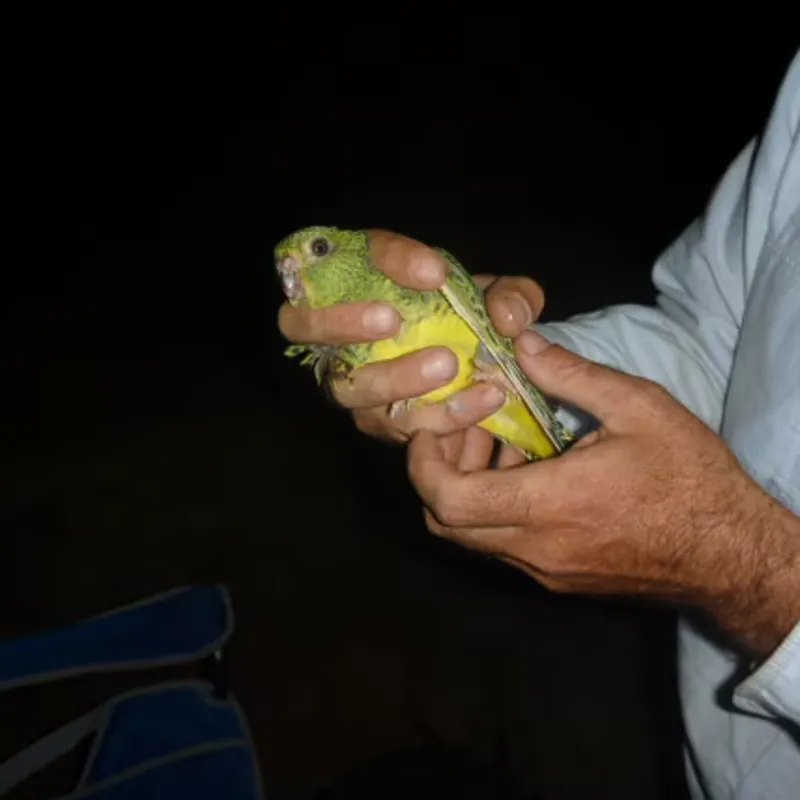

Conservationists in Queensland have been given a rare reason for optimism after researchers detected night parrot calls in a fresh pocket of the state’s far-west, a development that could expand what is currently known about one of Australia’s most mysterious birds. For a species that has spent decades hovering between legend and science, the discovery matters not only because of where it happened, but because it may point to a separate surviving group in the wild.
The night parrot has long occupied a near-mythical place in Australian wildlife history. It was absent from the scientific record for generations and, for years, many assumed it had slipped into extinction. Even after its return to public attention, firm evidence remained scarce. Confirmed records have been few, sightings even fewer, and the bird’s behavior makes it exceptionally hard to study. It moves at night, shelters in dense spinifex country, and leaves behind little for researchers to follow.
That is why the latest breakthrough is so important. Instead of relying on a brief visual encounter, researchers were able to detect repeated calls from the species through acoustic monitoring across remote country in south-west Queensland. The sound evidence is considered highly significant in night parrot work because listening is often far more reliable than trying to physically spot the bird in harsh, low-visibility habitat.
The recordings were picked up during a large-scale field effort spread across cattle properties between Winton and Boulia. Automated devices were placed in the landscape for long periods, quietly capturing wildlife activity that human observers would almost certainly miss. In total, the team gathered an enormous body of material, then worked through the recordings with specialist software designed to flag possible matches. Out of that mountain of data came the calls that now have ecologists convinced they are dealing with a genuine night parrot presence.
What lifts the discovery beyond a routine conservation update is the distance from the best-known Queensland population. Researchers say the newly detected site sits more than 150 kilometres from the established Pullen Pullen area, which has been central to modern night parrot conservation. That separation raises the possibility that this is not simply spillover from a known group, but a distinct sub-population with its own ecological importance. In species recovery, that kind of geographic spread can be crucial. It suggests resilience, genetic value, and a better chance that the bird is persisting in more than one refuge.
Scientists have been careful not to overstate the result. No bird has yet been photographed or directly observed at the new location, and the exact site is being withheld. That secrecy is deliberate. Rare species can be harmed as much by attention as by predators, and those working on the ground are keen to avoid disturbance while also respecting the wishes of the landholder. In a story like this, restraint matters. Public excitement is understandable, but habitat protection comes first.
There is another reason researchers are moving quickly. Heavy rain across south-west Queensland earlier this year may have transformed conditions in a way that benefits the species. Good rain in arid country can trigger grass growth and seed production, and that pulse of food is closely tied to activity in seed-eating birds. For the night parrot, better seasonal conditions may also mean breeding opportunities. Researchers believe that when the birds are breeding, they become more vocal, which improves the odds of detecting them again and learning more about how they use the landscape.
That next stage of work is already taking shape. The immediate goal is not tourism or publicity, but precision. Conservation teams want to understand where the birds are feeding, where they are sheltering during the day, and how large the local group might be. Those answers will shape the response on the ground. If key roosting and foraging zones can be identified, protection efforts can be far more targeted and effective.
A major part of that effort will focus on feral cats, which remain among the most serious threats to small and medium-sized native fauna across inland Australia. For a bird as rare and secretive as the night parrot, even limited predation pressure can have an outsized impact. Conservation managers are expected to work with the landholder on stronger cat control around the habitat, alongside broader measures designed to keep disturbance low.
The find could also influence a bigger debate inside conservation circles. Because the species is so scarce, some experts have previously discussed whether “insurance populations” might eventually need to be created in other parts of the interior. A naturally occurring additional group in Queensland changes that picture. It does not remove the risks facing the bird, but it may mean the species still has more natural footholds than previously confirmed. That would give recovery planning a stronger base and potentially reduce the need for more intervention-heavy strategies.
Beyond the science, the discovery lands with emotional force because the night parrot has become a symbol of both loss and survival in Australia. It represents the fragility of inland ecosystems, but also the possibility that determined fieldwork, patient monitoring, and cooperation with landholders can still produce extraordinary results. In a period when biodiversity news is often grim, a breakthrough like this carries unusual weight.
It also highlights how modern conservation is changing. Technologies such as passive acoustic monitoring are opening windows into species that once seemed almost unknowable. Instead of relying on luck alone, researchers can now scan years’ worth of environmental sound for patterns that point to hidden wildlife. That does not replace field expertise; it amplifies it. In the case of the night parrot, it may be the difference between guessing and knowing.
The species remains listed as critically endangered, and any hope generated by this discovery needs to be matched with long-term protection. According to the IUCN Red List, birds in this category face an extremely high risk of extinction in the wild, which makes every viable habitat and every surviving group matter. Continued collaboration between researchers, conservation groups, and landholders will now be essential.
For readers following Australia’s conservation story, this development is more than a rare wildlife headline. It is a reminder that some of the country’s most remarkable species are still holding on in places few people ever see. And in the case of the night parrot, a bird once written off by history, that persistence may turn out to be one of the most important environmental stories of the year.
You may like: New Zealand’s Rarest Bird Population Grows in Major Conservation Boost

Make Swikblog your go-to source on Google for reliable updates, smart insights, and daily trends.