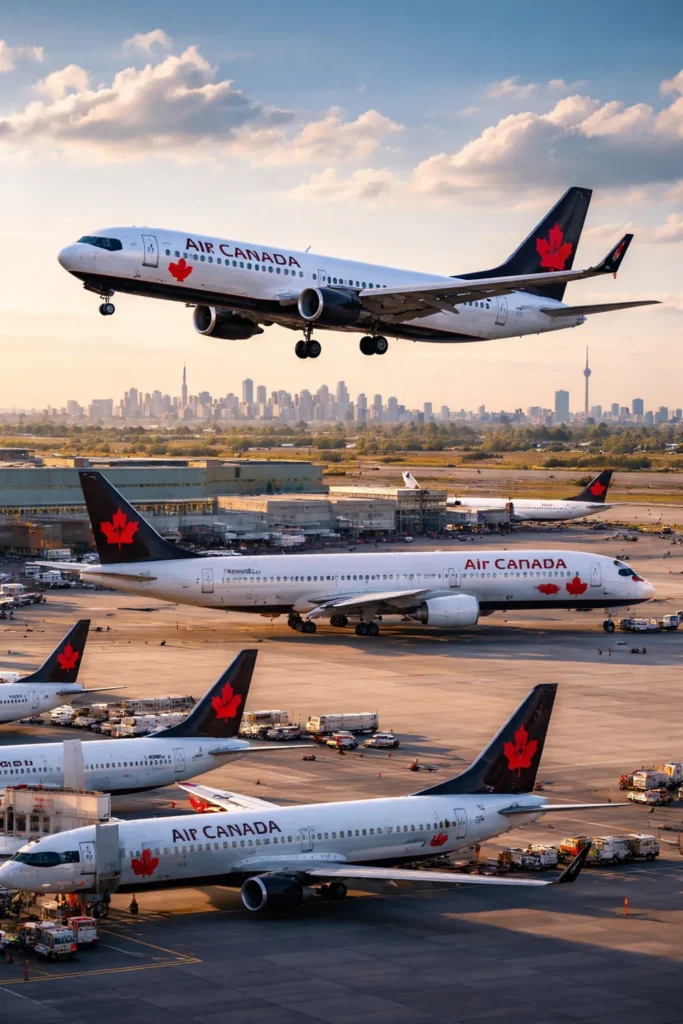

New details are emerging after two passenger flights — one operated for Air Canada Express and the other flying under the American Airlines banner — were forced to abandon their landings at New York’s John F. Kennedy International Airport after a dangerous loss of separation during approach. The episode, which unfolded on Monday afternoon, is now under investigation by U.S. regulators and has renewed attention on how quickly a routine airport arrival can turn into a high-stakes safety event.
The aircraft involved were Republic Airways Flight 4464, operating for American Airlines, and Jazz Aviation Flight 554, operating for Air Canada Express. Both were approaching JFK at roughly the same time and had been lined up for parallel runways, a common practice at large international airports built to handle heavy traffic. American’s regional jet had been cleared for Runway 31 Left, while the Air Canada flight was cleared for Runway 31 Right.
On paper, there was nothing unusual about the setup. Parallel approaches happen every day at major hubs. But they depend on exact track-keeping, disciplined cockpit coordination, and rapid controller response when something starts to drift. According to preliminary reporting, the American Airlines-operated aircraft moved off its intended approach path and entered airspace that brought it too close to the Air Canada flight on the neighboring approach. That is the point at which a normal arrival sequence turned into an urgent conflict.
Air traffic control recordings captured the tension in real time. Controllers can be heard reacting immediately as collision alerts sounded. One instruction was direct and urgent: the Air Canada crew was told to climb and maintain 3,000 feet. In other words, stop the landing, add power, and get away from the runway environment. Almost at the same moment, the pilots reported they were responding to a Resolution Advisory, or RA — the most serious form of warning issued by an aircraft’s onboard traffic collision avoidance system.
Those warnings matter because they are designed for exactly these last-second conflicts. When two aircraft come too close and projected flight paths indicate possible danger, the system gives pilots immediate vertical guidance intended to restore safe separation. It is one of the final layers of protection in commercial aviation, and in this case it appears to have worked exactly as intended. Both crews broke off the approach, climbed away, and later landed safely.
What makes the incident stand out is how small the margin became. Flight-tracking data cited by multiple reports suggested the aircraft were separated by less than one kilometre horizontally and by only a few hundred feet vertically at the closest point. Another estimate placed them about 997.79 metres apart and within 106.68 metres of the same altitude. Numbers like that may sound abstract to non-pilots, but in a landing environment at a major airport, they represent a serious breakdown in spacing that demands immediate corrective action.
Why the JFK incident matters
JFK is one of the busiest and most complex airports in the United States. Controllers there routinely manage tightly sequenced arrivals from domestic and international carriers, often while balancing weather, runway flow, and spacing constraints. Parallel runway operations are efficient, but they leave less room for even small deviations. If one aircraft strays from its intended line, the geometry can tighten fast.
That is why investigators will likely focus on a basic but critical question: why did the American Airlines-operated aircraft miss the intended approach path? The answer may involve cockpit workload, visual alignment, localizer tracking, situational awareness, weather influences, or procedural issues. At this stage, those are only possibilities, and the formal investigation will determine the actual cause. What is already clear is that both crews responded when the warning systems activated, and controllers moved quickly once the conflict became visible.
The Federal Aviation Administration has already confirmed that it is investigating. In its initial statement, the agency said Republic Airways Flight 4464 performed a go-around after missing its intended approach path and flying too close to Jazz Aviation Flight 554, which had been cleared to land on a parallel runway. The FAA also said both crews responded to onboard alerts. Information about how the agency handles runway and approach safety oversight is available through the Federal Aviation Administration, which publishes guidance and safety updates tied to commercial flight operations.
For travelers, a go-around can feel dramatic. One moment the aircraft appears committed to landing; the next, engines spool up, the nose rises, and the runway falls away. To passengers, it can be unsettling. To pilots, though, it is a trained and standard maneuver. Airlines rehearse these scenarios repeatedly because a go-around is often the safest answer when a landing is no longer stable or separation is in doubt. In that sense, the fact that both aircraft landed later without injury is not a small detail — it is evidence that the safety chain held under pressure.
The close call also lands at a time when aviation safety has been receiving closer public scrutiny. Reports tied this episode to a broader conversation after earlier incidents in the New York area, including a deadly runway collision involving an Air Canada Express aircraft and a fire truck at LaGuardia in March. Each event has its own facts, but together they add to growing concern about how little room for error exists in busy airspace and on crowded airfields.
Still, there is an important distinction between concern and panic. Commercial flying remains one of the safest forms of transport, precisely because the system is built with overlapping protections: trained controllers, cockpit discipline, instrument procedures, automated warnings, and mandatory evasive responses when conflicts become acute. Monday’s event did not become a catastrophe because those protections activated in time.
The bigger test now is what comes next. If investigators find a procedural weakness, a training gap, or a technical factor, that conclusion will feed into future safeguards. That is how aviation safety has improved for decades — not by assuming close calls are acceptable, but by treating each one as a lesson that can prevent the next.
For readers tracking aviation, transport, and breaking business stories, more coverage is available at Swikblog. At JFK this week, the headline was not just that two aircraft came too close. It was that in a matter of seconds, human judgment, cockpit technology, and air traffic control combined to stop a dangerous situation from becoming something far worse.
You may also like: Air New Zealand Airpoints Rebrand: What the New Koru Loyalty Program Means for Travelers

Make Swikblog your go-to source on Google for reliable updates, smart insights, and daily trends.