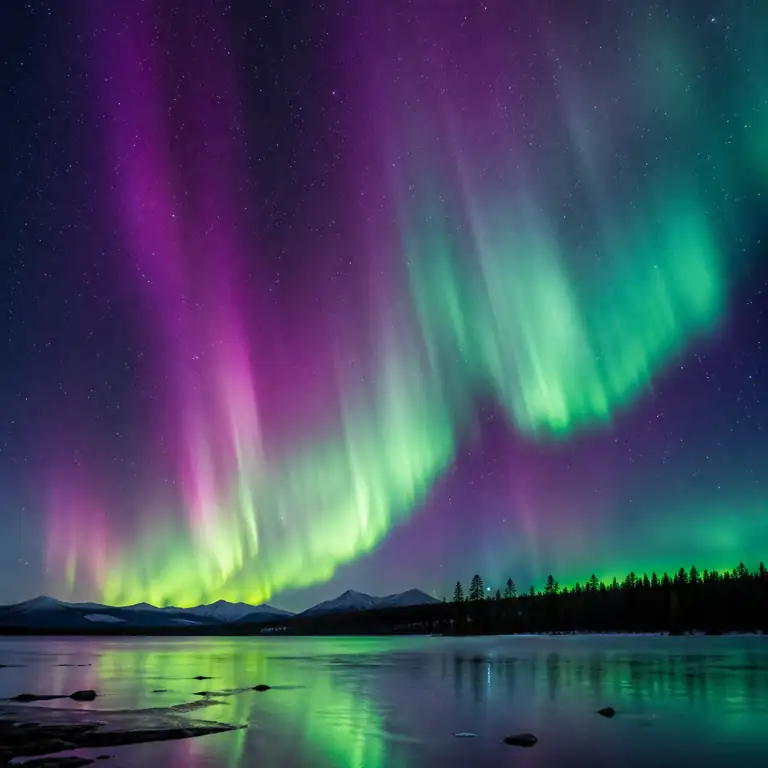

A fresh burst of solar activity could turn Sunday night into a rare skywatching opportunity for millions of Americans, as the Northern Lights may become visible across parts of 24 U.S. states. The aurora borealis is usually associated with Alaska, Canada and far-northern regions, but tonight’s geomagnetic setup may allow the lights to stretch much farther south than normal.
The forecast is being driven by charged particles from the sun moving toward Earth’s magnetic field after recent solar flare activity and a glancing coronal mass ejection. NOAA’s Space Weather Prediction Center said the greatest expected three-hour Kp reading for April 26 through April 28 is around 4.67, which falls near G1 minor geomagnetic storm levels. A G1 storm is the lowest category on NOAA’s five-level geomagnetic scale, but even minor storms can produce noticeable auroras when the sky is dark and the magnetic field aligns favorably.
Readers can follow the latest official space weather updates through the NOAA Space Weather Prediction Center’s 3-day forecast, which tracks Kp levels, geomagnetic storm probabilities and changes in solar wind conditions.
Which states could see the Northern Lights tonight?
The strongest viewing odds remain in Alaska, where aurora displays are more common and often brighter because of the state’s high latitude. In the continental U.S., the best chances are expected across the northern tier, especially in Washington, Idaho, Montana, North Dakota, South Dakota, Minnesota, Wisconsin, Michigan and Maine. These areas are close enough to the auroral oval that even a modest geomagnetic push can bring visible activity.
The forecast zone may also extend into Wyoming, Nebraska, Iowa, Illinois, Indiana, Ohio, Pennsylvania, New York, New Jersey, Connecticut, Rhode Island, Massachusetts, Vermont and New Hampshire. For these states, the display may not appear overhead. Instead, viewers may see a faint green, pale white or reddish glow low in the northern sky, particularly from rural areas with little light pollution.
That difference matters. Aurora forecasts often describe where the lights could be possible, not guaranteed. People in the northernmost counties of a state may have a much better chance than those farther south. A viewer in northern Michigan, for example, is likely to have a stronger opportunity than someone near central Ohio or southern New Jersey. Still, if the solar wind strengthens or the magnetic field turns more favorable, visibility can improve quickly.
The key number behind tonight’s forecast is the Kp index, a global measure of geomagnetic disturbance that runs from 0 to 9. The higher the number, the farther south auroras can travel. A Kp near 5 can bring displays into northern U.S. states, while stronger storms can push them deeper into the country. Tonight’s projected peak near 4.67 places the event near the lower edge of storm conditions, which is why dark skies and clear weather will be so important.
Best time to watch and how to improve your chances
The most favorable viewing window is expected between 10 p.m. and 2 a.m. local time. Aurora activity often strengthens after nightfall and can come in waves rather than staying steady. A quiet sky at 10 p.m. does not mean the show is over. It may brighten suddenly near midnight, fade, and then return again before the early morning hours.
To improve your chances, get away from city lights and look toward the northern horizon. Open fields, lakeshores, hilltops and rural roads can offer better views than neighborhoods filled with streetlights. Even a short drive outside a city can make the difference between seeing nothing and spotting a faint glow.
A clear northern view is especially important for people in the southern edge of the forecast zone. In places such as Illinois, Ohio, Pennsylvania, New Jersey or Connecticut, the aurora may sit low on the horizon, so trees, buildings or hills can block it. The best locations will be dark, open and away from bright parking lots, highways and downtown areas.
Cloud cover remains the biggest wildcard. A geomagnetic storm can be active overhead, but thick clouds will hide it completely. Before heading out, check local cloud forecasts and be ready to move if nearby areas have clearer skies. Patience also matters. Give your eyes at least 20 minutes to adjust to darkness and avoid repeatedly looking at a bright phone screen.
For photos, a smartphone in night mode may capture more color than the human eye can see. A tripod or stable surface helps prevent blur. If using a camera, try a long exposure of several seconds, a wide aperture and manual focus set near infinity. The aurora may look gray or milky at first, but a photo can reveal green or purple tones that are difficult to see in real time.
This event also fits into a broader period of elevated solar activity. The sun is near the active phase of its 11-year cycle, when solar flares and coronal mass ejections become more frequent. NASA explains that these eruptions can send charged material into space, and when that material reaches Earth, it can disturb the magnetosphere and produce auroras. More background is available from NASA’s solar science resources.
For skywatchers, the best approach is simple: check the latest NOAA update, watch the weather, find a dark northern view and give the sky enough time. Tonight’s display may be subtle in some states and brighter in others, but the chance to see the Northern Lights across such a wide section of the U.S. is still unusual enough to be worth the effort.
For more space weather updates and skywatching coverage, visit our Science & Technology section.
You may like: YouTube Deepfake Detection Tool Targets Hollywood Celebrities

Make Swikblog your go-to source on Google for reliable updates, smart insights, and daily trends.