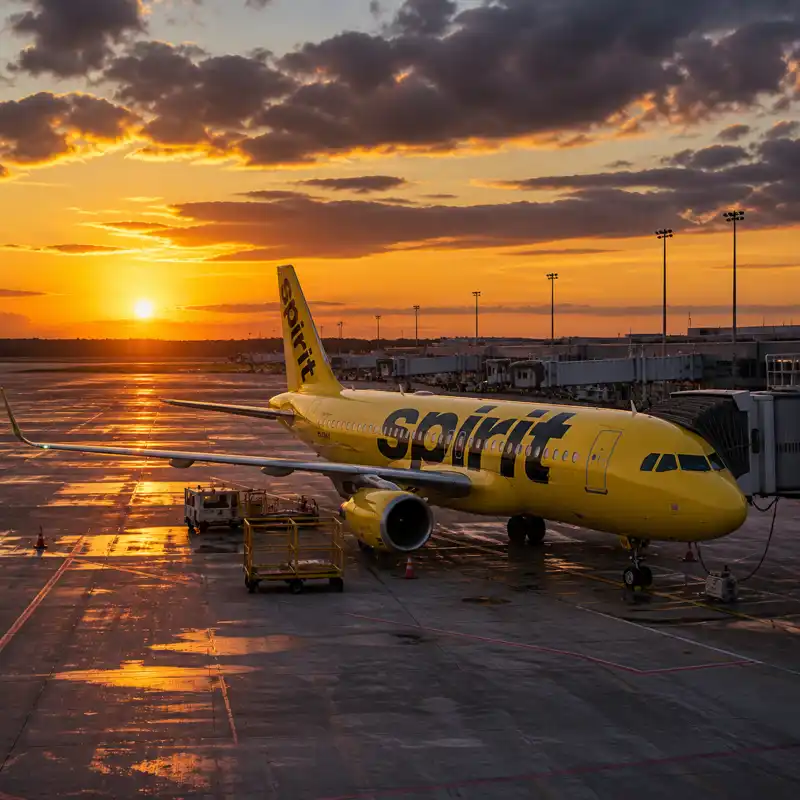

The viral “Let’s Buy Spirit” campaign has turned Spirit Airlines’ collapse into one of the most unusual internet-driven business stories of the year. Days after the budget carrier stopped operations, thousands of travelers, aviation fans and former customers began backing an online proposal to bring Spirit back as a community-supported airline.
The idea started with Hunter Peterson, a voice actor whose TikTok video quickly moved from a casual suggestion to a full-blown online movement. Peterson argued that if even a small portion of U.S. adults contributed roughly the cost of a cheap airline ticket, the public could theoretically pool enough money to acquire Spirit and rebuild it as “the people’s carrier.”
That message landed at the right moment. Spirit’s shutdown had already left passengers looking for refunds, employees facing uncertainty and budget travelers worried about fewer low-cost options. Swikblog earlier reported how the carrier’s collapse raised concerns over canceled flights, job losses and immediate travel disruption in its coverage of Spirit Airlines shutting down after 34 years.
Why the ‘Let’s Buy Spirit’ Campaign Exploded Online
Within a short period, the campaign reportedly drew more than 36,000 to 37,000 supporters and around $22.8 million in pledged interest. The average pledge was said to be more than $600, though organizers have stressed that no actual money has been collected so far. These are non-binding pledges, not completed investments.
The campaign’s website also became part of the story. After a surge of traffic, the site crashed and displayed a message saying the response had overwhelmed its servers. Peterson later admitted that the original site had been built quickly and needed to be rebuilt properly as attention grew.
The online momentum was not limited to TikTok. Searches for “Let’s Buy Spirit” surged, and social media pages linked to the movement gained rapid followings. Peterson also launched an Instagram presence around the idea of “Spirit 2.0,” where supporters began sharing mock branding, revival proposals and arguments for why the airline should not disappear from the market.
The emotional pull is easy to understand. Spirit was often mocked for its fees, tight seats and bare-bones service, but it also helped millions of passengers fly for less. For many travelers, especially those booking last-minute or leisure trips, Spirit was not just another airline. It was the cheapest way to get somewhere.
Read More
- Visit Swikblog Homepage
- Etihad A380 Toronto Flight Diverts to Munich After Medical Emergency
- Delta Cancels 400 Flights and Delays 1,000 Amid Staffing Issues
- Foxconn Satellite Launches on SpaceX Falcon 9
- Pokémon x Target Collection With 100 Items Set for June 6 Release
- Pittsburgh Marathon 2026 Results: Will Loevner and Jane Bareikis Win
Could Public Ownership Save a Budget Airline?
The campaign’s most interesting feature is not the pledge number. It is the ownership idea. Supporters want Spirit to be run less like a Wall Street asset and more like a public-interest travel company, with passengers, workers and communities having a say in its future.
The Green Bay Packers are often mentioned as inspiration because the NFL team is famously community-owned. But applying that kind of model to aviation would be far more complicated. Airlines require aircraft leases, airport slots, maintenance systems, safety compliance, trained crews, insurance, customer support and federal regulatory approvals.
Even a large grassroots pledge pool would be only the beginning. Buying or restarting an airline can require capital far beyond tens of millions of dollars. Fuel prices, labor costs and debt can quickly overwhelm even established carriers. Swikblog previously noted that Spirit’s shutdown risk was tied to rescue talks, fuel pressure and financial strain in its report on Spirit Airlines rescue talks collapsing.
That is why the movement should be viewed carefully. It is not yet a formal acquisition bid. It does not appear to have a final legal structure, a confirmed investor group, a regulatory pathway or an operational restart plan. But it has succeeded in doing something important: it turned Spirit’s failure into a public debate about who benefits when low-cost airlines disappear.
Budget airlines matter because they can pressure larger carriers to keep fares competitive. The U.S. Bureau of Transportation Statistics tracks airline and airport data that shows how deeply air travel pricing, capacity and competition affect consumers. When a low-cost competitor exits the market, travelers may face fewer choices on routes where budget capacity once helped hold prices down.
That concern is already shaping the reaction to Spirit’s collapse. If fewer ultra-low-cost seats are available, rivals may gain more pricing power. Frontier, JetBlue, Delta, American and United could all benefit in certain markets, but passengers who depended on cheaper fares may feel the pressure first.
The broader airline industry is also moving through a volatile period. Strong travel demand has helped some carriers, but fuel costs and operating expenses remain key risks. Swikblog recently covered how airline investors were watching revenue strength and cost pressure in its analysis of Delta stock rising despite fuel concerns.
That backdrop makes “Let’s Buy Spirit” more than a viral stunt. It is a reaction to consolidation, rising travel costs and public frustration with corporate decision-making. Supporters are not simply asking whether an airline can be bought. They are asking whether affordable flying should depend entirely on investors who may walk away when returns shrink.
Still, the road from viral pledge campaign to functioning airline is extremely long. Organizers would need experienced aviation executives, legal advisers, bankruptcy specialists, regulators, labor groups and serious capital partners. They would also need to rebuild trust with passengers affected by cancellations and uncertainty.
For now, the campaign’s biggest achievement is visibility. More than $22 million in pledged interest shows that Spirit’s brand, despite years of criticism, still carries value among travelers who saw it as a gateway to affordable flying. Whether that value can be converted into a real ownership plan remains unclear.
What is clear is that Spirit’s shutdown has left a gap in the U.S. travel market, and “Let’s Buy Spirit” has turned that gap into a national conversation. The movement may never buy an airline, but it has already proved one thing: when budget travel disappears, passengers notice — and some are willing to fight for it.

Make Swikblog your go-to source on Google for reliable updates, smart insights, and daily trends.