
The NYT Connections puzzle for May 15, 2026, puzzle #1069, looks manageable during the opening minutes before turning into one of the most misleading grids of the week. The yellow category revolves around river navigation, while the green group focuses on legendary NBA MVP winners. But the puzzle becomes significantly harder in the final stages because the blue category depends on a famous literary palindrome and the purple category relies entirely on dog-breed homophones.
Today’s Wordle Hints, Answer and Help for May 15, #1791Below are today’s Connections hints, category clues, solving breakdowns, full answers, explanations and a bonus practice game to help improve your Connections strategy.
Hints for Today’s Connections Groups
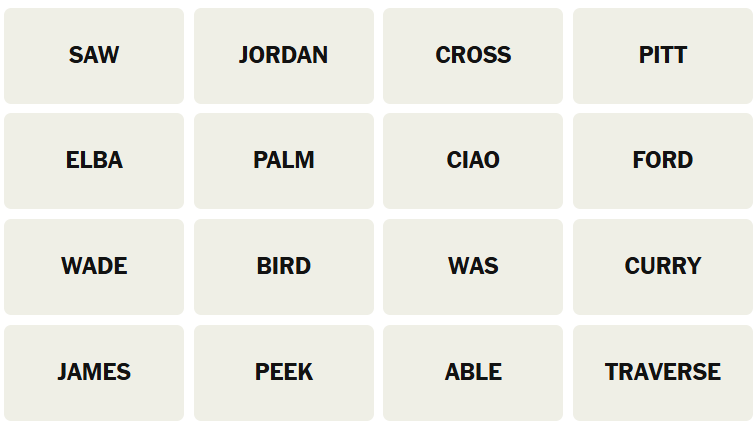
🟨 Yellow group hint: Mississippi travel.
Extra clue: These words describe ways of getting across or through a river.
Detailed solving clue: Imagine hikers, settlers or travelers trying to cross a river without a bridge.
Advanced hint: One of the words specifically refers to a shallow part of a river where people or animals can cross safely.
Solving strategy: “Wade” and “ford” naturally pair together because both involve physically entering water to cross.
🟩 Green group hint: Hoops superstars.
Extra clue: These surnames belong to basketball legends who won multiple NBA MVP awards.
Detailed solving clue: Think about athletes constantly mentioned in GOAT debates and basketball documentaries.
Advanced hint: One player changed modern three-point shooting forever, while another dominated the 1990s NBA era.
Solving strategy: Sports fans likely recognized Jordan, James and Curry immediately, making this category much easier than the final two groups.
🟦 Blue group hint: Think of the palindrome, “Able was I ere I saw Elba.”
Extra clue: These words are pulled from one of the most famous palindromes in English language history.
Detailed solving clue: The category is not about palindromes themselves. It specifically focuses on words inside the palindrome that are NOT palindromes individually.
Advanced hint: “Elba” references the Mediterranean island associated with Napoleon Bonaparte.
Solving strategy: Players who recognized the classic phrase early gained a massive advantage because otherwise the words appear unrelated.
🟪 Purple group hint: Woof!
Extra clue: These answers sound like familiar dog breed nicknames when spoken aloud.
Detailed solving clue: Ignore spelling completely and focus only on pronunciation.
Advanced hint: One answer sounds like “Pom,” while another sounds like “Pit.”
Solving strategy: Saying the words aloud is the key to solving this category because visually the words seem disconnected.
Today’s NYT Connections Answers
🟨 Yellow Group
🟩 Green Group
🟦 Blue Group
🟪 Purple Group
For official gameplay and archived puzzles, players can visit the New York Times Connections page.

Make Swikblog your go-to source on Google for reliable updates, smart insights, and daily trends.