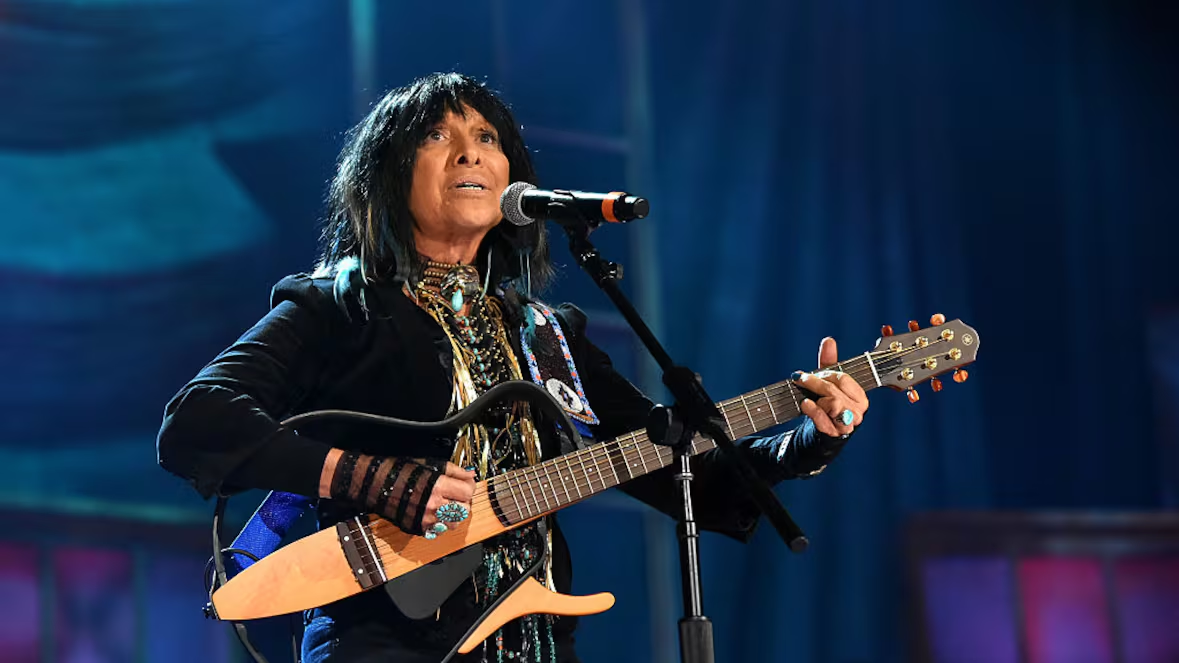

The University of Toronto has withdrawn Buffy Sainte-Marie’s honorary Doctor of Laws degree, adding a new chapter to the growing fallout over questions about the singer-songwriter’s Indigenous identity.
The university said the decision took effect on Wednesday after a confidential review that ended with approval from its governing council. Sainte-Marie had received the honorary degree in 2019, when the school praised her achievements in music, the arts and her advocacy for human rights and dignity.
The reversal comes after a petition called on the university to remove the honour. It also follows the 2023 investigation by CBC’s The Fifth Estate, which raised serious questions about the public story of Sainte-Marie’s ancestry.
For decades, Sainte-Marie was widely described in media profiles and public materials as an Indigenous artist, with references over time to Algonquin, Mi’kmaw and later Cree identity. CBC’s investigation reported the existence of a birth certificate showing she was born in Massachusetts to Italian-American parents, a finding that challenged the identity narrative that had followed her public career for much of her life.
Sainte-Marie has pushed back against claims that she knowingly misled the public. She told The Canadian Press last year that she is an American citizen with a U.S. passport and said she was adopted as a young adult by a Cree family in Saskatchewan. She has also said that questions around her background are complicated by adoption and family history.
Her management and media team did not respond to CBC News before the story was published.
A Rare Move by the University
Honorary degrees are symbolic awards, but they carry real reputational weight. Universities use them to associate themselves with people whose public work reflects institutional values. Revoking one is unusual because it signals that the university no longer believes the honour should remain attached to that person’s record.
The University of Toronto said Sainte-Marie and Duncan Campbell Scott are the only two people whose honorary degrees have been de-recognized since the school created its Standing Committee on Recognition in 2023.
Scott’s case involved a very different historical record. His honorary degree was awarded in 1921 for his contributions to Canadian literature. But Scott also worked in the Department of Indian Affairs from 1879 to 1932, including 19 years as deputy superintendent. He became closely associated with assimilation policies and the expansion of Indian Residential Schools, and is remembered for saying he wanted to “get rid of the Indian problem.”
The university revoked Scott’s degree last year, reflecting a wider reassessment of honours connected to Canada’s colonial history. Sainte-Marie’s case now places questions of identity, representation and institutional responsibility into that same process of review.
Audra Simpson, a Kanien’kehá:ka scholar from Kahnawà:ke and professor of political anthropology at Columbia University, told CBC News the university’s decision was overdue. She described it as “a just consequence” and said both Scott and Sainte-Marie had acted on settler colonialism in different ways and in different periods.
Read More
- Visit Swikblog Homepage
- Australia’s Best Private Primary Schools 2026 Rankings
- Google Nest Outage: Cameras and Thermostats Offline in US
- School Bus Driver Wins $5 Million Maryland Lottery Scratch-Off
- Spaghetti House Closes All London Restaurants After 70 Years
- Maldives Diving Horror: Five Italians Die in Underwater Caves
“I hope it sends a message,” Simpson said.
Why the Decision Matters
The controversy around Sainte-Marie is not only about one honorary degree. It goes to the heart of how institutions recognize Indigenous identity and who receives public authority, awards and cultural platforms through that recognition.
Sainte-Marie’s career has been extraordinary by any artistic measure. Her music, activism and visibility shaped generations of listeners. She was known for protest songs, advocacy for Indigenous rights and a public image tied closely to Indigenous survival and resistance.
That is also why the dispute has carried such weight. Critics argue that Indigenous identity cannot be treated as a vague public brand, especially when it influences access to recognition, trust and representation. Supporters of Sainte-Marie point to her long career of activism and say her work should not be erased, even as institutions review the honours connected to her name.
The University of Toronto is not the first school to act. Dalhousie University in Halifax stripped Sainte-Marie of an honorary degree in January after a Mi’kmaw student questioned whether keeping the honour was ethical in light of the identity controversy.
The decisions from Dalhousie and the University of Toronto show how universities are responding to public pressure around Indigenous representation. They are also part of a broader Canadian debate over how institutions handle honours that later become disputed, whether because of colonial history, misconduct or questions about the truth behind a public legacy.
For the University of Toronto, the message is clear: honorary degrees can be reconsidered when new information or ethical concerns challenge the basis on which they were awarded. For Sainte-Marie, the decision adds to an already significant reassessment of her public image.
Her songs and influence remain part of North American music history. But the honours attached to her identity and advocacy are now being reviewed through a different lens, one shaped by accountability, Indigenous voices and a stronger demand for institutions to verify the stories they celebrate.
The revocation is therefore more than a university announcement. It is a marker of how public recognition is changing in Canada, especially when identity, reconciliation and historical harm intersect.

Make Swikblog your go-to source on Google for reliable updates, smart insights, and daily trends.