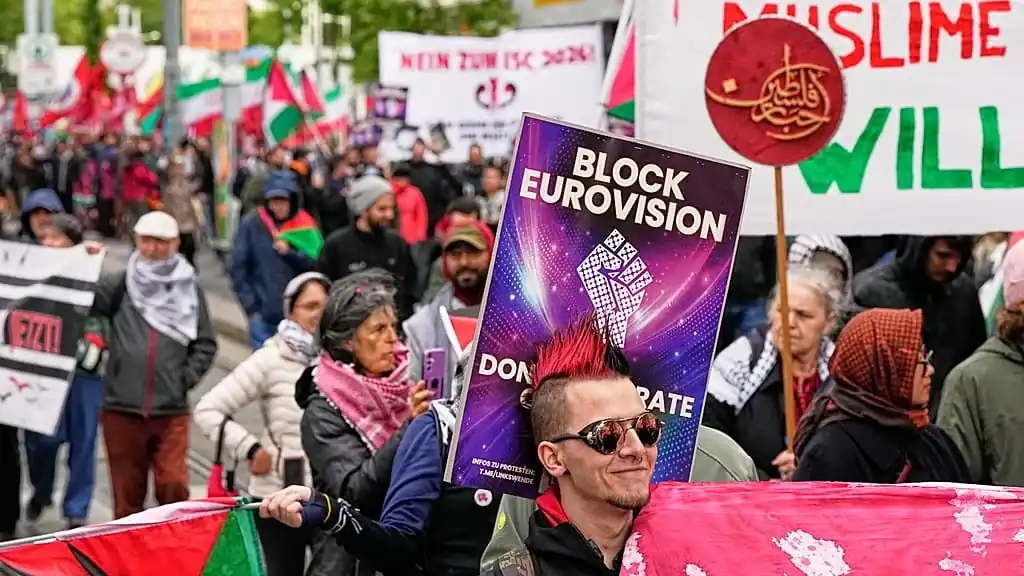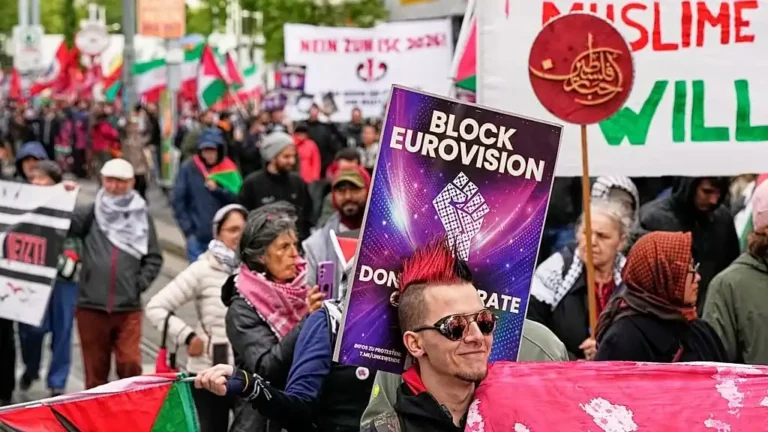

Eurovision 2026 has reached its grand final in Vienna under a level of political pressure rarely seen around a music contest built on spectacle, national pride and mass television appeal. Hours before Saturday’s final at the Wiener Stadthalle, several hundred demonstrators gathered near the venue to protest Israel’s participation, turning one of Europe’s biggest entertainment nights into another flashpoint over the war in Gaza.
The protest did not stop the show from going ahead, but it changed the atmosphere around it. Demonstrators carrying Palestinian flags and banners assembled in a square near the arena before moving toward the contest site, where police barriers and patrols marked the edge of a tightly controlled security zone. Austrian authorities kept surrounding streets open while monitoring the march, with security reinforced across Eurovision week and support brought in from neighbouring Germany.
The wider issue is not just a single protest in Vienna. This year’s final has become the third consecutive Eurovision season shaped by anger over Israel’s place in the competition, following controversy around previous contests in Malmö in 2024 and Basel in 2025. The difference in 2026 is that the dispute has moved from audience protest into broadcaster-level boycott, reducing the contest field and forcing organisers to defend Eurovision’s long-standing claim that it is a cultural event rather than a political stage.
Eurovision’s 70th edition becomes a test of unity
The 70th edition of Eurovision held its semi-finals on May 12 and May 14, before Saturday’s grand final on May 16. The final includes 25 countries, including Israel, competing in Vienna. But the overall number of contest entries has fallen to 35, the smallest field since 2003, after five broadcasters chose not to participate.
Spain, Ireland, Iceland, Slovenia and the Netherlands are absent this year after boycotting the contest over Israel’s inclusion. Their withdrawal followed the European Broadcasting Union’s decision not to suspend Israeli broadcaster KAN. For viewers, that means the show still offers the familiar Eurovision mix of staging, voting drama and cross-border pop, but with several major European voices missing from the competition.
The boycott matters because Eurovision is not only a TV event. It is also a meeting point for public broadcasters, national audiences, tourism campaigns, music industries and soft power. Spain’s absence is especially visible because it is usually one of the contest’s major participating markets. Ireland and the Netherlands also carry deep Eurovision history, while Iceland and Slovenia add to the sense that the dispute has cut across both larger and smaller broadcasting nations.
For readers following the background, Swikblog has previously explained the wider participation row in this Eurovision 2026 boycott analysis, including why the EBU’s decision became so divisive months before the Vienna final.
The political tension has also affected the way this year’s contest is being watched. Last year’s Eurovision audience was estimated at 166 million, bigger than the Super Bowl’s reported 128 million audience. A smaller entry list and the absence of several broadcasters could put pressure on the size and tone of this year’s global viewership, even if Eurovision remains one of the world’s most powerful live entertainment brands.
Key context: The Vienna final is not being overshadowed by one protest alone. It is being shaped by a wider clash between Eurovision’s identity as a shared cultural event and the political reality surrounding Israel’s participation during the Gaza war.
Security, voting and the pressure on organisers
The strongest original angle in Vienna is the collision between celebration and control. Eurovision is usually sold as a night of colour, fan culture and musical excess. This year, the contest has also required police planning, crowd monitoring and emergency readiness. Authorities were braced for possible disruption around the venue, including blockade attempts, although the protest near the arena remained smaller than organisers had expected.
There had already been a disruption during Tuesday’s semi-final when a protester shouted pro-Palestinian slogans within range of a television microphone. The European Broadcasting Union and Austrian broadcaster ORF later said that four people were removed from the arena for disruptive behaviour. Israeli entrant Noam Bettan also said he heard booing during his performance.
The EBU has faced pressure on another front as well: voting. Eurovision Song Contest director Martin Green said the event was going through “challenging times” and issued a formal warning to KAN after videos posted online by Israel’s contestant urged viewers to vote for him the maximum 10 times. KAN said it follows the rules and that the videos were removed.
The voting issue is sensitive because Eurovision tightened its rules after concerns that an Israeli advertising campaign may have affected the previous contest. Israel finished second after receiving a major public vote, far above the support it received from national juries. For Eurovision fans, voting is part of the drama; for broadcasters, it is also a question of trust. If audiences believe political mobilisation can overwhelm musical preference, the contest’s credibility becomes harder to defend.
The Gaza war remains the central reason behind the boycott and protests. The Hamas-led attack on October 7, 2023 killed at least 1,200 people, most of them civilians. Israel’s military response in Gaza has killed more than 72,000 Palestinians, mostly civilians, and left large parts of the enclave in ruins. Those figures explain why a song contest has become emotionally charged for broadcasters, artists, fans and protesters across Europe.
Still, Eurovision organisers have tried to keep the focus on the stage. Green urged viewers to set aside global problems during the show, which began at 9 p.m. CET in Vienna. That appeal captures the central difficulty of this year’s final: the contest depends on the idea that music can create a temporary shared space, but many viewers and broadcasters argue that the world outside the arena cannot simply be closed off for four and a half hours.
There is still a competition to decide. Finland’s “Liekinheitin,” performed by violinist Linda Lampenius and pop singer Pete Parkkonen on a fiery stage set, has been viewed as a favourite, while Australia’s Delta Goodrem is also drawing attention with “Eclipse.” An Associated Press report also noted the contrast between the grand-final spectacle and the protest atmosphere surrounding Vienna.
For fans, the Vienna final may be remembered less for a single winner than for the moment Eurovision’s political contradictions became impossible to keep backstage. The contest still offers the familiar release of pop performance, live voting and national celebration. But in 2026, every song arrives inside a larger argument about culture, accountability and whether Europe’s biggest music night can remain “united by music” when some broadcasters have decided absence is the only message they can send.
Read More
- Visit Swikblog Homepage
- Puffins Found Dead After Deadly Storms as Breeding Season Begins
- Belfast Plants 293,516 Trees Under 1 Million Trees Initiative
- Hackney Half Marathon 2026 Road Closures: East London Streets Shut
- Kingston Power Outage Leaves 13,432 Customers Affected
- NTSB Wimberley Plane Crash Report: 5 Killed

Make Swikblog your go-to source on Google for reliable updates, smart insights, and daily trends.