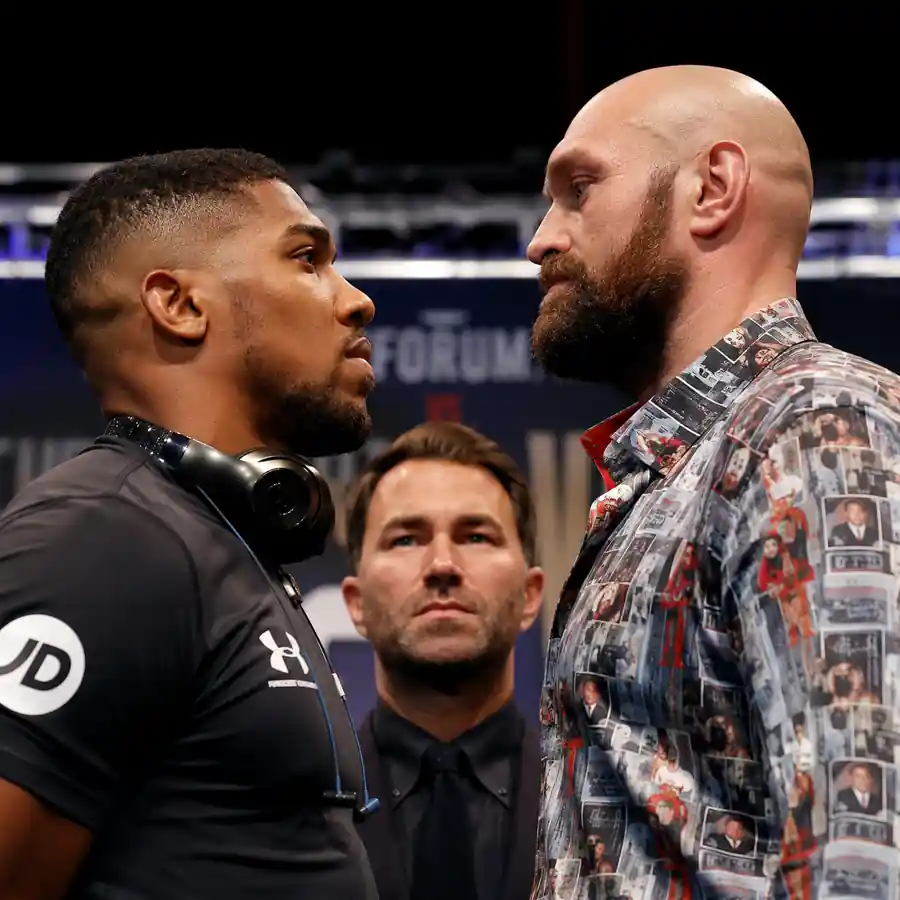

Anthony Joshua vs Tyson Fury may finally be signed, but the biggest British heavyweight fight of this era is still not fully protected from boxing’s oldest danger: one bad night.
The planned Joshua-Fury showdown is being lined up for November 2026, with both fighters understood to have agreed terms for a long-awaited meeting. For fans who have watched this fight move in and out of reach for years, that is the strongest sign yet that the event could actually happen.
But Eddie Hearn has now put a sharp warning around the build-up. Before Joshua and Fury can share the ring, both men are expected to take warm-up fights. Hearn says a defeat for either fighter would make the November blockbuster impossible to stage in its current form.
“In my opinion if either fighter loses, you cannot do the fight,” Hearn told Sky Sports.
That line cuts through the excitement. The contracts may be signed, the interest may be enormous, and the money may be waiting, but heavyweight boxing does not guarantee safe passage.
Joshua’s July 25 return has become more than a comeback fight
Joshua is scheduled to fight Kristian Prenga on July 25 in Riyadh, Saudi Arabia. It is being framed as a comeback bout and a tune-up before Fury, but the stakes are far bigger than a routine summer appearance.
For Joshua, this is not only about getting rounds. It is about proving he is still physically and mentally ready for an opponent as awkward, experienced and unpredictable as Fury. Hearn admitted he will be deeply nervous when Joshua makes his ringwalk in Riyadh, especially given the road AJ has travelled to reach this point.
“I will feel sick at the ringwalk on July 25,” Hearn said. “Especially with what AJ’s come back from.”
That anxiety is understandable. Joshua has rebuilt his career under heavy public scrutiny, and every performance now gets judged through the lens of what it means for a Fury fight. A flat win may invite questions. A difficult night may increase doubt. A defeat would almost certainly wreck the plan altogether.
Prenga may not carry the profile of Fury, Oleksandr Usyk or Deontay Wilder, but that is exactly what makes the assignment dangerous in a different way. Joshua is expected to win. When a major fight is already waiting, the pressure is not just to beat the opponent in front of him, but to avoid cuts, injuries, mistakes and any result that weakens the story.
Fury is also expected to take a summer fight of his own. Hearn suggested the former world champion is unlikely to face anyone at the level of Arslanbek Makhmudov before Joshua, especially after already banking 12 rounds in his recent comeback win over Makhmudov.
That does not remove the risk. Fury’s career has often been built around chaos, surprise and sudden changes of direction. Even a low-key opponent can become a problem if preparation slips or motivation drops.
Why the first face-off could become a major moment
One detail from Hearn’s comments stands out beyond the fight contracts and venue talk: Joshua and Fury have still never properly come face to face in the way modern super-fights usually demand.
Hearn expects Fury to be in Riyadh for Joshua’s July 25 bout. If that happens, the first public face-off between the two British heavyweights could become the real starting gun for the November promotion.
For years, Joshua vs Fury has existed mostly through interviews, social media clips, negotiations and fan arguments. A face-off would make it feel real in a way signed paperwork cannot. Hearn said that moment would give sports fans “the shivers,” and he is probably right.
This is not just another heavyweight fight. It is a rivalry built around two very different personalities. Joshua has long carried the image of the disciplined Olympic gold medallist turned global boxing brand. Fury has played the role of unpredictable showman, comeback king and heavyweight disruptor. Their careers have run beside each other for more than a decade without ever colliding in the ring.
That is why the warm-up fights matter so much. The public is not waiting for Joshua vs Fury because it is convenient. They are waiting because it answers a question British boxing has never been able to settle.
Read More
- Visit Swikblog Homepage
- New Zealand Fuel Prices Drop: Diesel and Unleaded 91 Fall
- Xbox Game Pass June 2026: Five Games Confirmed
- Amazon Alexa AI Shopping Assistant Can Track Deals and Auto-Buy Products
- Ram 2500 Recall Over Tire Speed Rating Issue
- Swatch x Audemars Piguet Royal Pop Watch Sparks Crowds and Resale Frenzy
Swikblog has followed Joshua’s wider comeback storyline, including his recent headline-making win covered in Anthony Joshua Beats Jake Paul by Sixth-Round Knockout. The Fury fight would be a far bigger test, and also a far more meaningful chapter in how Joshua’s late-career run is remembered.
UK venue hopes remain alive, but Saudi influence is central
The November fight does not yet have a confirmed date or venue. Hearn has made clear that he would like it to happen in the United Kingdom, and there is obvious logic behind that preference.
Joshua vs Fury is a British fight at its core. Wembley Stadium would give it a grand London stage. Tottenham Hotspur Stadium has already hosted major boxing nights and remains a modern option. Cardiff’s Principality Stadium, with its roof, could be especially useful for a November event when weather becomes a real factor.
Hearn also mentioned the commercial reality. Turki Alalshikh and Saudi Arabia’s boxing operation are central to making major fights happen at this level. Hearn said Turki understands the importance of staging the event in Britain, but also noted that he is “paying the bill.”
That balance may decide the final location. The UK offers history, atmosphere and symbolism. Saudi Arabia offers financial power and recent experience in staging heavyweight events. Either way, the fight is expected to sell out instantly if both men arrive unbeaten from their tune-ups.
The business case is obvious. Joshua remains one of the biggest names in British sport. Fury remains one of the most recognisable heavyweights in the world. Together, they can pull casual fans, hardcore boxing followers and mainstream sports audiences into the same event.
But the sporting case is more fragile. This fight needs both men to look credible in November. It needs the feeling that Joshua can still hurt Fury and that Fury can still outthink Joshua. A summer defeat for either man would damage that balance and turn a mega-fight into a salvage job.
That is why Hearn’s warning should not be dismissed as promotional drama. It is the simple truth of prizefighting. A signed contract does not throw punches. A future date does not protect a chin. A planned stadium night does not matter if one fighter loses before getting there.
Joshua’s July 25 fight in Riyadh is now the first major checkpoint. Fury’s own summer outing will be the second. If both pass, the sport can finally move toward the heavyweight event it has chased for years.
If one of them fails, boxing may lose Joshua vs Fury at the very moment it looked closer than ever.

Make Swikblog your go-to source on Google for reliable updates, smart insights, and daily trends.