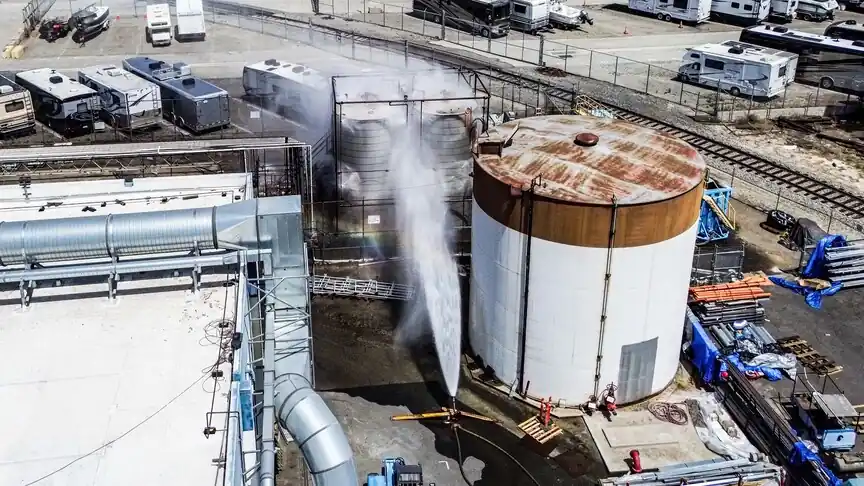

About 40,000 Californians were ordered to evacuate after a toxic chemical tank at a Garden Grove aerospace facility became unstable, raising fears of either a major chemical spill or an explosion in Orange County.
The emergency involves a storage tank at GKN Aerospace containing roughly 6,000 to 7,000 gallons of methyl methacrylate, a highly flammable chemical used in plastics and resins. Officials said the tank could fail by spilling hazardous material into the area or by overheating further and exploding, prompting school closures, evacuation centers and urgent warnings for residents across parts of Garden Grove and nearby communities.
The situation moved quickly beyond a routine hazmat response because responders could not immediately rule out a sudden tank failure. Fire crews focused on cooling the overheated tank with water while keeping people away from the danger zone, as officials warned that the outcome could depend on whether the container stabilizes, ruptures or enters a more dangerous thermal reaction.
The Associated Press reported that the evacuation orders expanded across parts of Garden Grove and nearby Orange County communities as authorities worked to protect residents from the risk of a chemical release or blast. The size of the evacuation zone reflected the uncertainty around the tank, not just the conditions visible from outside the facility.
Officials warn of spill or explosion risk
Orange County Fire Authority officials described the emergency as a crisis situation because the tank’s condition left responders with limited control over the final outcome. Crews were trying to cool the chemical and reduce the chance of thermal runaway, while also preparing for the possibility that the container could rupture and release thousands of gallons of hazardous material at ground level.
Air quality readings were being monitored, and officials said there was no active gas plume reported in the area at one stage of the response. But that did not remove the evacuation risk. The main danger remained the unstable tank itself, the volume of chemical inside it and the possibility that nearby tanks or industrial materials could become involved if the situation worsened.
No injuries had been reported in the early updates, but authorities repeatedly urged residents inside the evacuation area not to wait for visible smoke or a strong odor before leaving. Chemical emergencies can change quickly, and responders often widen evacuation zones before the worst-case outcome occurs.
Key details: The emergency involved a chemical tank at a Garden Grove aerospace facility, evacuation orders affecting about 40,000 people, school closures, multiple evacuation centers and continued work by fire crews to cool and stabilize the tank.
Evacuation zone covers several Orange County neighborhoods
The evacuation area included neighborhoods around the facility, with residents told to leave immediately while police and fire officials worked through alerts, door-to-door checks and emergency notices. Evacuation centers were opened for displaced residents, including people who had to leave quickly without medication, documents, pets or other essentials.
The disruption stretched beyond individual households. Schools in the affected area were closed, traffic patterns changed and local officials warned residents not to return until emergency crews declared the area safe. Some people were allowed back briefly to collect medication or urgent belongings, but authorities stressed that those visits were controlled and temporary.
The incident also raised fresh attention around industrial sites located close to dense residential neighborhoods. Garden Grove sits in a heavily populated part of Orange County, where factories, warehouses, homes, schools and major roads can sit close together. That geography makes chemical tank emergencies especially difficult because responders must protect both the immediate industrial site and the surrounding community.
Methyl methacrylate is widely used in manufacturing, including plastics and acrylic products, but it can pose fire and health risks when released in unsafe conditions. Vapors can irritate the eyes, skin and respiratory system, while the chemical’s flammability makes overheating storage tanks a serious concern for hazmat teams.
For residents, the most important instruction remained simple: stay out of the evacuation zone until officials lift the order. Even if the tank appears stable from a distance, emergency crews were still managing temperature, containment and the risk of sudden failure.
The Orange County incident follows other recent industrial leak emergencies that have forced evacuations and disrupted local communities. Swikblog previously covered a separate Brisbane chemical leak that evacuated hundreds of workers, underlining how quickly industrial chemical incidents can become wider public safety events.
As crews continued working around the Garden Grove tank, the evacuation order showed the scale of caution officials were taking. A controlled spill would still create a hazardous cleanup operation, while an explosion could put surrounding tanks, buildings and nearby neighborhoods at greater risk. Until responders fully stabilize the site, the emergency remains one of Southern California’s most significant chemical safety incidents of the year.

Make Swikblog your go-to source on Google for reliable updates, smart insights, and daily trends.