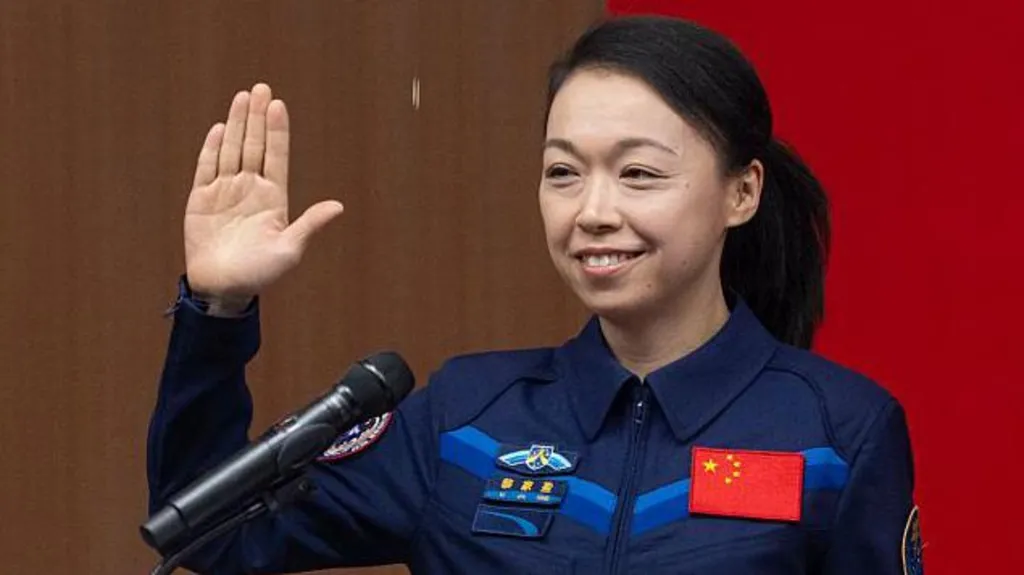

Hong Kong’s place in human spaceflight changed this week after Li Jiaying became the city’s first astronaut to travel into orbit, joining China’s Shenzhou-23 mission to the Tiangong space station. The launch gives Hong Kong a direct role in China’s crewed space program at a time when Beijing is preparing for a much larger goal: putting astronauts on the Moon before 2030.
Li, a 43-year-old police officer and mother of three, is serving as the payload specialist on the mission. She travelled with commander Zhu Yangzhu, a space engineer, and Zhang Zhiyuan, a former air force pilot. The spacecraft lifted off at 23:08 local time on Sunday from the Jiuquan Satellite Launch Center in the north-west Gobi Desert aboard a Long March 2F rocket.
The mission quickly became a national moment. Crowds near the launch site waved Chinese flags as the rocket rose into the night sky, carrying a crew that reflects both China’s technical ambitions and Hong Kong’s first direct representation in space. A few hours after launch, Shenzhou-23 docked with the Tiangong space station, where the astronauts will begin a busy research schedule.
One of the most important parts of the mission is its focus on the human body in microgravity. The crew is expected to conduct experiments that help scientists understand how long periods in orbit affect health, movement, endurance and daily work in space. These studies matter because future lunar missions will require astronauts to operate far from Earth for longer and under more demanding conditions.
According to AP News, one Shenzhou-23 crew member is expected to remain in space for an entire year, which would mark one of the longest single stays in orbit. Chinese authorities have not yet confirmed which astronaut will stay behind for the extended mission.
A year in orbit would be a major test for China’s space station systems as well as for astronaut health. It would still fall short of the 14-month record set by Russian cosmonaut Valery Polyakov in 1995, but it would give China valuable experience in the type of long-duration missions needed for lunar bases and deeper space exploration.
Li’s journey also carries strong public meaning. Hong Kong Chief Executive John Lee described her participation as a historic moment for the city. Li has said she was inspired by Yang Liwei, the first person sent into space by China’s space program, and viewed the opportunity as too rare not to attempt.
China has been sending astronauts to Tiangong on regular six-month missions since 2021, steadily turning the station into a platform for science, training and long-term space operations. Shenzhou-23 builds on that pattern but raises the stakes through the planned year-long stay and its closer link to China’s lunar timeline.
Read More
The launch also comes during a sharper global race for the Moon. The United States is pursuing its Artemis program, while China is working toward its own crewed lunar landing before 2030. Swikblog previously covered this wider competition in Musk vs Bezos Moon Race Heats Up as NASA Targets 2028 Landing and China 2030, where the pressure between American and Chinese space plans is already reshaping the next phase of exploration.
China’s recent progress has added weight to that rivalry. In 2024, the Chang’e-6 mission returned rock samples from the far side of the Moon for the first time in history. Later this year, China is also expected to carry out an orbital test flight of Mengzhou, a next-generation spacecraft designed to carry astronauts on future Moon missions.
For Hong Kong, Shenzhou-23 is more than a symbolic achievement. It places one of the city’s own professionals inside a mission tied to scientific research, space station endurance and China’s future lunar strategy. For Beijing, it is another step toward proving that its space program can support longer missions, more complex crews and eventually human operations beyond low Earth orbit.
Li Jiaying’s launch may be remembered as a first for Hong Kong, but it also reflects something much larger: the rapid transformation of Asia’s role in the future of space exploration.

Make Swikblog your go-to source on Google for reliable updates, smart insights, and daily trends.