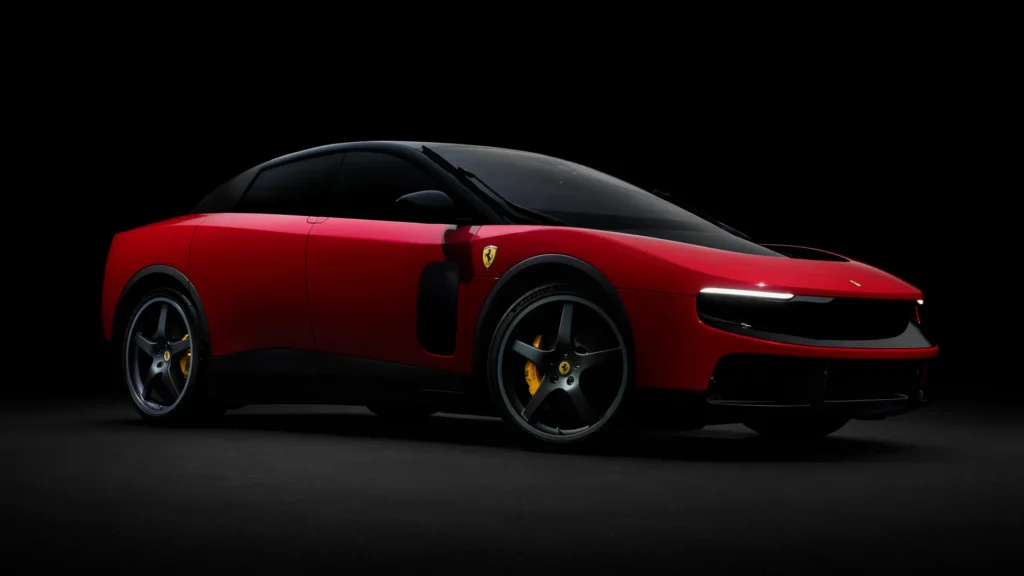

Ferrari has officially unveiled the Luce, the company’s first fully electric production car, and it may be the most controversial Ferrari launched in decades. Revealed in Rome after years of speculation, the Luce marks a dramatic shift for Maranello, combining hypercar-level electric performance with a practical five-seat layout, futuristic styling and a completely new design philosophy developed alongside LoveFrom, the studio led by former Apple design chief Jony Ive and industrial designer Marc Newson.
At first glance, the Ferrari Luce barely resembles the brand’s traditional mid-engined supercars. Instead of aggressive wedge-shaped proportions, the EV features a stretched monobox silhouette, a large glass-heavy cabin, a sloping aerodynamic roofline and rear-hinged suicide doors. Ferrari says the unusual proportions were necessary to create a more spacious electric grand tourer while maximizing aerodynamic efficiency.
The front fascia is dominated by a deep black S-duct inspired by Ferrari’s racing cars, visually shortening the nose while channeling airflow more effectively. A strong black horizontal band continues across the body, helping break up the car’s large proportions and giving it a futuristic “car within a car” appearance. The teardrop-inspired body shape delivers a drag coefficient of 0.254 Cd, making it the most aerodynamically efficient Ferrari road car ever produced.
The Luce rides on massive 23-inch front wheels and even larger 24-inch rear wheels. Other standout design elements include vertically parked windshield wipers, flush-mounted door handles, quad circular LED tail lights, yellow-painted brake calipers and Ferrari badges mounted on the quarter panels. Ferrari designers even engineered the body so number plates do not visually interrupt the shape of the car.
Inside, the Ferrari Luce takes an entirely different direction from most modern EVs. LoveFrom avoided overwhelming touchscreen layouts and instead focused on tactile interaction and physical craftsmanship. The dashboard uses machined aluminum, glass and physical toggle controls rather than relying solely on software menus.
The steering wheel is one of the cabin’s centerpiece features. Made from 100 percent recycled aluminum with leather grips and anodized detailing, it combines the torque-control paddles, instrument binnacle and Ferrari’s signature Manettino drive selector into one sculptural assembly. Ferrari says the goal was to make the driver feel physically connected to the machine instead of isolated behind screens.
The cabin also includes Samsung-developed OLED displays, a pivoting center screen that can tilt toward either the driver or passenger, jet fighter-inspired roof controls, analogue-style digital gauges, panoramic glass roofing and a new 21-speaker 3,000-watt sound system powered by Ferrari-developed software. Even small details received obsessive attention, including CNC-machined switchgear, glass-covered center console elements and a dedicated typeface called “LF Maranello” created specifically for the Luce.
Performance remains extreme despite the car’s practicality-focused approach. The Ferrari Luce uses four electric motors — one mounted at each wheel — producing between 1,035bhp and 1,050bhp depending on configuration. Ferrari claims 0-100km/h acceleration in just 2.5 seconds and 0-200km/h in 6.8 seconds, while top speed reaches 310km/h (192mph).
Power comes from a 122kWh battery pack paired with an 800V electrical architecture supporting ultra-fast 350kW charging. Ferrari says the system can recover around 70kWh of energy in approximately 20 minutes. Claimed driving range stands at over 530km on a full charge.
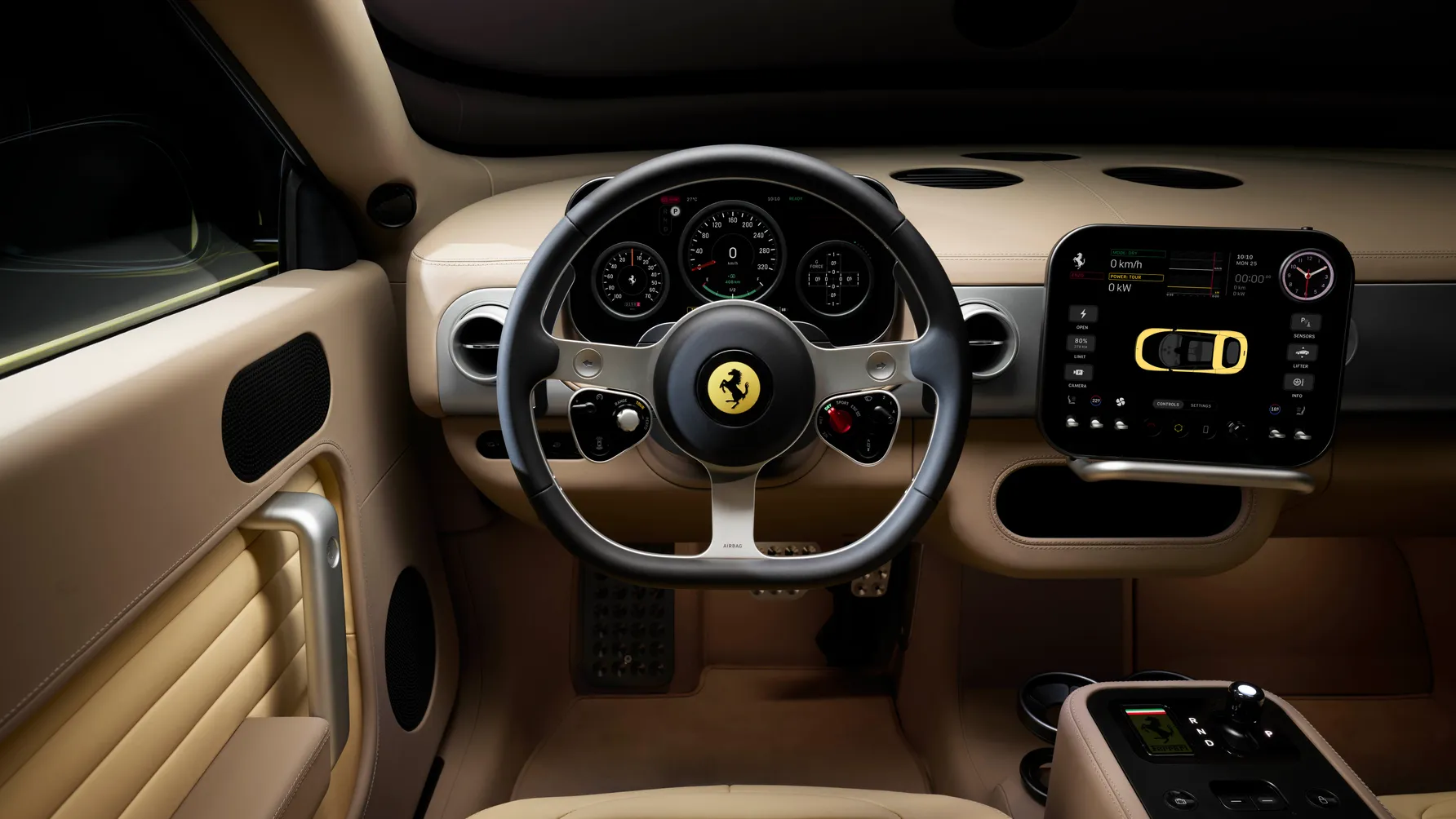
The Luce also introduces new ways of interacting with an electric performance car. Instead of fake gear shifts, Ferrari developed a torque-management system controlled through paddles behind the steering wheel. Drivers can independently adjust power delivery and regenerative braking levels, creating a more involved driving experience closer to managing a combustion-engine Ferrari.
One of the project’s most ambitious engineering challenges involved sound. Ferrari did not want artificial engine noise played through speakers. Instead, engineers mounted accelerometers near the rear axle to capture genuine vibrations from the electric drivetrain. Those vibrations are filtered, amplified and shaped to produce a unique sound signature that behaves more like an electric guitar amplifier than a fake combustion soundtrack.
Ferrari says the Luce also benefits from a new vehicle control system capable of processing data 200 times per second to manage torque vectoring, active suspension, rear-wheel steering and the latest generation of Ferrari’s Side Slip Control software. Engineers also lowered the center of gravity by 95mm compared to the Purosangue SUV while improving torsional rigidity through battery integration into the chassis.
The Luce is also Ferrari’s first true five-seater and features the largest trunk ever fitted to a Ferrari production car, measuring 597 liters. Ferrari executives described the EV as an attempt to expand the brand into a new luxury category without abandoning emotional driving dynamics.
Ferrari’s electric push comes as luxury automakers race to redefine high-performance vehicles for the EV era. Similar developments across the premium segment have already begun reshaping the market, including recent electric GT projects covered in Swikblog’s report on Jaguar’s next-generation EV strategy.
More official technical information and specifications can be found directly on Ferrari’s official Luce page.
Whether enthusiasts embrace or reject its unconventional appearance, the Ferrari Luce represents one undeniable fact: Ferrari did not take the safe route into electrification. The Luce is futuristic, technically ambitious, emotionally engineered and intentionally provocative — exactly the kind of statement car capable of defining Ferrari’s electric future.

Make Swikblog your go-to source on Google for reliable updates, smart insights, and daily trends.