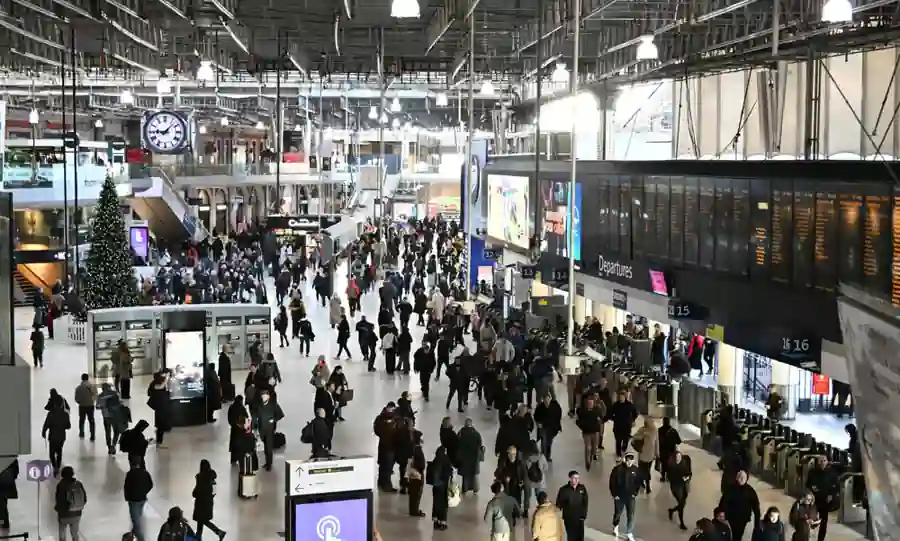

London Waterloo passengers faced a difficult day of travel after a smoke report on the tracks between Waterloo and Vauxhall led South Western Railway to slow services while safety checks were carried out.
The disruption hit one of Britain’s busiest stations during a period of extreme heat, adding fresh pressure to commuters and longer-distance passengers travelling across south-west London, Surrey, Hampshire and the south coast.
South Western Railway said smoke had been reported on the track on the approach to Waterloo. As a precaution, trains were made to run at reduced speed while the line was inspected. That meant delays began building on services in and out of Waterloo, with passengers warned that journey times could be longer than planned.
The affected routes included services between London Waterloo and Guildford, Woking, Chessington South, Dorking, Hampton Court, Shepperton and Strawberry Hill. These are busy commuter corridors, so even a short inspection near Waterloo can quickly create wider timetable problems across the network.
The impact was not limited to local stopping services. SWR also cancelled several trains due to run during the afternoon and early evening, including services between London Waterloo and Weymouth via Winchester, Southampton and Bournemouth. Trains between Waterloo and Aldershot via Woking and Guildford were also affected.
Passengers travelling from the west of England also faced changes. Some services between Exeter St Davids, Salisbury and London Waterloo were only running as far as Basingstoke, meaning passengers heading into London needed to check whether onward connections were available.
SWR issued a wider warning that services across its network could be revised because of the hot weather. The operator did not say the smoke incident was caused by high temperatures, but the timing came as southern England was dealing with unusually intense heat.
The UK recorded its hottest May conditions on record over the bank holiday period, with parts of London seeing temperatures above 33C. Kew Gardens in south-west London also provisionally reached 34.8C, marking the hottest meteorological spring temperature recorded in the UK.
Forecasters warned that temperatures across large parts of southern England and Wales could rise towards 35C or 36C, although thunderstorms were also possible later in the day. For the rail network, extreme heat can be a serious operational challenge because tracks and equipment are more vulnerable when temperatures remain high.
Passengers using Waterloo were advised to check live updates before travelling rather than relying only on the printed timetable. The latest information on delays, cancellations and revised services is available through South Western Railway’s official live journey planning page.
There was also disruption elsewhere in London. National Rail Enquiries said Elizabeth line services between London Liverpool Street and Stratford were affected on Tuesday afternoon. Eastbound services that usually run from platform 17 at Liverpool Street towards Gidea Park were cancelled, with passengers told to use Shenfield services from low-level platform A instead.
The latest disruption shows how quickly problems near a major London terminal can spread. Waterloo is a key hub for SWR services, and any restriction between the station and Vauxhall can affect trains before they even reach their main departure platforms.
Swikblog has recently reported on similar pressure across the rail network, including Southern England train delays linked to London Waterloo disruption, where problems at a major interchange led to cancellations and long delays across several routes.
For passengers caught in the latest disruption, the best option is to check the status of the specific train, allow extra time, carry water during the heat and avoid tight connections where possible. Travellers delayed by 15 minutes or more may also be able to claim compensation through SWR’s Delay Repay scheme, depending on their ticket and journey.
Normal services may take time to recover even after a safety inspection is completed, as delayed trains and crews often need to be put back into the correct position. Passengers heading to or from London Waterloo should continue checking updates throughout the day.

Make Swikblog your go-to source on Google for reliable updates, smart insights, and daily trends.