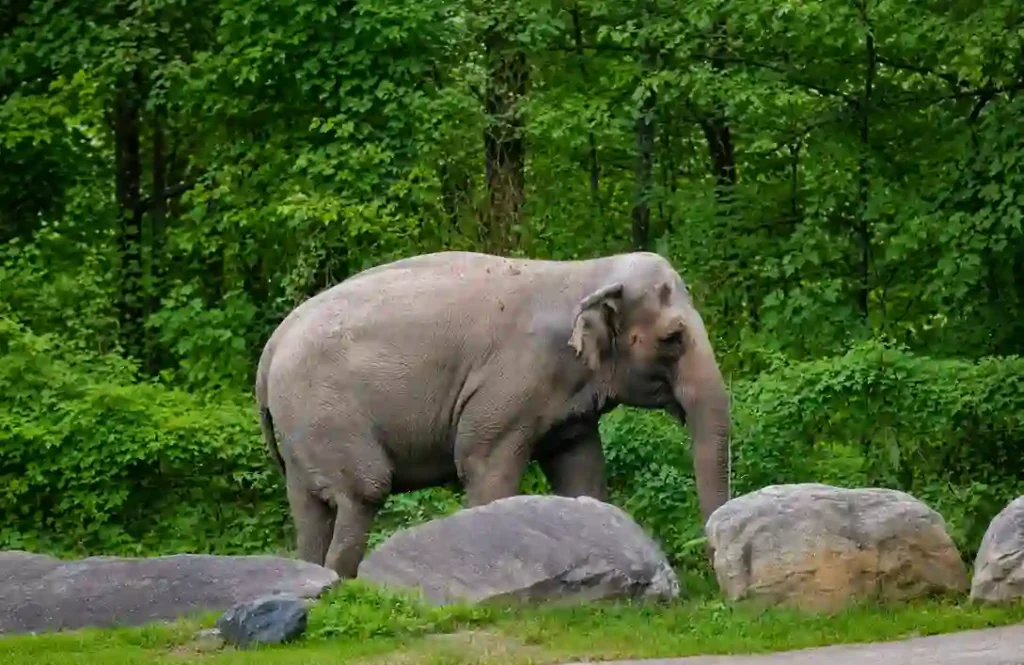

Happy the elephant, whose name became known far beyond the Bronx Zoo, has died at 55 after a life that connected science, animal welfare, courtroom debate and decades of care from zoo staff. Her final goodbye was especially painful for keepers who had watched over her for years, with some staff members having cared for her for more than three decades.
The Bronx Zoo said Happy was euthanized after age-related health problems worsened sharply in her final weeks. Before her death, she had shown signs linked to possible kidney or liver decline. A necropsy later found severe arthritis and large uterine tumors that could not be removed, conditions that are difficult to diagnose in elephants through routine examinations or imaging. The Associated Press reported the zoo’s confirmation of her death and the medical findings after the procedure.
Happy’s final days were spent away from the public exhibit, in a barn and yard within her familiar enclosure. Zoo staff provided what officials described as hospice-style care, including hydration, nutrition support and pain management. For an animal that had lived at the Bronx Zoo since 1977, the decision was not only medical but emotional for the people who had built daily routines around her care.
Born in the wild in Asia, Happy arrived in the United States as a calf and was named after one of the characters from Disney’s “Snow White and the Seven Dwarfs.” She came to the Bronx Zoo when she was still young and remained there for nearly five decades. Over time, caretakers described her as alert, responsive and strongly motivated by favorite treats such as watermelon and strawberries. One detail often shared by staff was that she sometimes tucked snacks into her ear to save them for later.
Happy became internationally significant in 2005 when she took part in a mirror self-recognition study. During the experiment, researchers placed a visible mark above her eye. After seeing herself in a mirror, she used her trunk to touch the mark repeatedly. That response helped researchers argue that elephants can show signs of self-awareness, a rare ability associated with highly intelligent species.
That scientific finding later gave Happy’s life a wider public meaning. In 2018, the Nonhuman Rights Project filed a lawsuit seeking to have her recognized as a legal “person” for the purpose of challenging her confinement. The group argued that Happy was a cognitively complex and autonomous animal who should be moved to a large elephant sanctuary rather than remain at the zoo.
The Bronx Zoo rejected that argument and said Happy was receiving expert care in a setting she knew well. Officials said she had space for foraging, swimming and other natural behaviors, and warned that moving an elderly elephant from her longtime home could place her under serious stress. New York’s highest court eventually ruled against the animal rights group in a 5-2 decision, though two dissenting judges strongly criticized the conditions of her captivity.
Happy’s life also reflected a larger shift in how the public views elephants in zoos. Many animal welfare advocates argue that elephants are deeply social animals that naturally travel long distances and require complex environments. Some zoos have already ended elephant exhibits, while others say carefully managed zoo programs still play a role in education and conservation.
Happy had previously been paired with other elephants, but after the death of her last close companion in 2006, she lived separately from Patty and Maxine because of compatibility concerns. She still maintained sensory contact across a divider. Maxine died in 2018, and Happy’s death now leaves Patty, 57, as the only elephant remaining at the Bronx Zoo.
The Wildlife Conservation Society, which operates the Bronx Zoo, decided years ago that it would stop acquiring elephants. Zoo officials have said they will be thoughtful in considering Patty’s future, including whether relocation would be appropriate for an animal that has also spent most of her life at the facility.
Read More
Happy’s death comes as global awareness around animal protection and conservation continues to grow. Swikblog has covered this wider conversation through its animal awareness and wildlife conservation calendar, which highlights key global observances including World Elephant Day and World Wildlife Day.
Happy’s legacy is difficult to place in a single category. To researchers, she was evidence of elephant intelligence. To animal rights lawyers, she became a test case for the future of nonhuman legal rights. To Bronx Zoo staff, she was a familiar presence whose final days brought grief after decades of care. Her death closes one chapter, but the questions raised by her life — about captivity, conservation and the emotional lives of animals — remain very much alive.
Source: The Associated Press

Make Swikblog your go-to source on Google for reliable updates, smart insights, and daily trends.