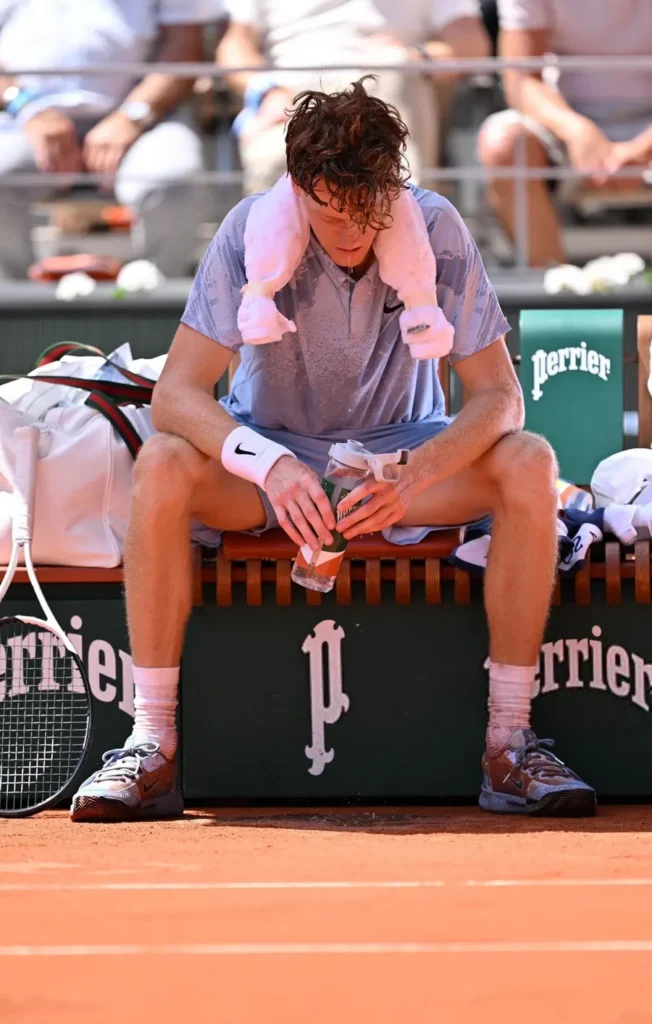

Jannik Sinner led Juan Manuel Cerundolo 6-3, 6-2, 5-1. The match should have been over within minutes. Instead, it became one of tennis’s most startling lost winning positions, with Sinner fading physically in the heat before Cerundolo completed a comeback to win 3-6, 2-6, 7-5, 6-1, 6-1.
The defeat immediately joined a painful tennis list: matches where a player had victory almost secured, only for cramps, heat, pain, injury, pressure or emotional collapse to take the match somewhere completely different. Sinner’s case was especially jarring because he was not simply leading. He was one game from a straight-sets win.
The Italian’s rise has often been framed around control, discipline and physical sharpness, from his clay-court progress to his place among the leading men in the sport. His latest setback adds a harsher layer to that story, coming after a run that had already placed him in historic Italian tennis conversations, including the list of Italian men who won Rome before Jannik Sinner.
Guillermo Coria vs Gastón Gaudio, 2004 French Open final
The strongest comparison remains Guillermo Coria’s collapse against Gastón Gaudio in the 2004 French Open final.
Coria began that match like a champion walking toward the trophy. He won the first set 6-0 and the second 6-3, leaving Gaudio looking beaten in the first all-Argentine men’s Grand Slam final. On clay, Coria was one of the most feared players in the world, and for two sets the final looked one-sided.
Then his legs began to fail. Cramps hit Coria, his movement declined, and the match turned. Gaudio took the third set 6-4 and the fourth 6-1. Even after that collapse, Coria still came close to finishing the job. He served for the championship twice in the fifth set and held two championship points.
He could not take either. Gaudio completed one of the most astonishing comebacks in Grand Slam history, winning 0-6, 3-6, 6-4, 6-1, 8-6.
Coria’s defeat remains the classic tennis example of a player doing nearly enough to win, then being dragged into a physical and emotional storm before the finish line. Sinner’s loss carried the same uncomfortable theme: the scoreboard can say a match is almost finished, but the body still has to complete it.
Steve Johnson vs Tatsuma Ito, 2014 US Open
Steve Johnson’s 2014 US Open defeat to Tatsuma Ito showed how quickly cramps can erase a strong position.
Johnson led two sets to one and was up a break in the fourth set. The match had moved in his direction, and he appeared close to reaching the second round. Then severe cramping changed everything. His body began to lock up, his movement deteriorated, and he could no longer play at a competitive level.
The match ended when Johnson retired, with the score recorded as Ito leading the fourth set after Johnson had taken a two-sets-to-one lead: 2-6, 6-3, 7-5, 4-1.
That match is relevant to Sinner because it was not a tactical defeat. Johnson had put himself in a winning position through his tennis. The loss came because his body stopped allowing him to execute the shots and movement required to close the match.
Peng Shuai vs Caroline Wozniacki, 2014 US Open semifinal
Peng Shuai’s 2014 US Open semifinal against Caroline Wozniacki remains one of the most worrying heat-related scenes in recent Grand Slam tennis.
Wozniacki won the first set 7-6(1) and led 4-3 in the second when Peng’s physical condition worsened dramatically in the New York heat. Peng suffered badly with cramping and heat-related illness, left the court for treatment, attempted to continue, and was eventually forced to retire.
This was not a collapse from match point, but it belongs in the same conversation because it showed the danger of extreme conditions in elite tennis. The match moved beyond ordinary scoreboard pressure. Player safety became the story.
Sinner’s defeat to Cerundolo was different because he had built a near-finished lead before his level dropped. But both matches showed how heat can become an opponent of its own, turning elite athletes into players simply trying to survive the next point.
Zheng Qinwen vs Iga Swiatek, 2022 French Open
Zheng Qinwen’s 2022 French Open match against Iga Swiatek was another example of a promising upset collapsing after a physical problem took control.
Zheng won the opening set against the world No. 1, taking it 7-6(5). At that stage, she had done what few players were managing against Swiatek: she had disrupted the rhythm, taken the scoreboard lead and forced the favourite into a real contest.
Then the match changed. Zheng later spoke about severe menstrual cramps, along with a leg issue, after losing the final two sets 6-0, 6-2. Swiatek won the match 6-7(5), 6-0, 6-2.
The defeat deserves a place in this wider pattern because it showed that physical collapse in tennis is not limited to visible injuries or heat cramps. Pain can restrict movement, recovery and concentration in ways that completely alter a match that had been moving toward a possible upset.
Carlos Alcaraz vs Novak Djokovic, 2023 French Open semifinal
Carlos Alcaraz’s 2023 French Open semifinal against Novak Djokovic was not a defeat from one game away, but it remains one of the clearest recent examples of cramps transforming a major match.
Djokovic won the first set 6-3. Alcaraz responded by taking the second 7-5. After two sets, the match was level and had the feel of a classic: the sport’s most decorated Grand Slam player against its most explosive young star.
Then Alcaraz cramped early in the third set. His movement dropped sharply, and Djokovic took control with ruthless efficiency. The final score was 6-3, 5-7, 6-1, 6-1.
The comparison matters because Sinner and Alcaraz have become central figures in the modern men’s game, with their rivalry shaping much of the sport’s next chapter. Sinner’s own statement wins, including when Sinner beat Alcaraz in Monte Carlo as world No. 1, have helped define that rivalry. But Alcaraz’s collapse against Djokovic showed that even the most physically gifted players can lose a match quickly once movement disappears.
Jannik Sinner vs Tallon Griekspoor, 2025 Shanghai Masters
Sinner had already experienced a physical warning before the Cerundolo defeat.
At the 2025 Shanghai Masters, he retired against Tallon Griekspoor in humid conditions after struggling physically. Sinner won the first set, but Griekspoor fought back, and the match ended with the Dutch player leading 6-7(3), 7-5, 3-2.
That result did not carry the same shock as losing from 6-3, 6-2, 5-1 at a Grand Slam, but it now feels relevant. Sinner’s game depends on balance, clean footwork, quick recovery steps and the ability to repeatedly absorb pace from the baseline. When his legs go, the rest of the structure weakens quickly.
Against Cerundolo, the decline was visible in the scoreline. Once Sinner failed to finish the third set, the match stopped looking like a brief physical wobble and became a full reversal.
Jana Novotná vs Steffi Graf, 1993 Wimbledon final
Not every lost winning position is physical. Jana Novotná’s 1993 Wimbledon final against Steffi Graf remains one of tennis’s most famous pressure collapses.
Novotná led 4-1 in the final set and had a point for 5-1. She was close to a Wimbledon title and appeared to have Graf under control. But Graf survived, doubt entered the match, and Novotná could not close the door.
Graf won the final five games and took the title 7-6(6), 1-6, 6-4.
The match became part of Wimbledon history because it captured the cruelty of closing a major final. Novotná had played well enough to lead. She had created the winning position. But the final steps demanded composure under pressure, and the match slipped away.
Sinner’s defeat was rooted more in physical distress than nerves, but the lesson is similar. Tennis offers no protection for a player who is close to winning. The last game still has to be played cleanly.
Martina Hingis vs Steffi Graf, 1999 French Open final
Martina Hingis’s 1999 French Open final against Graf was another major final that turned from control into chaos.
Hingis won the first set 6-4 and later served for the match at 5-4 in the second set. She was chasing the career Grand Slam and had the final on her racket.
Then the match changed after a disputed line call, a confrontation over a mark, and a crowd that turned heavily against Hingis. The emotional balance of the final shifted. Graf recovered to win 4-6, 7-5, 6-2.
Hingis’s defeat was not about cramps or heat. It was about emotional control disappearing in a match that had been there to win. In that sense, it belongs with the most painful lost winning positions: matches where the lead was real, but the finish became too heavy.
Djokovic, Alcaraz and the pressure of finishing great matches
The modern game has only made these collapses feel more dramatic because margins are smaller and rallies are more physically demanding. Matches between Djokovic, Alcaraz and Sinner often show how one shift in movement, timing or nerve can decide everything. Even high-profile battles such as the Djokovic vs Alcaraz Australian Open final carry that same tension: the score can look stable until one player’s body or belief begins to crack.
That is why Sinner’s defeat will linger. It was not just an upset by ranking. It was an upset by position. A player leading 6-3, 6-2, 5-1 is expected to finish. When he does not, the match immediately becomes part of tennis history’s harsher catalogue.
Coria had two championship points in Paris and lost. Johnson led two sets to one and a break before cramps ended his US Open match. Peng’s body failed in punishing New York heat. Zheng took a set from Swiatek before pain changed the match. Alcaraz was level with Djokovic before cramps broke the contest open. Novotná and Hingis were close to major titles before pressure and emotion took over.
Sinner now joins that group because the lead was so large and the collapse so sudden. Cerundolo deserves full credit for staying present when the match looked lost, but the story will inevitably be remembered through Sinner’s vanished advantage.
Tennis has always been unforgiving in this way. It does not reward a player for being one game away. It does not protect a favourite because he has built a two-set lead. Until the final point is won, heat, cramps, pain, pressure and panic can still change the result. Sinner’s defeat is the latest reminder that in tennis, a winning position is not the same as a win.

Make Swikblog your go-to source on Google for reliable updates, smart insights, and daily trends.