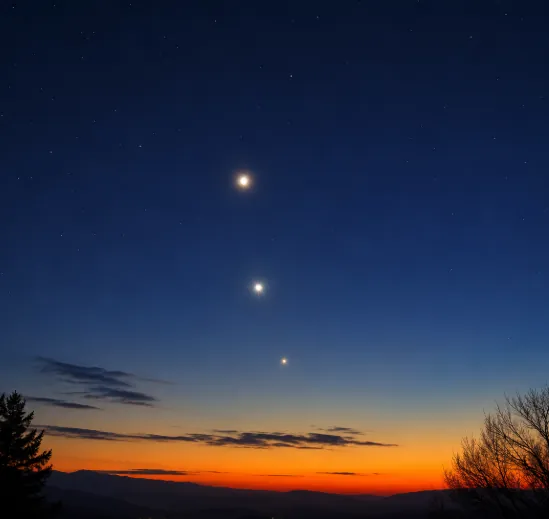

One of the most anticipated skywatching events of 2026 is unfolding this month as Venus, Jupiter and Mercury gather in the evening sky for a rare three-planet parade. The celestial display begins with a close conjunction between Venus and Jupiter on June 9 before Mercury joins the pair from June 11 through June 15, creating a striking lineup visible to the naked eye for observers across much of the Northern Hemisphere. According to NASA’s June 2026 Skywatching Guide, the event is expected to be one of the month’s most impressive astronomy highlights.
For skywatchers, the attraction lies not only in seeing three planets at once but also in Mercury’s participation. While Venus and Jupiter are among the brightest and most frequently observed planets in Earth’s sky, Mercury is often difficult to spot because it remains close to the Sun and is frequently hidden in twilight. That makes this multi-day alignment a relatively uncommon opportunity for casual observers and astronomy enthusiasts alike.
Venus and Jupiter Begin the Cosmic Meetup
The event starts on June 9 when Venus and Jupiter appear exceptionally close together after sunset in the western sky. Astronomers call this a conjunction, which occurs when two celestial objects appear near each other from Earth’s perspective despite being separated by enormous distances in space.
Conjunctions occur because planets orbit the Sun at different speeds and distances. As their orbital paths bring them onto the same side of the solar system, they can appear close together when viewed from Earth. Although the planets remain millions of miles apart, the visual effect creates one of the most striking sights in the night sky.
Read More
Mercury Joins for a Rare Three-Planet Parade
Between June 11 and June 15, Mercury will join Venus and Jupiter, creating what is popularly known as a planet parade. While the phrase is not an official astronomical term, it is commonly used when multiple planets appear arranged along the ecliptic, the path followed by the Sun, Moon and planets across the sky.
Mercury’s appearance makes this event especially noteworthy. The smallest planet in the solar system completes an orbit around the Sun every 88 days, yet it is often difficult to observe because it never strays far from the Sun in the sky. Unlike Venus and Jupiter, which regularly shine brightly after sunset or before sunrise, Mercury is visible only during certain favorable viewing windows.
Observers should look toward the western horizon about 30 to 60 minutes after sunset. Venus will be the brightest object, Jupiter will shine nearby, and Mercury will appear lower toward the horizon. A location with minimal light pollution and an unobstructed western view free from tall buildings, hills or trees will provide the best chance of spotting all three planets.
The timing is particularly favorable because the Moon will be entering a waning crescent phase before the June 14 new moon. With less moonlight in the sky, the planets will be easier to see against the twilight backdrop. All three planets can be observed without a telescope, although binoculars may enhance the experience.
The growing public interest in events such as planetary alignments comes at a time when space exploration is attracting renewed attention worldwide. Recent images returned during the NASA Artemis II mission have also highlighted humanity’s continuing efforts to explore and better understand our place in the solar system.
With clear skies and a good view of the horizon, the June 2026 planet parade offers a rare opportunity to watch three neighboring worlds share the same patch of sky. For many observers, it could become one of the most memorable skywatching moments of the year.

Make Swikblog your go-to source on Google for reliable updates, smart insights, and daily trends.