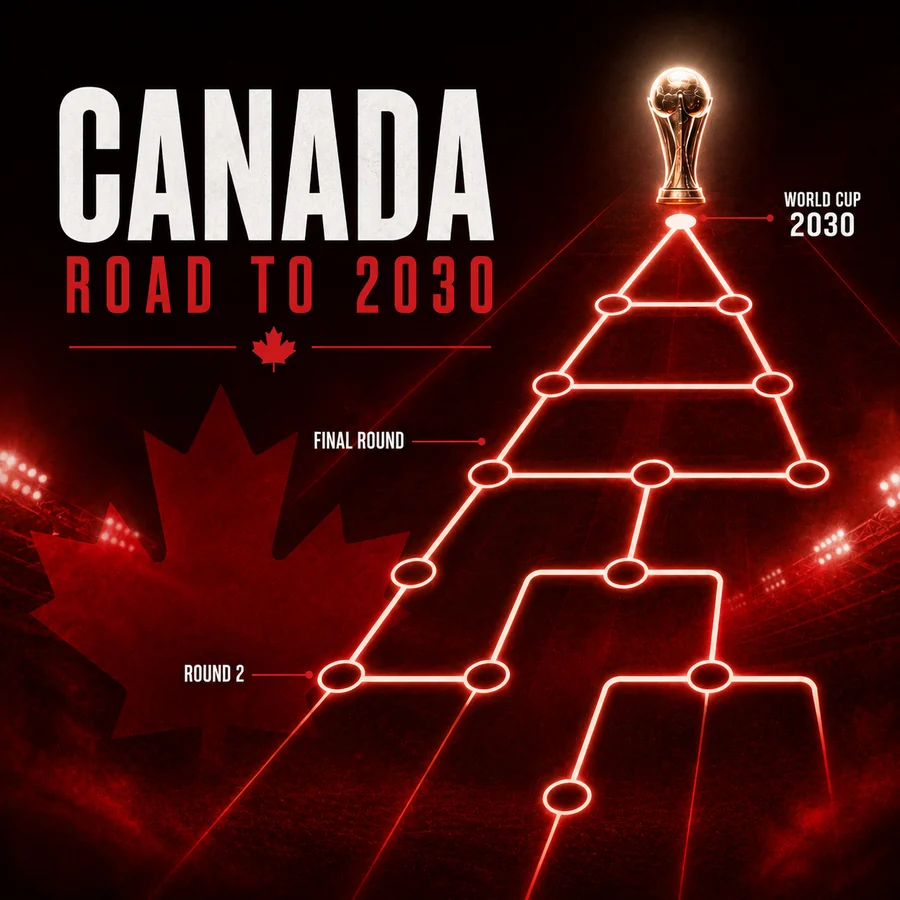

Canada’s path to the 2030 FIFA World Cup will look very different from previous qualifying campaigns, with six Concacaf teams guaranteed direct places and a seventh potentially advancing through the FIFA Intercontinental Play-Off.
The expanded qualification system gives Canada a favourable route, but qualification will not be automatic. Unlike the 2026 tournament, when Canada entered directly as one of the three host nations, the Canadian men’s national team will have to earn its place through Concacaf qualifying.
Will Canada receive a first-round bye?
Canada is expected to avoid the opening round, although its place in Round Two has not yet been formally guaranteed.
Concacaf has confirmed that Round One will involve the 22 member associations ranked from 14th to 35th in the FIFA rankings. Those teams will play home-and-away knockout ties in September and October 2027.
The 13 highest-ranked Concacaf nations will enter directly in Round Two. Canada’s recent performances and position among the region’s stronger national teams make a Round Two entry likely, provided it remains inside Concacaf’s top 13 when the rankings are applied.
This is more accurately described as entering qualifying in Round Two rather than receiving an automatic World Cup place.
How Round Two will work
Round Two will feature 24 national teams: the 13 highest-ranked Concacaf sides and the 11 winners from Round One.
The teams will be divided into six groups of four. Each country will play six matches, facing the other three teams at home and away.
Round Two is scheduled to begin during the September-October 2027 international window, before continuing in November 2027 and March 2028.
Only the group winners and runners-up will advance. Canada would therefore need to finish in the top two of its four-team group to reach the final qualifying stage.
What Canada must do in the final round
The final round will contain 12 teams divided into three groups of four. Matches are scheduled for June 2028 and the September-October international window in 2029.
Each team will again play six matches on a home-and-away basis.
The major difference from previous Concacaf qualification formats is that the top two teams in every final-round group will qualify directly for the World Cup. That means six direct places will be available across the three groups.
For Canada, the clearest route would be:
Finish first or second in Round Two, then finish first or second in the final-round group.
That would secure Canada’s fourth appearance at the men’s FIFA World Cup following its participation in 1986, 2022 and the home tournament in 2026.
Canada could still qualify after finishing third
Finishing third in the final group would not necessarily end Canada’s campaign.
The two best third-place teams from the three groups will advance to a new Concacaf Play-In in November 2029. They will meet over two legs, with the aggregate winner earning Concacaf’s place in the FIFA Intercontinental Play-Off.
That team would then still need to win through the international playoff process to reach the World Cup.
Full details of the three-round structure and Play-In are available in the official Concacaf qualifying announcement.
Why the new format benefits Canada
The expanded 48-team World Cup gives Concacaf six guaranteed qualification places, compared with three places available through qualifying for the 2026 edition because Canada, Mexico and the United States qualified automatically as hosts.
Canada should also benefit from avoiding an early knockout tie if it remains among the region’s 13 highest-ranked teams.
However, the long format leaves little room for a sustained drop in form. Canada must survive two separate group stages, with away matches in Central America and the Caribbean traditionally presenting difficult conditions.
The experience gained from the expanded 2026 FIFA World Cup could prove valuable as Canada prepares for a qualification campaign stretching from 2027 until potentially late 2029.
Canada’s route is therefore favourable, but the simple requirement remains unchanged: reach Round Two, advance from the first group and then finish among the top two teams in the final group to qualify directly for the 2030 FIFA World Cup.

Make Swikblog your go-to source on Google for reliable updates, smart insights, and daily trends.