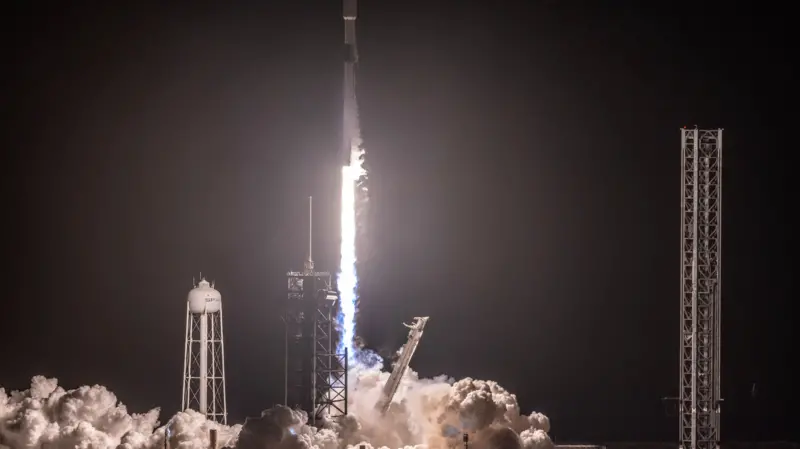

A discarded SpaceX Falcon 9 upper stage is believed to have struck the Moon at about 06:35 UTC on August 5, 2026, ending a 19-month uncontrolled journey through the space between Earth and its natural satellite.
The object, catalogued as 2025-010D, was calculated to hit sunlit terrain between the Einstein and Bell craters at approximately 8,700km/h, or 5,400mph. NASA said the collision posed no danger to Earth.
Tracking data strongly indicated that the impact occurred, but photographs of a fresh crater or a verified telescope detection were not immediately available.
Falcon 9 Moon impact details
- Object: Spent Falcon 9 upper stage
- Designation: 2025-010D
- Estimated mass: At least 4,000kg, or 8,800lb
- Approximate length: 14 metres, or 45 feet
- Impact time: 06:35 UTC on August 5, 2026
- Local times: 12:05pm in India, 7:35am in the UK and 2:35am on the US East Coast
- Predicted speed: About 2.4km per second
- Expected location: Between the Einstein and Bell craters
- Estimated energy: Nearly three tonnes of TNT
- Earth risk: None
Small uncertainties remained because the empty stage was rotating. Gravity from Earth, the Moon and the Sun influenced its path, while the weak pressure exerted by sunlight added another variable.
How the rocket stage reached the Moon
The Falcon 9 launched from Kennedy Space Center in Florida on January 15, 2025, carrying two commercial lunar spacecraft on the Ghost Riders in the Sky mission.
Firefly Aerospace’s Blue Ghost Mission 1 landed successfully in Mare Crisium on March 2, 2025. It carried 10 NASA science and technology instruments through the agency’s Commercial Lunar Payload Services programme.
The second spacecraft was Resilience, built by the Japanese company ispace. It reached lunar orbit but was lost during its landing attempt on June 6, 2025.
The object headed towards the Moon was the expendable upper stage, not the reusable first-stage booster commonly shown landing on a drone ship. The operation of the rocket’s separate stages can be seen in this account of a Falcon 9 launch visible across the California sky.
After deploying the landers, the upper stage lacked enough fuel for a controlled return to Earth or movement into a distant disposal orbit. It remained in a highly elongated path influenced by several gravitational forces.
Independent astronomers traced its orbit back to the January 2025 launch. Observations of reflected light produced characteristics consistent with spacecraft materials rather than a natural asteroid.
Crater and debris estimates
The stage was expected to release close to 12 billion joules of energy on impact. Estimates suggested it could produce a crater between 18 and 40 metres wide, although its final size depends on the impact angle, surface conditions and the rocket’s construction.
Some models placed the crater’s depth at approximately 3.5 to 5 metres. Up to one million kilograms of lunar dust and rock may have been disturbed, but that figure remains a prediction rather than a measurement.
Part of the ejecta plume could have risen as high as 100 kilometres before returning to the surface. The Moon has almost no atmosphere, so the stage would not have burned up or slowed substantially before hitting the ground.
A Falcon 9 stage is hollow and contains thin metal structures, tanks and an engine. Its collision may therefore produce a different crater pattern from a dense asteroid carrying similar energy.
Why the impact was difficult to observe
The expected impact site was on illuminated terrain close to the Moon’s apparent edge. Any flash would have been brief and faint against the bright lunar surface.
Large telescopes in the Americas had the most favourable opportunity to look for the event. Astronomers were particularly interested in sunlight reflecting from dust above the lunar limb because a plume might remain visible longer than the initial flash.
Observation teams must review their recordings carefully and rule out atmospheric distortion, camera noise and unrelated changes in brightness before claiming a detection.
Jodrell Bank Observatory Faces Closure After Funding Cuts: What It Means for UK Science
SpaceX Starship Flight 13: FAA Approval, Starlink V3 Mission and Launch Details
Visit the homepage for the latest science, space and technology news
When crater images may appear
NASA’s Lunar Reconnaissance Orbiter and South Korea’s Danuri spacecraft may search for the impact site. Scientists can compare new photographs with older images to identify a fresh crater and its surrounding debris field.
Confirmation may take days or weeks because an orbiter must pass over the correct area with suitable lighting and a useful camera angle. The actual crater could also lie some distance from the calculated point because of remaining trajectory uncertainty.
NASA outlined its observation plans and safety assessment in an official statement about the Falcon 9 lunar impact.
Why the accidental collision matters
Natural objects strike the Moon regularly, but scientists rarely know their exact mass, structure and speed beforehand. Researchers had much more information about 2025-010D, making it a useful test of crater and debris models.
Human-made lunar impacts are not new. NASA deliberately crashed Apollo rocket stages into the Moon so seismometers could measure the vibrations. Its LCROSS spacecraft struck the surface in 2009 while investigating water ice near the lunar south pole.
This Falcon 9 collision was not planned. It highlights the difficulty of tracking and disposing of inactive hardware in cislunar space, where Earth, lunar and solar gravity can gradually change an object’s path.
The growing competition to develop new Moon missions makes reliable tracking more important for future landers, satellites, scientific equipment and crewed bases.
The impact could not alter the Moon’s orbit, affect tides or send dangerous debris towards Earth. Its value now depends on whether telescopes detected the plume and whether orbiters can locate the crater.

Make Swikblog your go-to source on Google for reliable updates, smart insights, and daily trends.