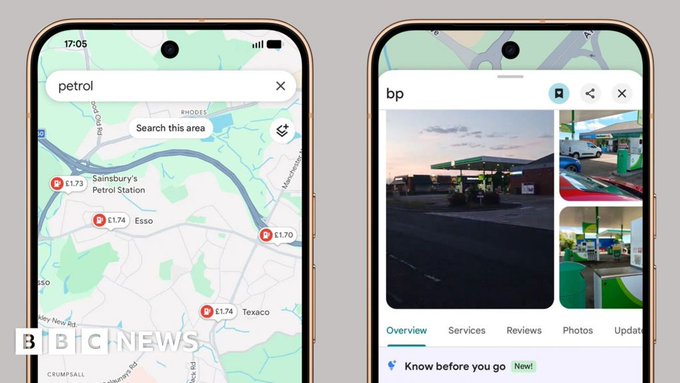

LONDON, October 8, 2026 — Google Maps now shows petrol and diesel prices at UK filling stations, giving motorists a new way to compare fuel costs before setting off. The government-backed rollout comes as diesel prices exceed £2 per litre at some forecourts, adding pressure to household budgets and everyday travel expenses.
Planning a long drive? @googlemaps won’t just give directions, it will help you find the cheapest fuel near you. Today our Fuel Finder scheme has been rolled out on Google Maps to support millions of drivers to save at the pump. https://t.co/NdKLJxMoWY https://t.co/VNIB6mhrQC
— Department for Energy Security and Net Zero (@energygovuk) October 8, 2026
The new feature uses the UK’s Fuel Finder database, which requires retailers to report price changes within 30 minutes. Officials estimate that greater transparency and competition could save car-owning households an average of £40 annually, although individual savings will vary.
Google Maps UK Fuel Prices Go Live Nationwide
The Department for Energy Security and Net Zero announced the integration on Thursday, October 8, bringing government-backed fuel-price information directly into Google Maps.
Energy Consumers Minister Polly Billington described the move as a “gamechanger” for motorists looking for cheaper fuel.
According to the UK government’s official announcement, Fuel Finder covers retailers responsible for approximately 99% of fuel sold on British roads.
The coverage figure represents fuel sales rather than every individual petrol station. Some locations may still have incomplete listings.
How to Find Cheapest Petrol and Diesel on Google Maps
Drivers can compare nearby filling stations without downloading a separate Fuel Finder application.
- Open Google Maps on your smartphone.
- Search for “petrol stations” or “fuel near me.”
- Browse nearby stations and their displayed prices.
- Select a station to check available petrol and diesel grades.
- Compare prices and choose a convenient location.
- Use directions to reach the selected forecourt.
Drivers should check the correct fuel type before comparing prices. Standard unleaded petrol, premium petrol and diesel may have different prices at the same station.
The cheapest advertised station is not always the most economical choice if reaching it requires a lengthy detour.
UK Petrol and Diesel Prices Remain High
The launch follows a period of rising fuel costs linked partly to disruption in international energy markets.
Diesel has recently exceeded 200p per litre at some stations, while petrol prices have also placed pressure on commuters, delivery drivers and families.
At £2 per litre, filling a 55-litre diesel tank costs £110. At £1.75 per litre, the same amount of petrol costs £96.25.
These are illustrative calculations, not guaranteed national averages. Actual pump prices vary by location, retailer and fuel grade.
Fuel-market pressures have also affected other European countries, including during fuel shortages and petrol station disruptions in France.
UK State Pension Set for £488 Rise From April 2027
UK Student Loan Guidance Changes: What Borrowers Need to Know
Fuel Stations Must Report Price Changes Within 30 Minutes
Mandatory Fuel Finder reporting began on February 2, 2026, following concerns about competition in the UK road-fuel market.
Qualifying retailers, including supermarkets, independent garages and motorway filling stations, must submit updated prices within 30 minutes of a change.
The Competition and Markets Authority oversees compliance and can take enforcement action against retailers that repeatedly fail to meet reporting requirements.
However, the reporting deadline does not guarantee that every Google Maps price changes instantly. Data-processing delays and inaccurate submissions remain possible.
Google Maps and Waze Both Show Fuel Finder Prices
Google has integrated Fuel Finder information into Google Maps and Waze, giving motorists additional ways to compare filling stations while planning journeys.
Fuel-price information is also available through comparison services including PetrolPrices, RAC Fuel Watch and other participating platforms.
Apple Maps was not included in the government’s October 8 announcement.
Some drivers may notice missing diesel prices or incomplete fuel-grade information at individual stations. A missing price does not necessarily mean the fuel is unavailable.
Drivers Could Save £40 a Year on Fuel
The government estimates that improved price transparency could save an average car-owning household approximately £40 annually.
For example, buying 50 litres at a station charging 165p rather than 175p per litre would save £5 on one fill-up.
The potential benefit is particularly relevant when comparing supermarket forecourts, independent retailers and motorway services, where prices can differ significantly.
Motorists should consider distance and fuel consumption before travelling to a cheaper station. Comparing prices along an existing route may offer better value.
Incorrect Fuel Prices Can Be Reported
Although Fuel Finder requires timely reporting, displayed prices can occasionally differ from those charged at the pump.
Drivers should confirm the current forecourt price before refuelling. Incorrect prices, missing station details and other discrepancies can be reported through the government’s Fuel Finder reporting service.
The rollout forms part of a broader shift towards digital travel services, alongside changes such as facial-recognition technology at UK airports.
For UK motorists, the immediate advantage is greater visibility over local fuel costs. With prices remaining elevated, comparing nearby stations before a journey could help reduce spending without changing driving habits.

Make Swikblog your go-to source on Google for reliable updates, smart insights, and daily trends.