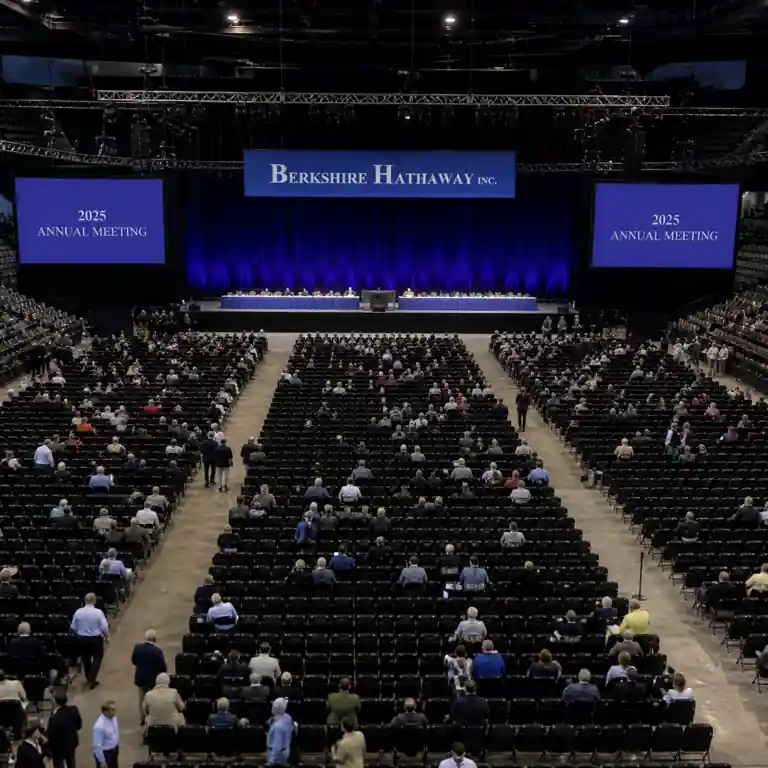

Berkshire Hathaway’s annual meeting has entered a new phase, and the change was impossible to miss in Omaha. For decades, the event was built around Warren Buffett’s voice, Charlie Munger’s wit and a packed arena of investors who treated the weekend as part finance lesson, part pilgrimage. This year, with Greg Abel leading the meeting as chief executive for the first time, the crowd was smaller, the tone was quieter and the message was more business-focused.
The headline image was striking: the arena was only a little over half full, a sharp contrast with the huge crowds that often came to hear Buffett speak in person. But the smaller turnout should not be read as a simple loss of confidence in Berkshire. Instead, it reflects a company moving from a founder-like era into a more conventional leadership chapter, where investors are likely to judge management less by stage presence and more by operating results.
Abel, who took over as CEO in January, is not an outsider trying to reinvent Berkshire. He has spent more than two decades inside the company and had already been responsible for many of its non-insurance businesses before the formal handover. That background matters because Berkshire’s strength has never rested on one product line. It owns or controls a wide mix of businesses, from insurance and railroads to utilities, consumer brands, retail operations and manufacturing companies.
A quieter meeting, but not a weaker Berkshire
The first meeting of the Abel era opened with a tribute to Buffett, giving shareholders a reminder of the legacy that still hangs over the company. Buffett, now chairman, remains deeply connected to Berkshire, but the practical center of gravity has shifted. Investors no longer have Buffett running the show, and that naturally changes the energy of the event.
For years, Berkshire’s annual meeting was unusual because it blended corporate reporting with personality. Shareholders did not only come for financial updates; many came to hear Buffett explain markets, investing, risk and business behavior in a way that felt simple but carried decades of experience. Munger added a sharper edge, often turning brief remarks into memorable lessons. With both no longer occupying the stage as before, the meeting is less of a spectacle and more of a test of Berkshire’s operating machine.
That machine is still producing. Berkshire reported first-quarter profit of $10.1 billion, more than double the level from a year earlier. The result was helped by investment gains and improved performance across several operating units. Insurance remained a key contributor, with underwriting profit rising to $1.7 billion from $1.34 billion a year earlier. BNSF Railway, utilities and manufacturing businesses also delivered better results, showing that the group’s diversification continues to matter.
The company’s investment portfolio remained large at just over $288 billion, while its cash reserve climbed to $397.4 billion. That cash pile is one of the biggest stories for shareholders. It gives Berkshire enormous flexibility, but it also raises the central question facing Abel: how can a company this large find deals or investments big enough to move the needle without sacrificing discipline?
Buffett’s answer was always patience. He preferred to wait rather than overpay. Abel is expected to follow that same approach, and there is little reason to expect sudden moves such as a dividend, a breakup of the company or a radical shift in investment policy. Berkshire’s identity is still built around long-term ownership, conservative capital use and trust in managers.
Read More
What Greg Abel now has to prove
Abel’s challenge is not to become another Buffett. That would be impossible and unnecessary. His real task is to show that Berkshire’s culture can continue working when the most famous investor in the world is no longer the person answering questions from the stage.
His management style is expected to be more direct than Buffett’s. Abel is known for asking detailed questions and pushing business leaders to strengthen their competitive position. That could bring a slightly sharper operating focus to Berkshire without changing its decentralized structure. Subsidiary CEOs are still expected to run their own businesses, while headquarters remains focused on capital allocation, major decisions and long-term discipline.
Several Berkshire businesses appear to be operating with little disruption. Brands such as Dairy Queen, See’s Candy, Brooks Running and Jazwares remain part of a structure where managers are trusted to execute without constant interference. That model is rare in modern corporate America, where central offices often dictate strategy across divisions. Berkshire’s advantage has been its ability to let strong managers work independently while keeping a conservative financial base behind them.
The leadership transition was also visible in the meeting’s exhibition hall. Berkshire companies used displays and merchandise to reflect the shift, including products featuring Abel alongside Buffett. These details may seem small, but they show how the company is trying to introduce its new leader without erasing its old one.
For investors, the reduced attendance may be less important than the quality of answers Abel gives over time. Berkshire’s future will depend on whether Geico can keep improving, whether BNSF and the utility businesses can grow steadily, whether manufacturing and retail units remain resilient, and whether the company can use its nearly $400 billion cash reserve wisely.
Official company reports and shareholder materials are available through Berkshire Hathaway’s website. The leadership transition and annual meeting developments have also been covered by the Associated Press, which has long reported on Berkshire’s Omaha gatherings.
As latest market insights on Swikblog continue to highlight, the real story for investors now lies beyond the stage and inside Berkshire’s balance sheet and operating performance.
What happened in Omaha was not just a smaller crowd at a shareholder meeting. It was a visible sign that Berkshire is becoming less dependent on the event as a personality-driven institution. That may disappoint some longtime attendees, but it could also make the company’s underlying performance easier to judge.
Berkshire’s new era begins with a quieter room, stronger quarterly profit and a balance sheet loaded with cash. Abel now has the difficult but clear job of proving that the system Buffett built can remain powerful without Buffett at the microphone. For shareholders, that is the real story of the post-Buffett Berkshire: not whether the annual meeting can still fill every seat, but whether the company can keep compounding value when the spotlight moves from legend to execution.

Make Swikblog your go-to source on Google for reliable updates, smart insights, and daily trends.