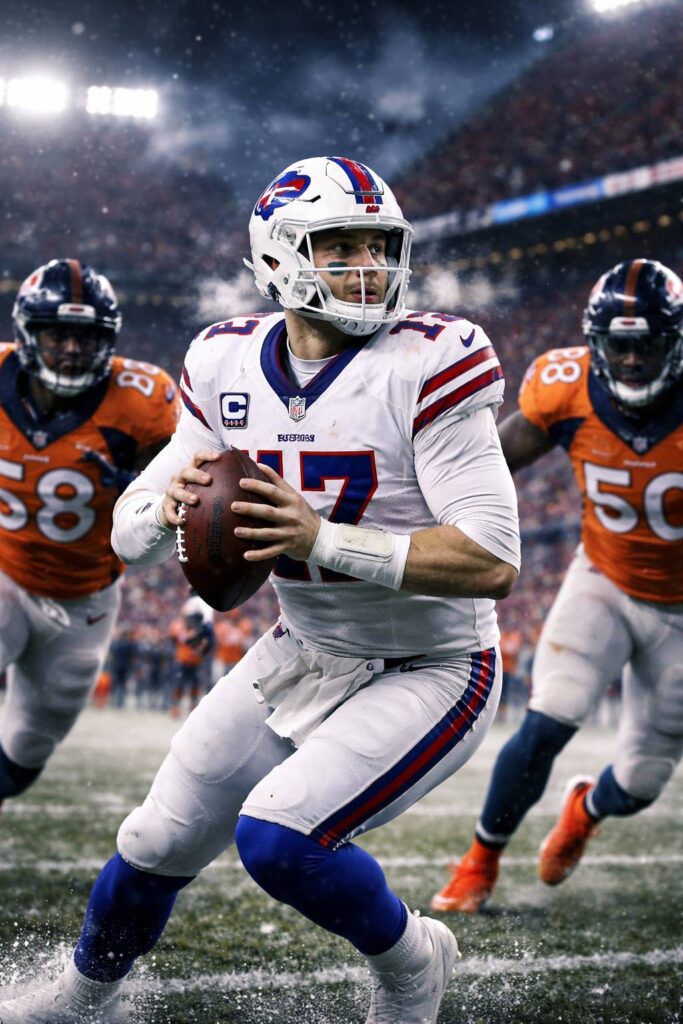

Denver hosts Buffalo in the AFC Divisional Round with altitude, rest, and defense on its side — while Josh Allen arrives with a battered supporting cast and everything still running through him.
The AFC Divisional Round has a clean headline: the No. 1 seed Denver Broncos are at home, well-rested, and built around a defense that can throttle opponents for long stretches. The twist is that their opponent is Buffalo — and in January, Buffalo often means one thing: Josh Allen creating offense when structure breaks.
Buffalo earned its trip to Denver with a gritty Wild Card win, but it came at a price. The Bills lost two receivers to season-ending torn ACLs — Gabe Davis and Tyrell Shavers — forcing a reshaped depth chart at the worst possible time, against a defense that rarely gifts easy yards. For the latest postseason context and official listings, you can cross-check match details on NFL.com’s playoffs hub.
Why Buffalo’s wide receiver problem is the story of this game
Entering the weekend, Buffalo’s available receivers are essentially a shortened list: Khalil Shakir, Brandin Cooks, Keon Coleman, plus Curtis Samuel (activated from injured reserve) and Mecole Hardman Jr. (elevated from the practice squad). The point isn’t just “who’s active.” It’s how this changes the geometry of the offense — because Denver can shade coverage toward Shakir and force less-used options to win one-on-one.
There’s also a deeper layer here: Buffalo’s 2025 passing distribution leaned heavily away from wideouts in general. Even before the injuries, the Bills were a tight-end-and-quarterback-driven attack, with Dalton Kincaid and Dawson Knox carrying a major share of the receiving load. In other words: this isn’t a normal “next man up” situation — it’s the offense becoming even more concentrated, in a matchup that punishes predictability. (Receiver injury context and quotes were reported by Pro Football Talk.)
Denver’s defensive plan starts with one decision
Denver’s defense is “legit” by any definition — disciplined, fast to the ball, and comfortable forcing opponents into long drives. But against Allen, the game-plan always turns into a choice: Do you commit extra help to Shakir, or do you trust your corners and spend resources on containing Allen’s off-script damage?
If Denver leans into bracket coverage or frequent safety help, it’s a challenge to Buffalo’s secondary options to separate quickly and reliably. If Denver plays it more straight and dares Allen to beat coverage with patience, it becomes a test of whether Buffalo can stay efficient without the explosive, confidence-building plays that usually keep defenses honest.
The tight end lane may be Buffalo’s best lane
The simplest path for Buffalo is also the most logical one: lean into Kincaid. Tight ends are built for playoff football — they thrive in congestion, convert third downs, and can punish defenses that sell out to stop perimeter receivers.
If Shakir draws extra attention, Kincaid’s middle-of-the-field work becomes even more valuable. The Bills don’t need a perfect game from their patchwork receiver group — they need a few chain-moving contributions at the right moments, while their tight ends and quarterback carry the volume.
Denver’s offense: spread targets, lean on efficiency, make altitude matter
On the other side, Denver’s attack is built to avoid panic. Bo Nix doesn’t rely on one “must-target” receiver, and that matters in playoff matchups where your first option is often taken away. When Denver stays on schedule, they can turn the game into a series of uncomfortable decisions for Buffalo — especially as the fourth quarter arrives and the thin Bills rotation is asked to keep tackling in the thin air.
Keep an eye on Jaleel McLaughlin as a change-of-pace piece and on Pat Bryant as a quietly steady receiver who has been more involved than casual fans may realize. Denver doesn’t need a fireworks show — it needs sustained drives, field position, and the kind of patient football that forces Buffalo to be perfect.
What decides Broncos vs Bills?
- Can Buffalo’s available receivers win enough snaps? If Shakir is contained, someone else must deliver real downs — not just “survive.”
- Can Kincaid and Knox keep the offense on schedule? Tight ends are Buffalo’s stabilizers right now.
- Can Denver keep Allen in the pocket? The playoffs are when quarterbacks run “just because they can,” and Allen’s legs change red-zone math.
- Can Denver’s controlled offense turn altitude into a fourth-quarter edge? Fatigue shows up as missed tackles, late hands in coverage, and penalties.
In short: Denver looks like the deeper, healthier roster. Buffalo has the most dangerous single force on the field. If this turns into a clean, methodical game, it favors the Broncos. If it turns into chaos, Allen has made a career out of turning chaos into points.
For more postseason coverage in the same style, browse our Swikblog NFL section.
Note: This article is written for news and analysis purposes. Availability and roster status can change close to kickoff.

Make Swikblog your go-to source on Google for reliable updates, smart insights, and daily trends.