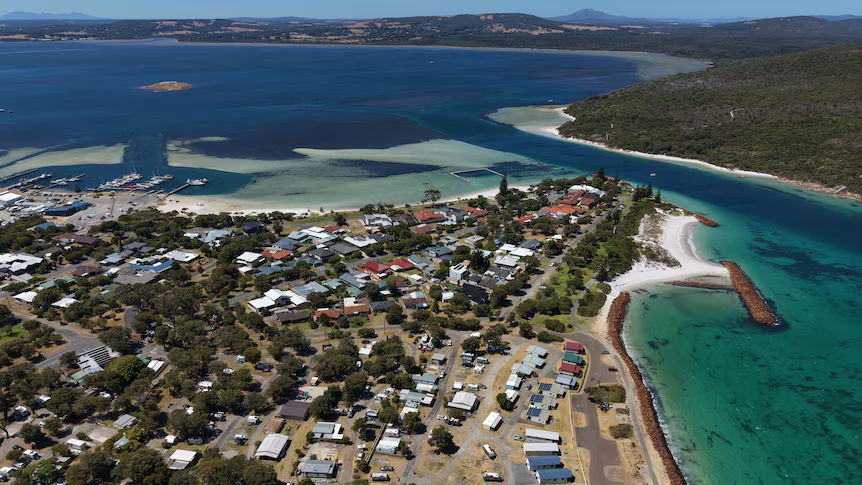

What looked like a safe and affordable place to retire has turned into a housing crisis for dozens of residents on Western Australia’s south coast. Around 25 long-term tenants at Albany’s Acclaim Rose Gardens Beachside Holiday Park have been forced out after the site was sold in early 2025 under a vacant possession condition, leaving many without a permanent home.
For Reg Hoyling, the shock has been life-altering. He spent $154,000 on his park home and another $16,000 on furniture, believing he had secured a place to live out his remaining years. Instead, he has been forced to leave — all while battling stage four cancer. Now without a fixed address, he is relying on short-term accommodation, while his partner Eva Johnson has moved into residential care.
“I panicked and went to members of parliament, Consumer Protection, SAT — we’ve been everywhere, and it’s cost me a lot of money for zero outcome,” he said, after selling his home and most of his belongings just days before eviction.
The case has exposed a growing risk in Australia’s housing system, particularly for retirees and low-income residents who turn to caravan parks as a more affordable option.
Why residents were forced out
The Rose Gardens Holiday Park, located at Emu Point in Albany, sits on crown land and was previously owned by the Western Australian government. It was sold to RAC Tourism Assets, with a strict condition that the site be handed over vacant.
That condition meant long-term residents — many of whom had lived there for decades — had no choice but to leave. They were offered ex gratia payments of up to $25,000, but for most, that amount fell far short of the real cost of relocating or starting over.
The deeper issue lies in how these housing arrangements work. Many residents owned their park homes but not the land they sat on. According to Consumer Protection, tenants on fixed-term agreements are better protected because their leases transfer to new owners. But those on periodic, month-to-month agreements — which applied to most Rose Gardens residents — can be asked to vacate if a buyer wants empty possession.
That legal gap is now at the centre of the debate, raising serious questions about how secure this form of housing really is.
Relocation challenges and rising costs
Some residents were offered the option of moving their homes to nearby Panorama Caravan Park, but that solution has been far from straightforward. The site still requires additional preparation before park homes can be installed, forcing some displaced residents into temporary living arrangements.
Jan and Victor Nickolson are among those currently staying in a caravan at Panorama while waiting for their home to be relocated. Others have faced even tougher decisions.
Former resident Pippa Minchin initially planned to move but backed out after learning it could cost up to $90,000 to bring her home into compliance with bushfire safety standards at the new site. Faced with that financial burden, she chose to sell instead and is now staying with family while searching for long-term housing.
“I’ve got my name down at places, but everybody’s got wait lists,” she said, highlighting the broader housing shortage now compounding the crisis.
The mismatch between compensation and actual relocation costs has been one of the biggest points of frustration for residents. While the payments offered some short-term relief, they did little to cover the real financial impact of displacement.
The City of Albany said it had provided support to residents “above and beyond the legislative requirements,” but many tenants say the outcome still left them without stable housing.
What happens next
The site is expected to be redeveloped by its new owner, RAC Tourism Assets, signalling a shift away from long-term residency towards tourism-focused use. For former residents, that transition has come at a heavy personal cost.
The situation has also intensified scrutiny of the WA Residential Parks (Long-stay Tenants) Act 2006, which is currently under review. Industry leaders say the legislation is outdated and lacks clarity, while advocates argue it fails to protect residents who invest significant savings into homes they ultimately do not control.
Consumer Protection Commissioner Trish Blake has warned that risks are inherent in this type of arrangement, particularly for those on periodic agreements where security can change quickly after a sale.
The review is being seen as a critical opportunity to modernise the system and create clearer, more balanced protections for both tenants and park operators. The ongoing review of residential parks laws is now expected to play a key role in shaping future safeguards.
For now, the Albany case stands as a stark example of how fragile this form of housing can be. What many residents believed was a permanent home has instead turned into a temporary arrangement, dependent on land ownership they never had.
As housing affordability pressures continue to rise, more Australians are turning to residential parks as an alternative. But for the former residents of Rose Gardens, the experience has revealed a difficult truth — that owning a home does not always guarantee having a place to stay.
For more fascinating archaeology news, read this report on the 2,500-year-old mass grave of 89 infants discovered in Israel.

Make Swikblog your go-to source on Google for reliable updates, smart insights, and daily trends.