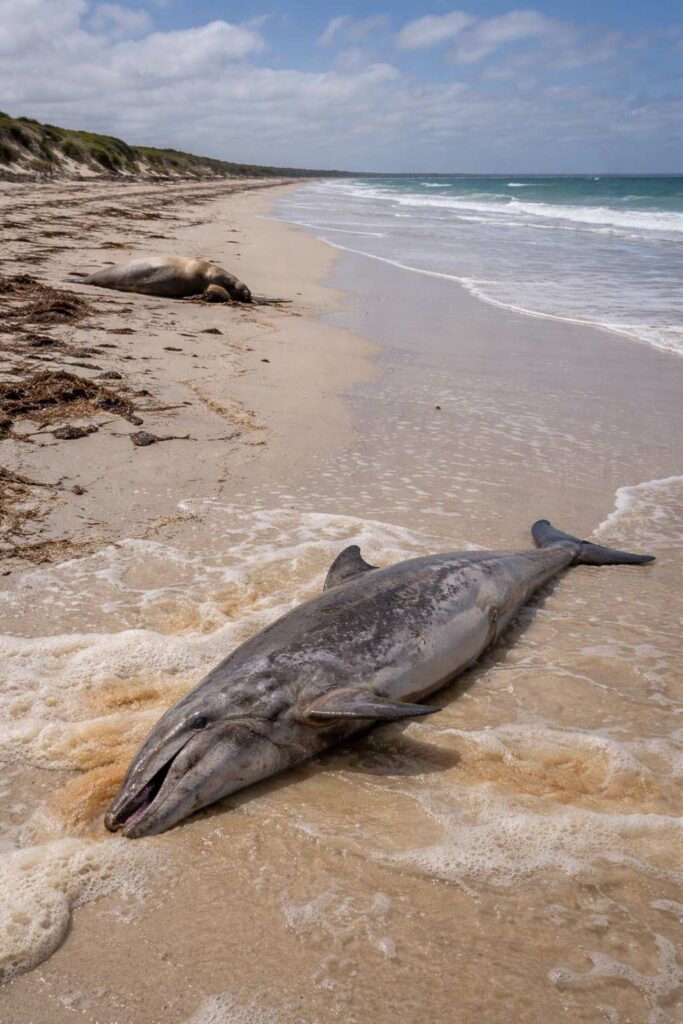

A troubling series of discoveries along South Australia’s Eyre Peninsula has deepened public concern about the health of local coastal waters, after dead dolphins and a seal were found on beaches north of Port Lincoln in recent weeks. Residents who know the coastline well say the scene feels deeply unusual, with one local describing rotting marine mammals, foul foam and growing unease over whether enough is being done to understand what is happening.
The latest reports centre on beaches around Louth Bay, Poonindie and North Shields, where locals have found deceased marine life washed onto the sand. The incidents come against the backdrop of continuing attention on the harmful algal bloom affecting parts of South Australia’s coastline, a marine event that has already triggered worries about wildlife losses, coastal conditions and the possible long-term stress on the region’s ecosystems.
Long-time beachgoers say the coastline feels different
Louth Bay resident Linda Davies, who has spent decades walking the local shoreline, said she had never before seen two dead marine mammals on the same stretch of beach. On a six-kilometre section north of Port Lincoln, she found an adult dolphin and later an adult seal, prompting her to contact the Department for Environment and Water.
For Davies, the distress did not stop with the initial discovery. She said one of the most upsetting parts of the experience was returning to the beach days later and seeing the animals still there, decomposing in place. That raised difficult questions for locals about whether authorities should have removed the carcasses, attempted further testing, or carried out more visible follow-up given the unusual coastal conditions being observed nearby.
Her concern was sharpened by the appearance of heavy foam on the beach. Davies did not claim a direct cause, but she openly questioned whether the current algal bloom may have played a role and whether standard procedures had gone far enough to rule that in or out. For communities living close to the sea, uncertainty itself can become part of the problem, especially when marine deaths occur close together and visible signs in the water appear abnormal.
Why the carcasses were not tested
According to the Department for Environment and Water, reports were received about a dead seal near Todd River, close to Poonindie, on February 26 and a dolphin carcass south of Louth Bay on March 1. Officials said the seal was too decomposed for testing or collection, while rangers who attended the dolphin report were unable to locate the carcass and believed it had washed back out to sea.
The department has also said a dead dolphin at North Shields was reported on February 9, with rangers determining at the time that the carcass was too decomposed for necropsy or further testing. That explanation reflects a reality that wildlife agencies often face on remote or exposed coastlines: by the time an animal is reported and reached, it may already be in a condition where laboratory work is no longer useful.
Officials say that in such cases a carcass may either be buried or left to further decompose and eventually wash away, depending on its location and condition. Even so, the explanation has done little to settle community anxiety, particularly for locals who feel multiple wildlife deaths during a period of unusual coastal change deserve closer scrutiny.
External resource: South Australia’s official algal bloom update page provides current public information on the bloom, affected areas and advice for beach users.
Orange foam, headaches and a sense that something is off
At North Shields, citizen scientist Wendy Lambert has been taking water samples since the bloom first emerged last year. Her observations add another layer to the concerns already circulating across the Eyre Peninsula. Lambert said she noticed a smaller bloom near a reef south of North Shields in early February, followed by foam that looked and felt different from the kind of sea foam locals are used to seeing during rough conditions.
She described it as mucky, orange foam that became more noticeable day after day. Dead wildlife, including a dolphin and a fairy penguin, was also seen on the beach in the same period before being washed away. After heavier wave action, Lambert said foam even crossed the road, turning an already unpleasant sight into something harder for nearby residents to ignore.
More worryingly, she said she felt physically unwell while the foam was present, describing symptoms including headache and nausea. Although a single firsthand account is not enough to establish a cause, it reflects broader public concern about how prolonged marine bloom events can affect not only wildlife but also the experience of living, walking and working near the water.
The bigger ecological fear hanging over Eyre Peninsula
The Eyre Peninsula coastline is part of a region where marine life, tourism, fishing and community identity are closely linked. That is why the conversation has moved beyond individual carcasses and toward the wider question of ecosystem stress. Lambert said she remains hopeful the environment can recover, but she is worried about what a warming climate could mean for the future and which species may be lost if these kinds of marine events become more frequent or more severe.
That concern is increasingly shared across South Australia as authorities continue monitoring the bloom and its impacts. Harmful algal blooms can be difficult to predict from one day to the next because they shift with weather, currents and wave conditions. Some beaches may appear improved while nearby stretches remain affected, leaving locals with a patchwork picture rather than a clean end point.
For communities around Port Lincoln and the broader Eyre Peninsula, that means the dead marine mammals are not being viewed as isolated incidents. They are being read as part of a larger and more unsettling coastal story, one involving wildlife stress, changing sea conditions and the possibility that these beaches are offering an early warning of deeper environmental strain.
What to report: If you find sick or dead marine mammals or wild birds, South Australia advises the public to call the Emergency Animal Disease Hotline on 1800 675 888. Fish deaths can be reported to Fishwatch on 1800 065 522.
For now, the images from Louth Bay and nearby beaches have left locals wanting clearer answers. A dead dolphin, a dead seal, orange foam and reports of illness may not yet tell a complete story on their own. But together, they have become a stark reminder that when coastal systems begin to look and feel wrong, communities notice quickly — and they expect the response to match the seriousness of what is washing ashore.

Make Swikblog your go-to source on Google for reliable updates, smart insights, and daily trends.